







Question: (2) Consider the function f : R* -> R* given by f(x, y, z, w) = (1 + x + sin(z - 2y), ey ,
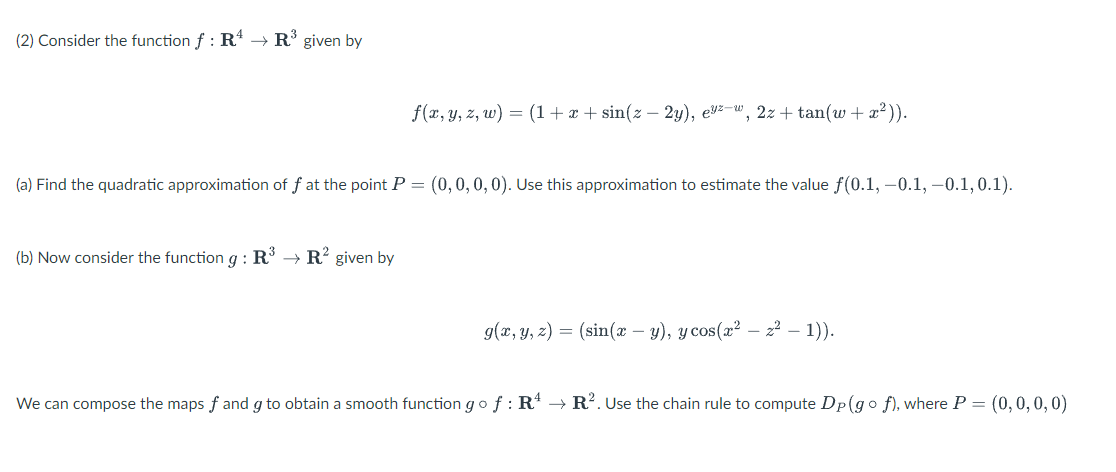
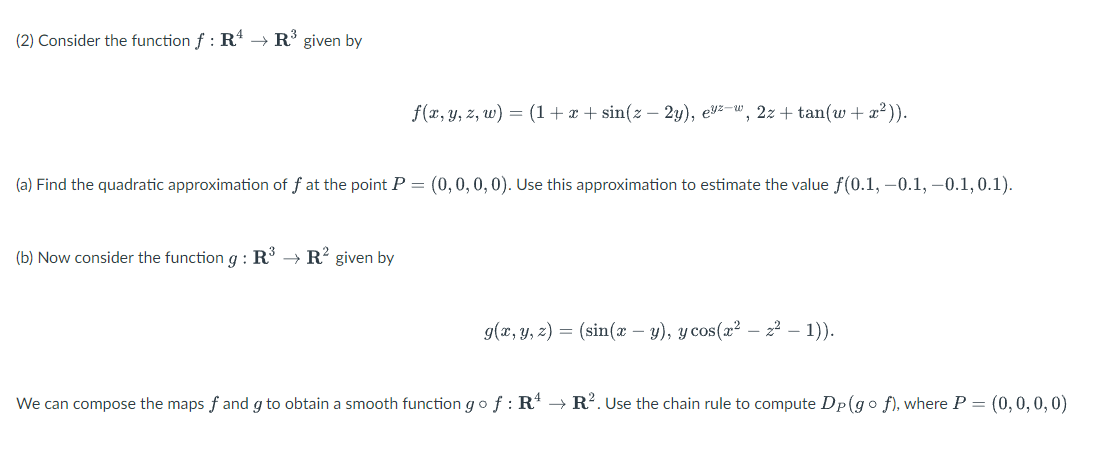
(2) Consider the function f : R* -> R* given by f(x, y, z, w) = (1 + x + sin(z - 2y), ey ", 2z + tan(w + x?)). (a) Find the quadratic approximation of f at the point P = (0, 0, 0, 0). Use this approximation to estimate the value f(0.1, -0.1, -0.1, 0.1). (b) Now consider the function g : R -> R given by g(x, y, z) = (sin(x - y), ycos(x2 - 22 - 1)). We can compose the maps f and g to obtain a smooth function go f : R* -> R.'. Use the chain rule to compute Dp(go f), where P = (0, 0, 0, 0)
Step by Step Solution
There are 3 Steps involved in it
1 Expert Approved Answer
Step: 1 Unlock

Question Has Been Solved by an Expert!
Get step-by-step solutions from verified subject matter experts
Step: 2 Unlock
Step: 3 Unlock
 Study Help