







Question: 2 . Consider the simple network in the below figure where there are 1 0 0 vehicles per hour travelling from ( A
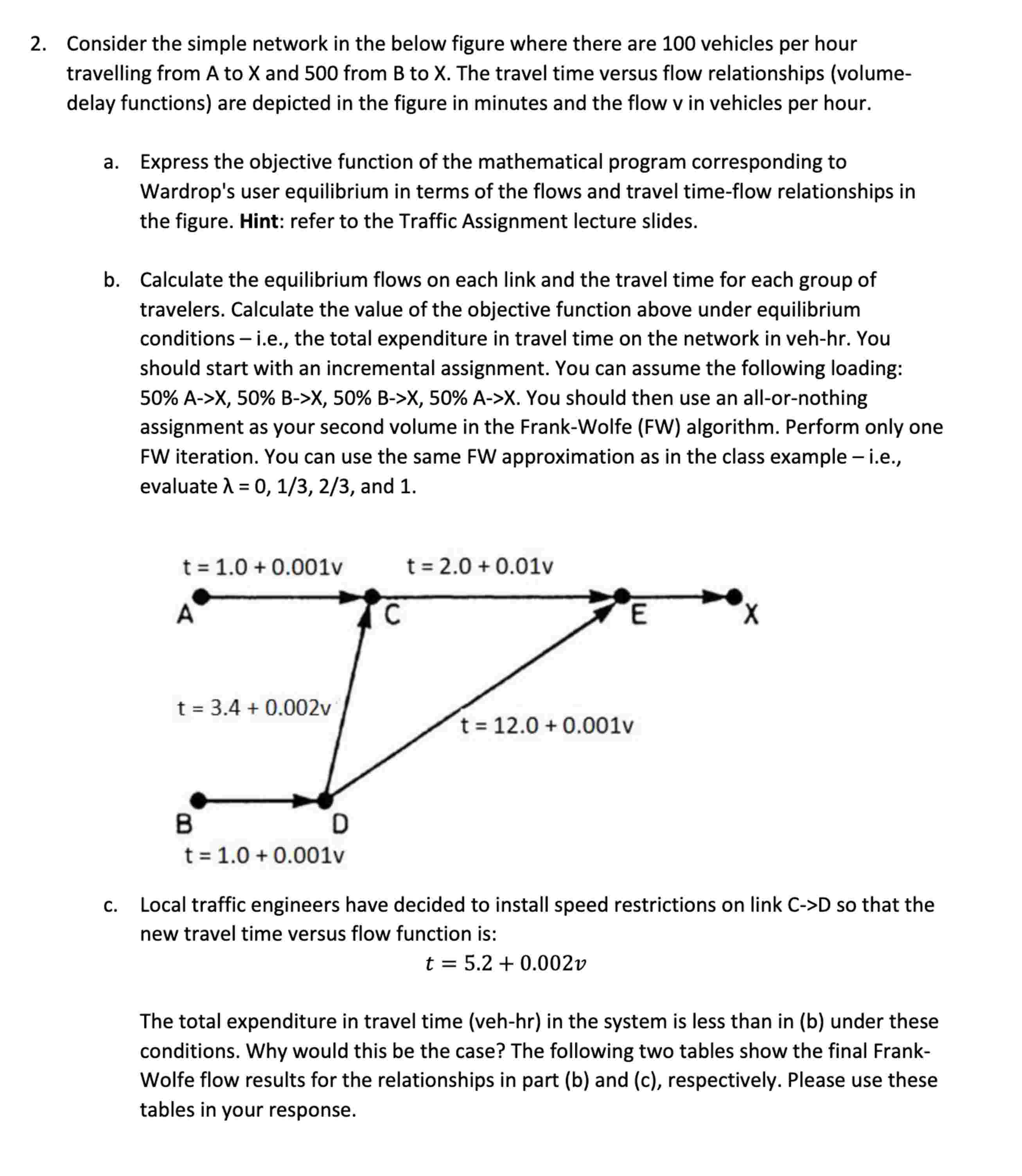
Consider the simple network in the below figure where there are vehicles per hour travelling from A to X and from B to X The travel time versus flow relationships volumedelay functions are depicted in the figure in minutes and the flow v in vehicles per hour.
a Express the objective function of the mathematical program corresponding to Wardrop's user equilibrium in terms of the flows and travel timeflow relationships in the figure. Hint: refer to the Traffic Assignment lecture slides.
b Calculate the equilibrium flows on each link and the travel time for each group of travelers. Calculate the value of the objective function above under equilibrium conditions ie the total expenditure in travel time on the network in vehhr You should start with an incremental assignment. You can assume the following loading: AX BX BX AX You should then use an allornothing assignment as your second volume in the FrankWolfe FW algorithm. Perform only one FW iteration. You can use the same FW approximation as in the class example ie evaluate lambda and
c Local traffic engineers have decided to install speed restrictions on link CD so that the new travel time versus flow function is:
t v
The total expenditure in travel time vehhr in the system is less than in b under these conditions. Why would this be the case? The following two tables show the final FrankWolfe flow results for the relationships in part b and c respectively. Please use these tables in your response.
Step by Step Solution
There are 3 Steps involved in it
1 Expert Approved Answer
Step: 1 Unlock

Question Has Been Solved by an Expert!
Get step-by-step solutions from verified subject matter experts
Step: 2 Unlock
Step: 3 Unlock
 Study Help