







Question: ( 2 ) Consider the two - dimensional drone depicted below. In what follows you will develop the equations of motion and then you will
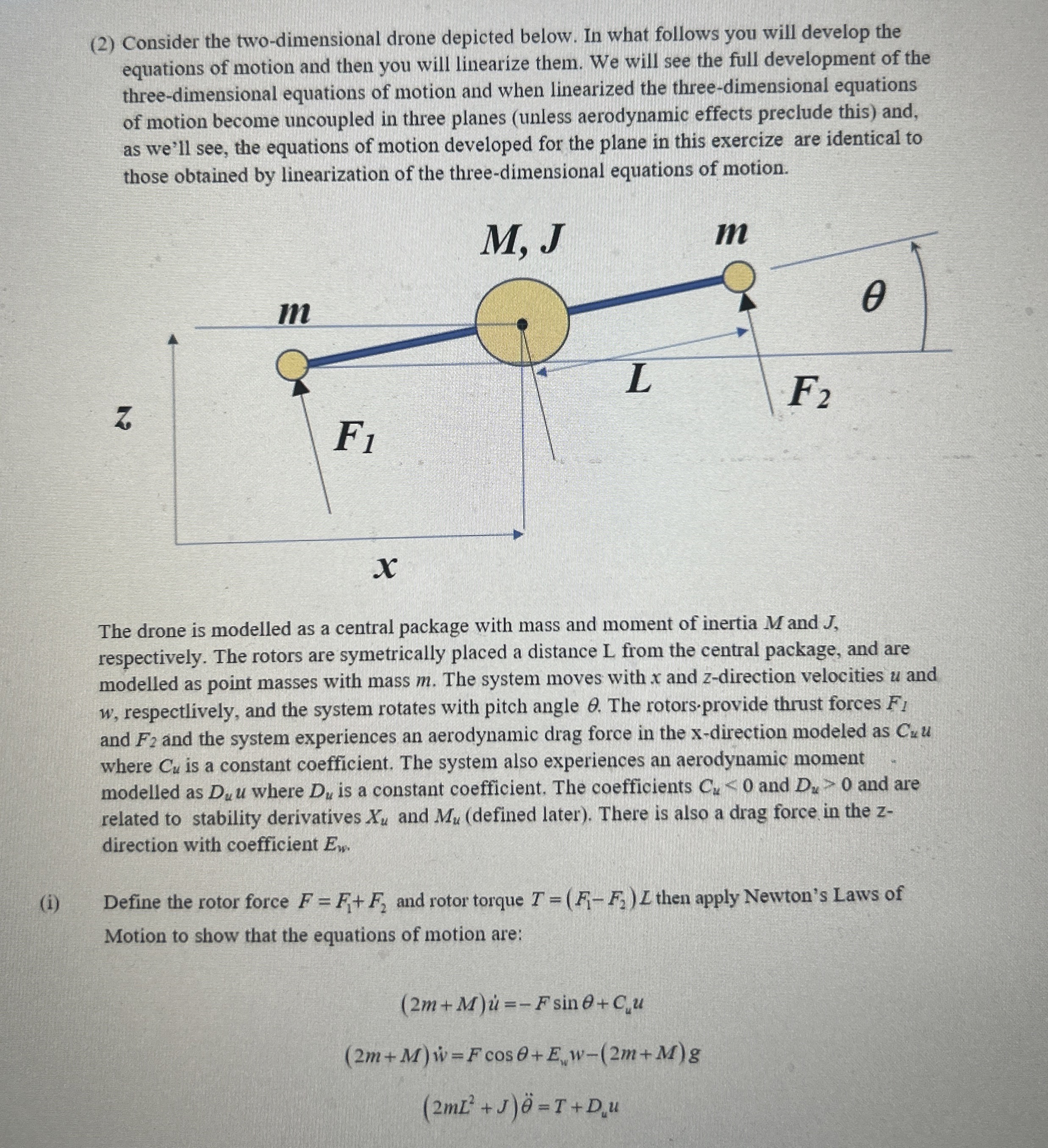
Consider the twodimensional drone depicted below. In what follows you will develop the equations of motion and then you will linearize them. We will see the full development of the threedimensional equations of motion and when linearized the threedimensional equations of motion become uncoupled in three planes unless aerodynamic effects preclude this and, as we'll see, the equations of motion developed for the plane in this exercize are identical to those obtained by linearization of the threedimensional equations of motion.
The drone is modelled as a central package with mass and moment of inertia and respectively. The rotors are symetrically placed a distance from the central package, and are modelled as point masses with mass The system moves with and direction velocities and respectlively, and the system rotates with pitch angle The rotors provide thrust forces and and the system experiences an aerodynamic drag force in the xdirection modeled as where is a constant coefficient. The system also experiences an aerodynamic moment modelled as where is a constant coefficient. The coefficients and and are related to stability derivatives and defined later There is also a drag force in the direction with coefficient
i Define the rotor force and rotor torque then apply Newton's Laws of Motion to show that the equations of motion are:
Fsin
Fcos
Step by Step Solution
There are 3 Steps involved in it
1 Expert Approved Answer
Step: 1 Unlock

Question Has Been Solved by an Expert!
Get step-by-step solutions from verified subject matter experts
Step: 2 Unlock
Step: 3 Unlock
 Study Help