







Question: 2. Consider the two (excess return) index model regression results for A and B: R4 = 1% +1.2RM R-square = 0.576 Residual standard deviation =
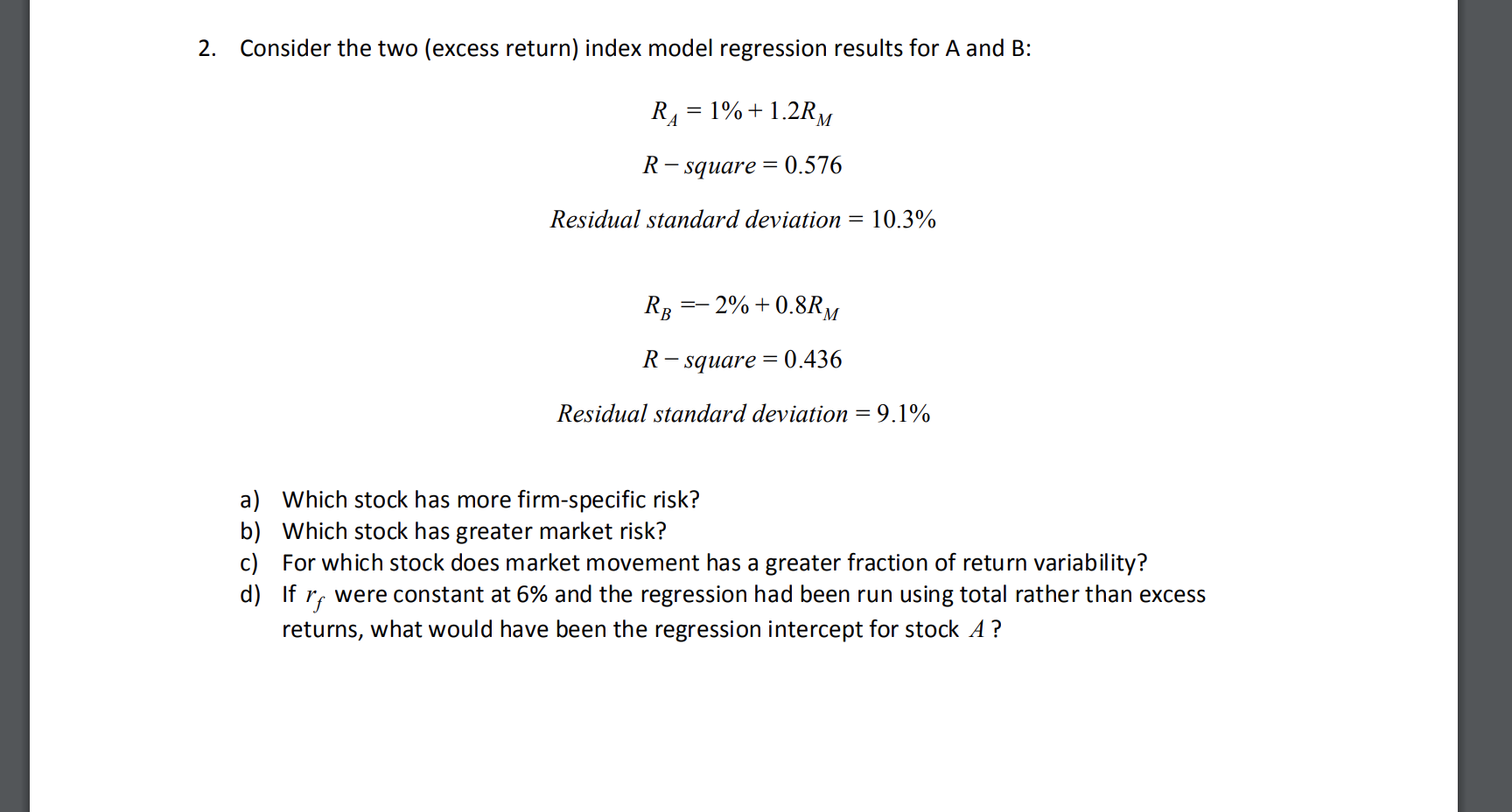
2. Consider the two (excess return) index model regression results for A and B: R4 = 1% +1.2RM R-square = 0.576 Residual standard deviation = 10.3% Rp =-2% +0.8RM R-square = 0.436 Residual standard deviation = 9.1% a) Which stock has more firm-specific risk? b) Which stock has greater market risk? c) For which stock does market movement has a greater fraction of return variability? d) If rg were constant at 6% and the regression had been run using total rather than excess returns, what would have been the regression intercept for stock A ? 2. Consider the two (excess return) index model regression results for A and B: R4 = 1% +1.2RM R-square = 0.576 Residual standard deviation = 10.3% Rp =-2% +0.8RM R-square = 0.436 Residual standard deviation = 9.1% a) Which stock has more firm-specific risk? b) Which stock has greater market risk? c) For which stock does market movement has a greater fraction of return variability? d) If rg were constant at 6% and the regression had been run using total rather than excess returns, what would have been the regression intercept for stock A
Step by Step Solution
There are 3 Steps involved in it

Get step-by-step solutions from verified subject matter experts
 Study Help