







Question: 2. Consider the two-period endowment model discussed in the lectures where the economy is populated by m consumers and a government, The agents derive utility
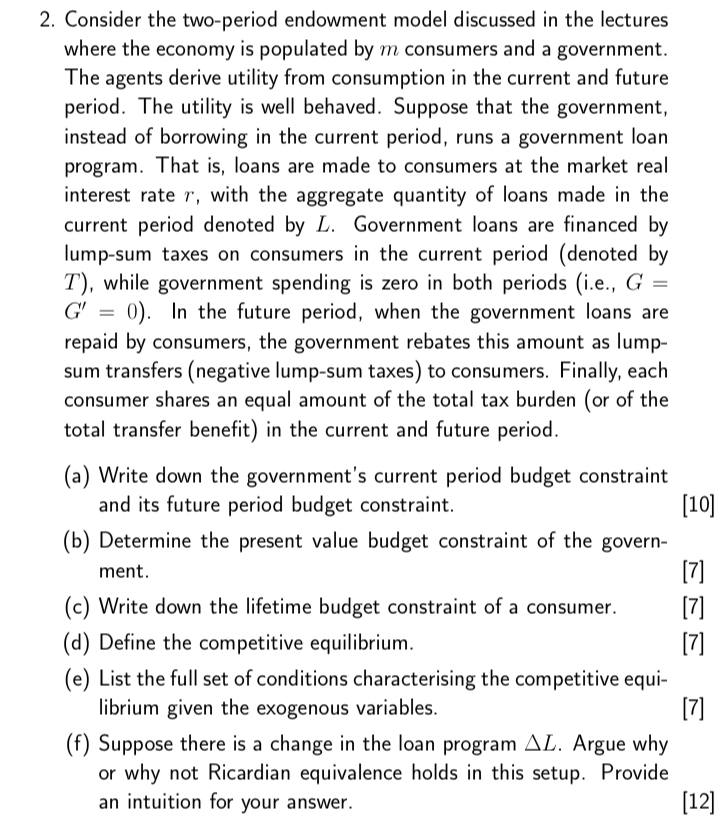
2. Consider the two-period endowment model discussed in the lectures where the economy is populated by m consumers and a government, The agents derive utility from consumption in the current and future period, The utility is well behaved. Suppose that the government, instead of borrowing in the current period, runs a government loan program. That is. loans are made to consumers at the market real interest rate 'r', with the aggregate quantity of loans made in the current period denoted by L. Government loans are financed by lump-sum taxes on consumers in the current period (denoted by T), while government spending is zero in both periods [i,e,, G = G\" = [1). In the future period, when the government loans are repaid by consumers, the government rebates this amount as lump- sum transfers (negative lump-sum taxes) to consumers. Finally, each consumer shares an equal amount of the total tax burden (or of the total transfer benefit) in the current and future period, (3) Write down the government's current period budget constraint and its future period budget constraint. [10] (b) Determine the present value budget constraint of the govern- ment. [7'] (c) Write down the lifetime budget constraint of a consumer, [i'] (d) Define the competitive equilibrium, [7'] (e) List the full set of conditions characterising the competitive equi- librium given the exogenous variables, ['1'] (f) Suppose there is a change in the loan program L. Argue why or why not Ricardian equivalence holds in this setup, Provide an intuition for your answer, [12]
Step by Step Solution
There are 3 Steps involved in it

Get step-by-step solutions from verified subject matter experts
 Study Help