







Question: ; help here please Answer ALL the parts. Post a CLEAR ANIIlI STEP BY STEP EXPLANATION. Do not post incomplete solutions Consider a two-period small
; help here please
![preferences described by the lifetime utility function In lCl+l[l|:|'fll]llnl:2, where C1 and](https://s3.amazonaws.com/si.experts.images/answers/2024/07/6683d25f2d5cc_1026683d25ee9ac8.jpg)
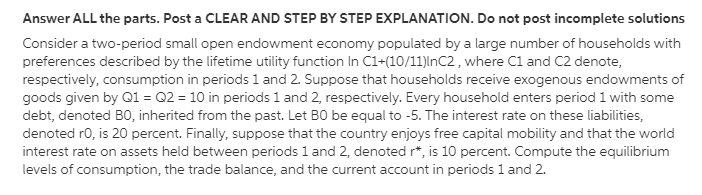
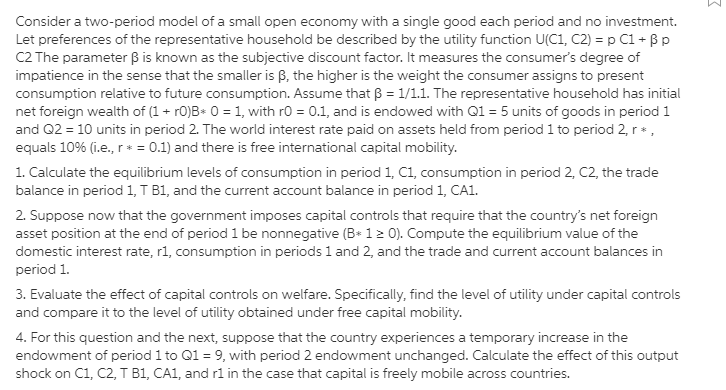
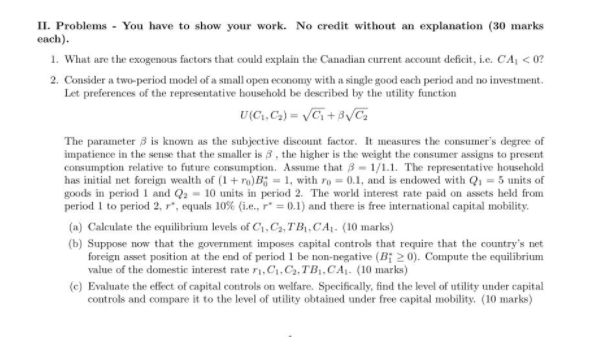
Answer ALL the parts. Post a CLEAR ANIIlI STEP BY STEP EXPLANATION. Do not post incomplete solutions Consider a two-period small open endowment economy populated by a large number of households with preferences described by the lifetime utility function In lCl+l[l|:|'fll]llnl:2, where C1 and C2 denote, respectively, consumption in periods 1 and 2. Suppose that households receive exogenous endowments of goods given by {11 2 G2 = 10 in periods 1 and 2 respectively. Every household enters period 1 with some debt, denoted ElCI, inherited from the past. Let BO be equal to -5. The interest rate on these liabilities, denoted rD, is 2D percent. Finally, suppose that the country enjoys free capital mobility and that the world interest rate on assets held between periods 1 and 2, denoted r*, is 1G percent. lEompute the equilibrium levels of consumption, the trade balance, and the current account in periods 1 and 2 Consider a twoperiod model of a small open economy with a single good each period and no investment. Let preferences of the representative household be described by the utility function U{C1, C2} = p C1 + [5 p C2 The parameter [3 is known as the subjective discount factor. It measures the consumer's degree of impatience in the sense that the smaller is B, the higher is the weight the consumer assigns to preserrt consumption relative to future consumption. Assume that B = U11. The representative household has initial net foreign wealth of {1 + rlt I] = 1, with r = [1.1, and is endowed with Ell = 5 units of goods in period 1 and 02 = ID units in period 2. The world interest rate paid on assets held from period lto period 2, r * , equals 16% {i.e., r * = [1.1] and there is free international capital mobility. 1. Calculate the equilibrium levels of consumption in period 1, C1, consumption in period 2, C2, the trade balance in period 1, T El, and the current accourrt balance in period 1, CA1. 2. Suppose now that the government imposes capital corrtrols that require that the country's net foreign asset position atthe end of period 1 be nonnegative {3* 1 a D}. Compute the equilibrium value of the domestic interest rate, r1, consumption in periods 1 and 2, and the trade and currerrt account balances in period 1. 3. Evaluate the effect of capital corrtrols on welfare. Specically, nd the level of utility under capital controls and compare it to the level of utility obtained under free capital mobility. 4. Forthis question and the next, suppose that the country experiences a temporary increase in the endowment of period 1 to El = '3, with period 2 endowment unchanged. Calculate the effect of this output shod: on C1, C2, T Bl, CA1, and r1 in the case that capital is freely mobile across courrtries. \fwhere (3'1 and 0: denote consumption in periods 1 and 2. In both periods, the household receives prots from the rm it owns. denoted H1 and H2. Households and rms have access to nancial markets 1Where the};r can borrow or lend at the interest rate n. The production technologiesinperiodsl and2aregivenhy Q1 = A1]? and Q: = A21? where Q1 and Qg denote output in periods 1 and 2, In and I1 denote the capital stool: in periods 1 and 2. A] and A2 denote the productivity factors in periods 1 and 2. and o is a parameter. Assume that ID = 113, A1: 3%. A: = 3.2, and c: = 3. At the beginning oi'period 1 households have 3!; = 3 bonds. The interest rate on bonds held eem peried e to period 1 is re = 0.25. In period 1, rms borrow the amount Dir to purchase investment goods that become productive capital in period 2, I]. Amume that there exists free international capital mobility and that the 1world intermt rate1 denoted r", is 20 percent. 3. Compute output and prots in period 1. b. Compute the optimal levels of investment in perimi 1 and output and prots in period 2. c. Solve for the optimal levels of oonsumption in periods 1 and 2. d. Find the country's net foreign asset position at the end of period 1, denoted Bf. saving. 31, trade halanoe, T31, and current acoount. CA1
Step by Step Solution
There are 3 Steps involved in it

Get step-by-step solutions from verified subject matter experts
 Study Help