







Question: 2. Current is flowing through a wire at a constant amperage of 15 coulombs/second. The wire is composed of copper that is 10 cm
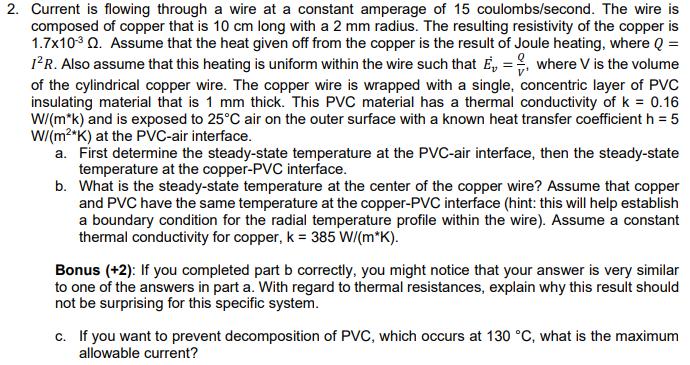
2. Current is flowing through a wire at a constant amperage of 15 coulombs/second. The wire is composed of copper that is 10 cm long with a 2 mm radius. The resulting resistivity of the copper is 1.7x10- Q. Assume that the heat given off from the copper is the result of Joule heating, where Q = 1R. Also assume that this heating is uniform within the wire such that E, where V is the volume of the cylindrical copper wire. The copper wire is wrapped with a single, concentric layer of PVC insulating material that is 1 mm thick. This PVC material has a thermal conductivity of k = 0.16 W/(m*k) and is exposed to 25C air on the outer surface with a known heat transfer coefficient h = 5 W/(m*K) at the PVC-air interface. a. First determine the steady-state temperature at the PVC-air interface, then the steady-state temperature at the copper-PVC interface. b. What is the steady-state temperature at the center of the copper wire? Assume that copper and PVC have the same temperature at the copper-PVC interface (hint: this will help establish a boundary condition for the radial temperature profile within the wire). Assume a constant thermal conductivity for copper, k = 385 W/(m*K). Bonus (+2): If you completed part b correctly, you might notice that your answer is very similar to one of the answers in part a. With regard to thermal resistances, explain why this result should not be surprising for this specific system. c. If you want to prevent decomposition of PVC, which occurs at 130 C, what is the maximum allowable current?
Step by Step Solution
There are 3 Steps involved in it
a To determine the steadystate temperature at the PVCair interface we can analyze the heat transfer through the various layers The heat generated by Joule heating within the copper wire is given by Q ... View full answer

Get step-by-step solutions from verified subject matter experts
 Study Help