







Question: 2. Design a between subject experiment to test whether bees can distinguish red from green. 3. Design a between subject experiment to test whether human
2. Design a between subject experiment to test whether bees can distinguish
red from green.
3. Design a between subject experiment to test whether human newborns can
tell the difference between male and female faces.
4. Design an experiment to test whether caffeine has an effect on the subjective
feeling of Nervousness. Make sure you specify the following:
(a) Independent variable and its implementation in the different treatment
groups.
(b) Dependent variable and how you are going to measure it.
(c) Intervening variables and how you will control them.
10. A manufacturer of automobile batteries claims that the average length
of life for its grade A battery is 60 months. But the guarantee on this brand
is for just 36 months. Suppose that the frequency distribution of the lifelength data is unimodal and symmetrical and that the standard deviation is
known to be 10 months. Suppose further that your battery lasts 37 months.
What could you infer, if anything, about the manufacturer's claim?
11. At one university, the students are given z-scores at the end of each
semester rather than the traditional GPA's. The mean and standard deviations of all students' cumulative GPA's on which the z-scores are based
are 2.7 and 0.5 respectively. Students with z-scores below -1.6 are put on
probation. What is the corresponding probationary level of the GPA?
12. Two variables have identical standard deviations and a covariance equal
to half that common standard deviation. If the standard deviation of the
two variables is 2, what is the correlation coefficient between them?
13. Application of Chebyshev's rule to a data set that is roughly symmetrically distributed implies that at least one-half of all the observations lie in
the interval from 3.6 to 8.8. What are the approximate values of the mean
and standard deviation of this data set?
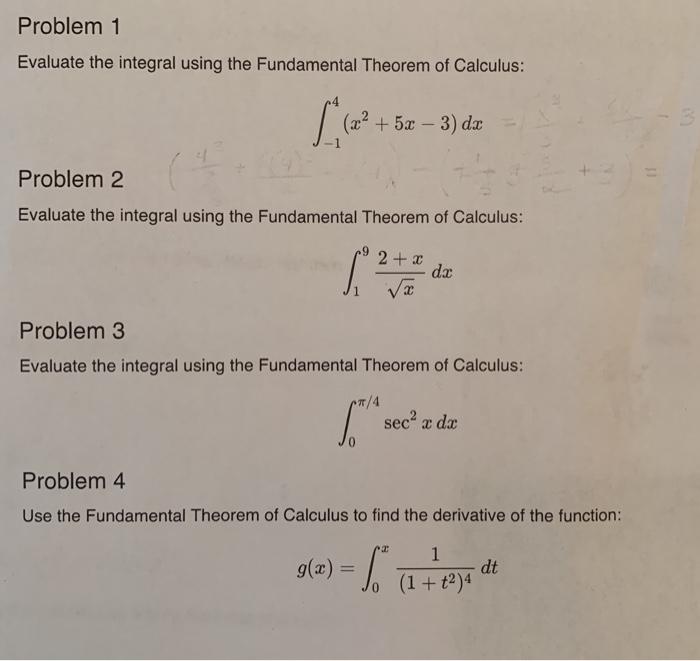
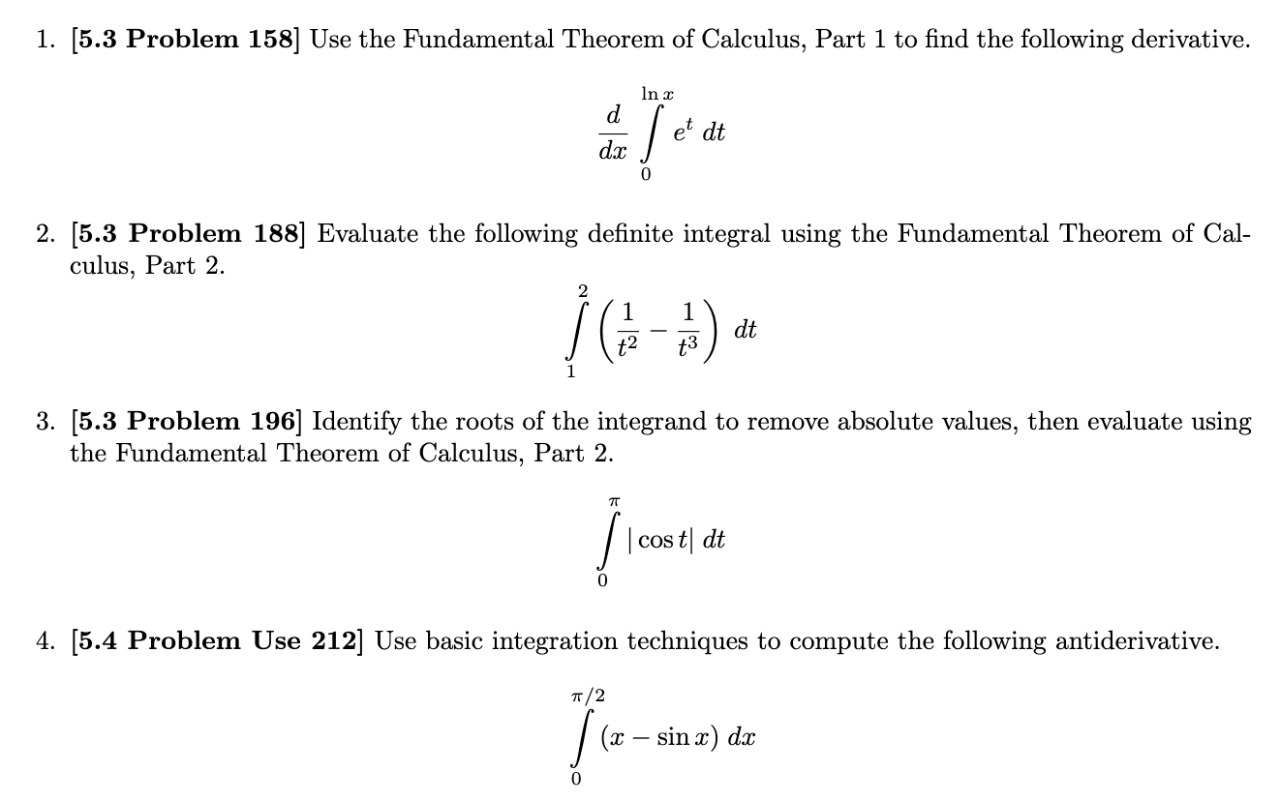
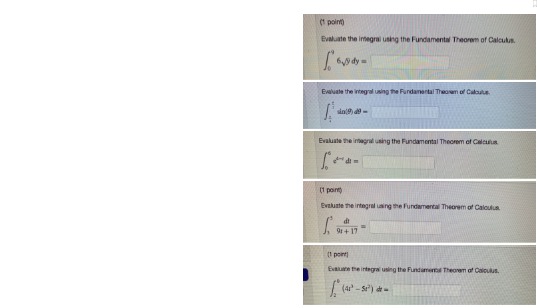
Problem 1 Evaluate the integral using the Fundamental Theorem of Calculus: (x2 + 5x - 3) dx Problem 2 + Evaluate the integral using the Fundamental Theorem of Calculus: 2+ Problem 3 Evaluate the integral using the Fundamental Theorem of Calculus: $7 /4 sec* x da Problem 4 Use the Fundamental Theorem of Calculus to find the derivative of the function: g(z) = 1 (1 + +2) 4 -dt1. [5.3 Problem 158] Use the Fundamental Theorem of Calculus, Part 1 to find the following derivative. In x a dx et dt 0 2. [5.3 Problem 188] Evaluate the following definite integral using the Fundamental Theorem of Cal- culus, Part 2. N dt 3. [5.3 Problem 196] Identify the roots of the integrand to remove absolute values, then evaluate using the Fundamental Theorem of Calculus, Part 2. | cost dt O 4. [5.4 Problem Use 212] Use basic integration techniques to compute the following antiderivative. 75 / 2 (x - sinx) da 0Evildurin the imaginl using the Fundamental Troone of Calculin Ewhats the integral using the Fundamental Theorem of Colate un Exilunto the imagrall using the Fundamental Theorem of Celsius Evaluate the intogrol using the Fundamental Theorem of Calculus 91 + 17 I! pointl Party's Feintegral using the Fund menad Thegram of Calculus
Step by Step Solution
There are 3 Steps involved in it

Get step-by-step solutions from verified subject matter experts
 Study Help