



Question: 2 ) Determine and sketch an appropriate channel model for two - path ionospheric propagation, where the relative time delay between the two received signal
Determine and sketch an appropriate channel model for twopath ionospheric propagation, where the relative time delay between the two received signal paths is msec and the transmitted signal bandwidth W is kHz
Suppose that a communication channel with a nominal bandwidth allocation of kHz is to be used for transmitting digital information at a rate of mathrmbitsmathrmsec The channel multipath spread is Tmmathrmmsec Specify a modulation method for achieving the desired data rate and indicate whether or not an equalizer is necessary at the receiver for the intersymbol interference.
A communication system employs dual antenna diversity and binary orthogonal FSK modulation. The received signals at the two antennas are
beginarrayl
rtalpha stnt
rtalpha stnt
endarray
where alpha and alpha are statistically iid Rayleigh random variables, and nlt and nt are statistically independent, zeromean white Gaussian random processes with powerspectral density Nmathrm~WmathrmHz
The two signals are demodulated, squared, and then combined prior to detection.
a Sketch the functional block diagram of the entire receiver including the demodulator, the combiner, and the detector.
b Plot the probability of error for the detector and compare the result with the case of no diversity.
The SNR required at the detector to achieve reliable communication in a DS spreadspectrum communication system is dB If the interferencetosignal power at the receiver is dB determine the processing gain required to achieve reliable communication.
Question III:
For a signal with Rayleighdistributed amplitude, what is the probability that the received signal power is at least dB below the mean power.
Compute the probability that the output power of a selection diversity system is dB lower than the mean power of each branch, when using mathrmNr antennas.
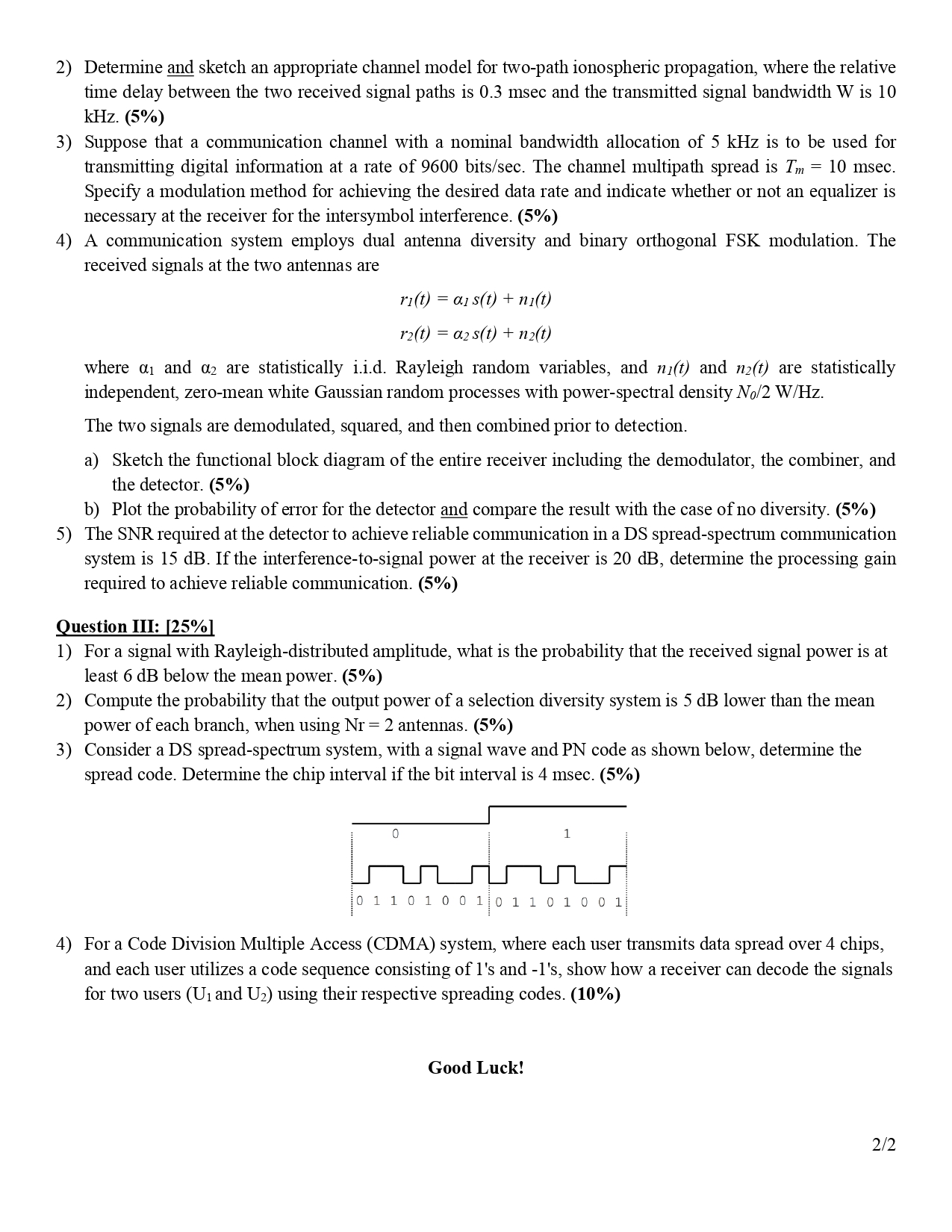
Consider a DS spreadspectrum system, with a signal wave and PN code as shown below, determine the spread code. Determine the chip interval if the bit interval is msec
For a Code Division Multiple Access CDMA system, where each user transmits data spread over chips, and each user utilizes a code sequence consisting of s and s show how a receiver can decode the signals for two users mathrmU and mathrmU using their respective spreading codes.
Good Luck!
Step by Step Solution
There are 3 Steps involved in it
1 Expert Approved Answer
Step: 1 Unlock

Question Has Been Solved by an Expert!
Get step-by-step solutions from verified subject matter experts
Step: 2 Unlock
Step: 3 Unlock