





Question: 2. Diffusion coefficients in cytoplasm have been estimated by a technique of photobleaching recovery. In this technique, an area of the cytoplasm is irradiated with
2. Diffusion coefficients in cytoplasm have been
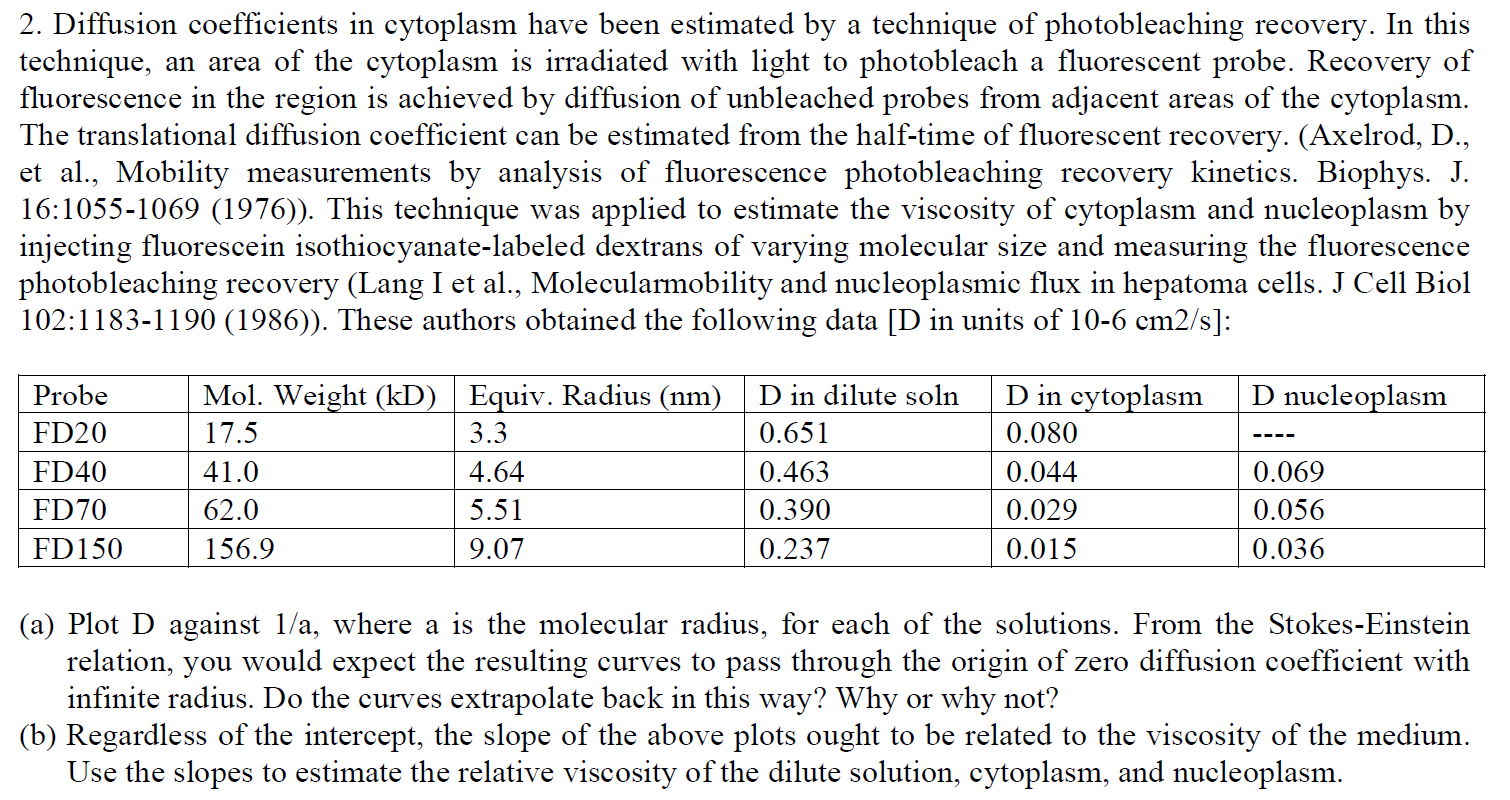
2. Diffusion coefficients in cytoplasm have been estimated by a technique of photobleaching recovery. In this technique, an area of the cytoplasm is irradiated with light to photobleach a fluorescent probe. Recovery of fluorescence in the region is achieved by diffusion of unbleached probes from adjacent areas of the cytoplasm. The translational diffusion coefficient can be estimated from the half-time of fluorescent recovery. (Axelrod, D., et al., Mobility measurements by analysis of fluorescence photobleaching recovery kinetics. Biophys. J. 16:1055-1069 (1976)). This technique was applied to estimate the viscosity of cytoplasm and nucleoplasm by injecting fluorescein isothiocyanate-labeled dextrans of varying molecular size and measuring the fluorescence photobleaching recovery (Lang I et al., Molecularmobility and nucleoplasmic flux in hepatoma cells. J Cell Biol 102:1183-1190 (1986)). These authors obtained the following data [D in units of 10-6 cm2/s]: Probe Mol. Weight (kD) Equiv. Radius (nm) D in dilute soln D in cytoplasm D nucleoplasm FD20 17.5 3.3 0.651 0.080 FD40 41.0 4.64 0.463 0.044 0.069 FD70 62.0 5.51 0.390 0.029 0.056 FD150 156.9 9.07 0.237 0.015 0.036 (a) Plot D against 1/a, where a is the molecular radius, for each of the solutions. From the Stokes-Einstein relation, you would expect the resulting curves to pass through the origin of zero diffusion coefficient with infinite radius. Do the curves extrapolate back in this way? Why or why not? (b) Regardless of the intercept, the slope of the above plots ought to be related to the viscosity of the medium. Use the slopes to estimate the relative viscosity of the dilute solution, cytoplasm, and nucleoplasm

Step by Step Solution

There are 3 Steps involved in it

1 Expert Approved Answer
Step: 1 Unlock blur-text-image
Question Has Been Solved by an Expert!

Get step-by-step solutions from verified subject matter experts

Step: 2 Unlock
Step: 3 Unlock

Students Have Also Explored These Related Law Questions!