


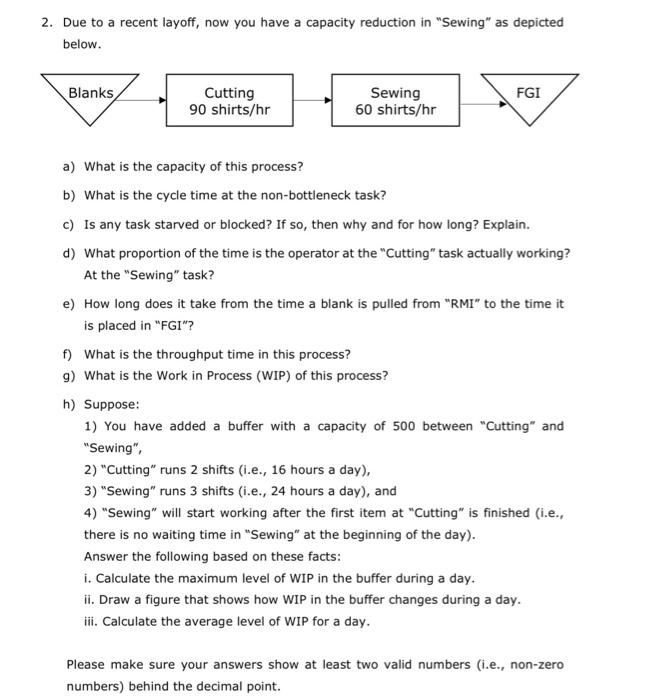
Question: 2. Due to a recent layoff, now you have a capacity reduction in Sewing as depicted below. Blanks FGI Cutting 90 shirts/hr Sewing 60 shirts/hr
2. Due to a recent layoff, now you have a
2. Due to a recent layoff, now you have a capacity reduction in "Sewing" as depicted below. Blanks FGI Cutting 90 shirts/hr Sewing 60 shirts/hr a) What is the capacity of this process? b) What is the cycle time at the non-bottleneck task? c) Is any task starved or blocked? If so, then why and for how long? Explain. d) What proportion of the time is the operator at the "Cutting" task actually working? At the "Sewing" task? e) How long does it take from the time a blank is pulled from "RMI" to the time it is placed in "FGI"? f) What is the throughput time in this process? g) What is the work in Process (WIP) of this process? n) Suppose: 1) You have added a buffer with a capacity of 500 between "Cutting" and "Sewing". 2) "Cutting" runs 2 shifts (i.e., 16 hours a day), 3) "Sewing" runs 3 shifts (i.e., 24 hours a day), and 4) "Sewing" will start working after the first item at "Cutting" is finished (i.e., there is no waiting time in "Sewing" at the beginning of the day). Answer the following based on these facts: 1. Calculate the maximum level of WIP in the buffer during a day. II. Draw a figure that shows how WIP in the buffer changes during a day. ill. Calculate the average level of WIP for a day. Please make sure your answers show at least two valid numbers (i.e., non-zero numbers) behind the decimal point

Step by Step Solution

There are 3 Steps involved in it

1 Expert Approved Answer
Step: 1 Unlock blur-text-image

Question Has Been Solved by an Expert!

Get step-by-step solutions from verified subject matter experts

Step: 2 Unlock
Step: 3 Unlock

Students Have Also Explored These Related General Management Questions!