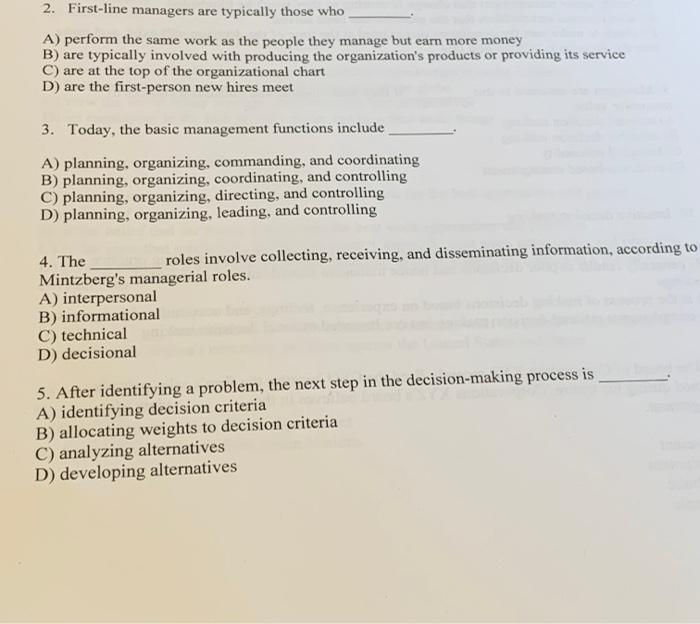
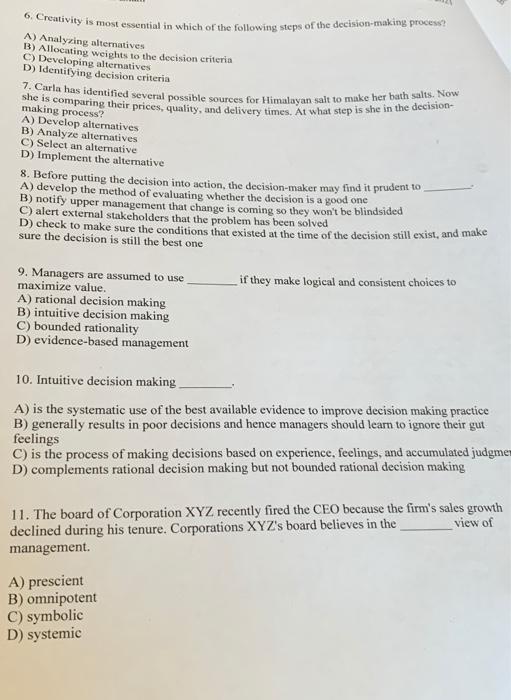
2. First-line managers are typically those who A) perform the same work as the people they manage but earn more money B) are typically involved with producing the organization's products or providing its service C) are at the top of the organizational chart D) are the first-person new hires meet 3. Today, the basic management functions include A) planning, organizing, commanding, and coordinating B) planning, organizing, coordinating, and controlling C) planning, organizing, directing, and controlling D) planning, organizing, leading, and controlling 4. The roles involve collecting, receiving, and disseminating information, according to Mintzberg's managerial roles. A) interpersonal B) informational C) technical D) decisional 5. After identifying a problem, the next step in the decision-making process is A) identifying decision criteria B) allocating weights to decision criteria C) analyzing alternatives D) developing alternatives Creativity is most essential in which of the following steps of the decision-making process A) Analyzing alternatives B) Allocating weights to the decision criteria C) Developing alternatives D) Identifying decision criteria she is comparing their prices, quality, and delivery times. At what step is she in the decision- 7. Carla has identified several possible sources for Himalayan salt to make her bath salts. Now making process? A) Develop alternatives B) Analyze alternatives C) Select an alternative D) Implement the alternative 8. Before putting the decision into action, the decision-maker may find it prudent-10 A) develop the method of evaluating whether the decision is a good one B) notify upper management that change is coming so they won't be blindsided C) alert external stakeholders that the problem has been solved D) check to make sure the conditions that existed at the time of the decision still exist, and make sure the decision is still the best one if they make logical and consistent choices to 9. Managers are assumed to use maximize value. A) rational decision making B) intuitive decision making C) bounded rationality D) evidence-based management 10. Intuitive decision making A) is the systematic use of the best available evidence to improve decision making practice B) generally results in poor decisions and hence managers should learn to ignore their gut feelings C) is the process of making decisions based on experience, feelings, and accumulated judgmen D) complements rational decision making but not bounded rational decision making 11. The board of Corporation XYZ recently fired the CEO because the firm's sales growth declined during his tenure. Corporations XYZ's board believes in the view of management. A) prescient B) omnipotent C) symbolic D) systemic