



Question: 2. For the Forum post (1-2 pages A4), you will respond to the Questions pertaining to the short case study below. (Total=12 marks) Case Study:
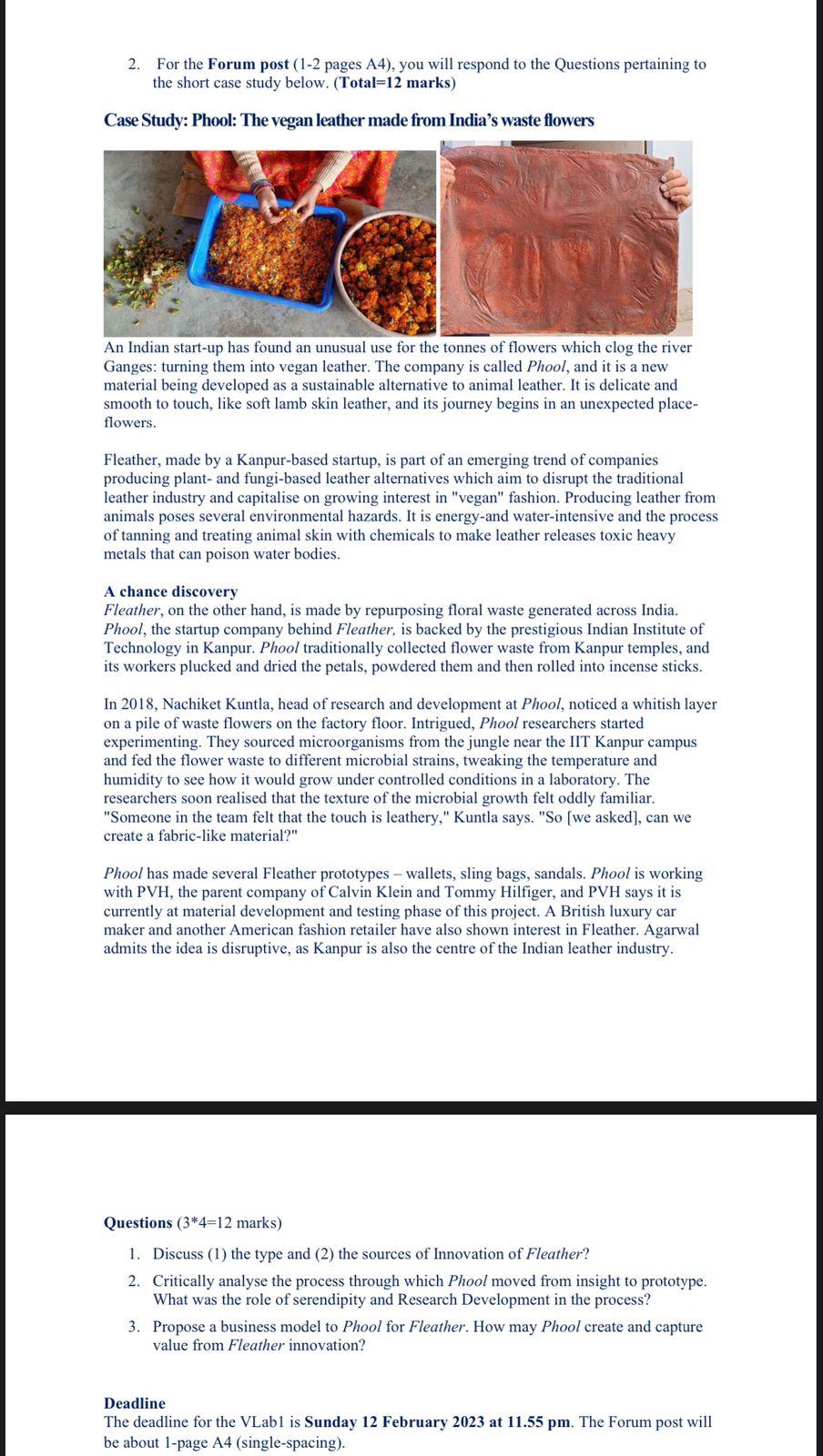
2. For the Forum post (1-2 pages A4), you will respond to the Questions pertaining to the short case study below. (Total=12 marks) Case Study: Phool: The vegan leather made from India's waste flowers An Indian start-up has found an unusual use for the tonnes of flowers which clog the river Ganges: turning them into vegan leather. The company is called Phool, and it is a new material being developed as a sustainable alternative to animal leather. It is delicate and smooth to touch, like soft lamb skin leather, and its journey begins in an unexpected placeflowers. Fleather, made by a Kanpur-based startup, is part of an emerging trend of companies producing plant- and fungi-based leather alternatives which aim to disrupt the traditional leather industry and capitalise on growing interest in "vegan" fashion. Producing leather from animals poses several environmental hazards. It is energy-and water-intensive and the process of tanning and treating animal skin with chemicals to make leather releases toxic heavy metals that can poison water bodies. A chance discovery Fleather, on the other hand, is made by repurposing floral waste generated across India. Phool, the startup company behind Fleather, is backed by the prestigious Indian Institute of Technology in Kanpur. Phool traditionally collected flower waste from Kanpur temples, and its workers plucked and dried the petals, powdered them and then rolled into incense sticks. In 2018, Nachiket Kuntla, head of research and development at Phool, noticed a whitish layer on a pile of waste flowers on the factory floor. Intrigued, Phool researchers started experimenting. They sourced microorganisms from the jungle near the IIT Kanpur campus and fed the flower waste to different microbial strains, tweaking the temperature and humidity to see how it would grow under controlled conditions in a laboratory. The researchers soon realised that the texture of the microbial growth felt oddly familiar. "Someone in the team felt that the touch is leathery," Kuntla says. "So [we asked], can we create a fabric-like material?" Phool has made several Fleather prototypes - wallets, sling bags, sandals. Phool is working with PVH, the parent company of Calvin Klein and Tommy Hilfiger, and PVH says it is currently at material development and testing phase of this project. A British luxury car maker and another American fashion retailer have also shown interest in Fleather. Agarwal admits the idea is disruptive, as Kanpur is also the centre of the Indian leather industry. Questions ( 34=12 marks) 1. Discuss (1) the type and (2) the sources of Innovation of Fleather? 2. Critically analyse the process through which Phool moved from insight to prototype. What was the role of serendipity and Research Development in the process? 3. Propose a business model to Phool for Fleather. How may Phool create and capture value from Fleather innovation? Deadline The deadline for the VLab1 is Sunday 12 February 2023 at 11.55pm. The Forum post will be about 1-page A4 (single-spacing)
Step by Step Solution
There are 3 Steps involved in it

Get step-by-step solutions from verified subject matter experts