







Question: 2. Generate 1000 pseudo random numbers using each of the multiplicative congruential generators Ri+1 (66R)mod401 with Ro-1. (a) Do these generators achieve full cycle? (b)
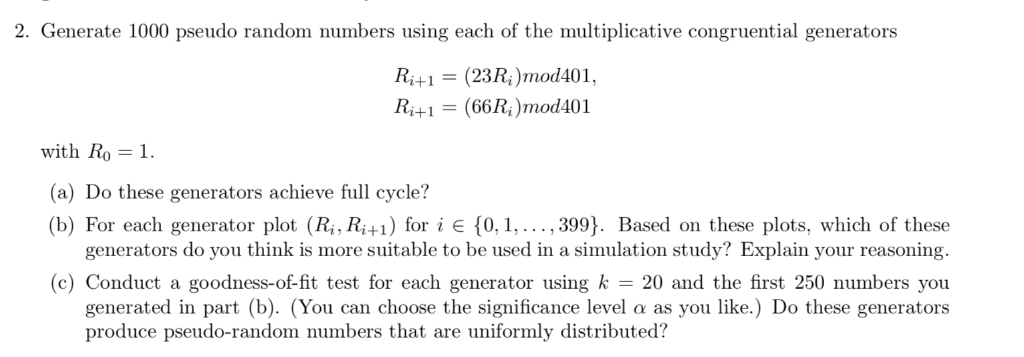
2. Generate 1000 pseudo random numbers using each of the multiplicative congruential generators Ri+1 (66R)mod401 with Ro-1. (a) Do these generators achieve full cycle? (b) For each generator plot (Ri, Ri+1) for i {0,1, , 399). Based on these plots, which of these generators do you think is more suitable to be used in a simulation study? Explain your (c) Conduct a goodness-of-fit test for each generator using k 20 and the first 250 numbers you generated in part (b). (You can choose the significance level a as you like.) Do these generators produce pseudo-random numbers that are uniformly distributed? 2. Generate 1000 pseudo random numbers using each of the multiplicative congruential generators Ri+1 (66R)mod401 with Ro-1. (a) Do these generators achieve full cycle? (b) For each generator plot (Ri, Ri+1) for i {0,1, , 399). Based on these plots, which of these generators do you think is more suitable to be used in a simulation study? Explain your (c) Conduct a goodness-of-fit test for each generator using k 20 and the first 250 numbers you generated in part (b). (You can choose the significance level a as you like.) Do these generators produce pseudo-random numbers that are uniformly distributed
Step by Step Solution
There are 3 Steps involved in it

Get step-by-step solutions from verified subject matter experts
 Study Help