







Question: 2) Given a uniform E-field, E = (2.001 - 3.00j + 4.00k) , and the Gaussian surface shown (a Rectangular Cuboid). There is no charge
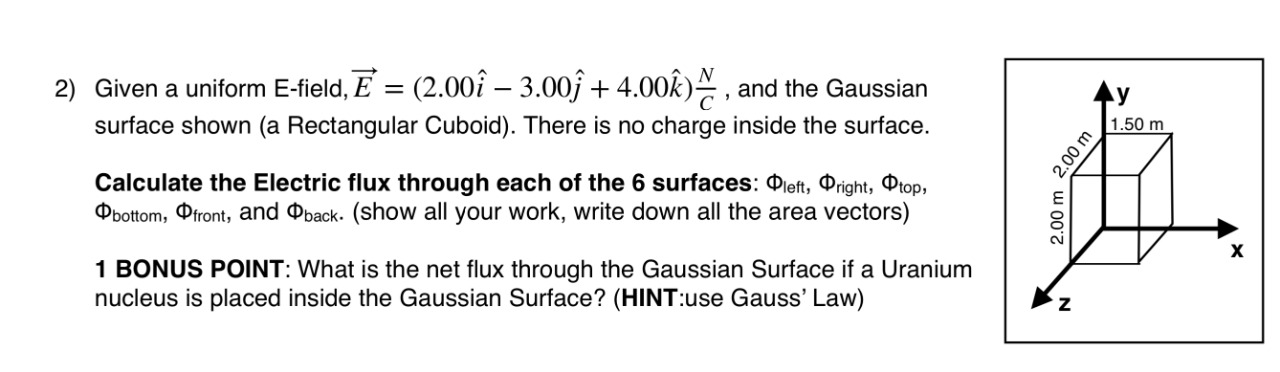
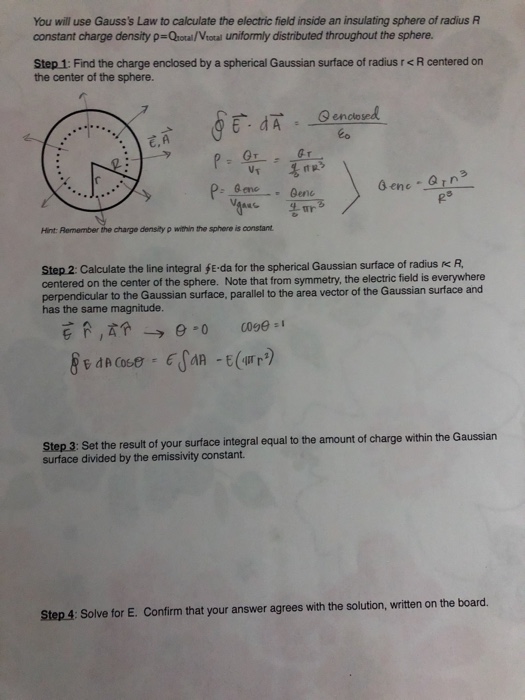
2) Given a uniform E-field, E = (2.001 - 3.00j + 4.00k) , and the Gaussian surface shown (a Rectangular Cuboid). There is no charge inside the surface. 1.50 m Calculate the Electric flux through each of the 6 surfaces: left, Pright, Ptop, 2.00 m 2.00 m Pbottom, Pfront, and @back. (show all your work, write down all the area vectors) X 1 BONUS POINT: What is the net flux through the Gaussian Surface if a Uranium nucleus is placed inside the Gaussian Surface? (HINT:use Gauss' Law) ZYou will use Gauss's Law to calculate the electric field inside an insulating sphere of radius R constant charge density p=Qowl/Visual uniformly distributed throughout the sphere. Step 1: Find the charge enclosed by a spherical Gaussian surface of radius r
Step by Step Solution
There are 3 Steps involved in it

Get step-by-step solutions from verified subject matter experts
 Study Help