







Question: 2 . HYDRAULIC MODELING: STANDARD STEP METHOD ( HEC - RAS ) For the compound channel with a discharge of ( 2 0 0
HYDRAULIC MODELING: STANDARD STEP METHOD HECRAS
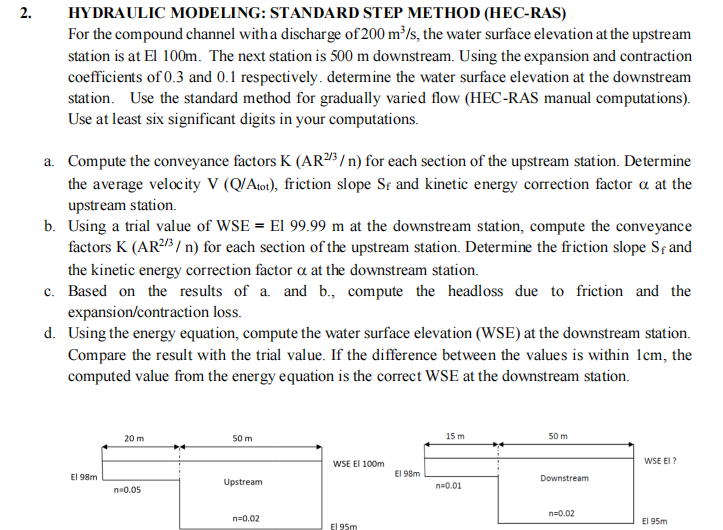
For the compound channel with a discharge of mathrm~mmathrms the water surface elevation at the upstream station is at El m The next station is m downstream. Using the expansion and contraction coefficients of and respectively. determine the water surface elevation at the downstream station. Use the standard method for gradually varied flow HECRAS manual computations Use at least six significant digits in your computations.
a Compute the conveyance factors mathrmKleftmathrmARmathrmnright for each section of the upstream station. Determine the average velocity mathrmVleftmathrmQmathrmAtext tot right friction slope mathrmSmathrmf and kinetic energy correction factor alpha at the upstream station.
b Using a trial value of mathrmWSEmathrmElmathrm~m at the downstream station, compute the conveyance factors mathrmKleftmathrmARmathrmnright for each section of the upstream station. Determine the friction slope mathrmSmathrmf and the kinetic energy correction factor alpha at the downstream station.
c Based on the results of a and b compute the headloss due to friction and the expansioncontraction loss.
d Using the energy equation, compute the water surface elevation WSE at the downstream station. Compare the result with the trial value. If the difference between the values is within cm the computed value from the energy equation is the correct WSE at the downstream station.
Step by Step Solution
There are 3 Steps involved in it
1 Expert Approved Answer
Step: 1 Unlock

Question Has Been Solved by an Expert!
Get step-by-step solutions from verified subject matter experts
Step: 2 Unlock
Step: 3 Unlock
 Study Help