







Question: 2. In this question we will derive a simple model for a population with migration. Consider an autoso- mal Mendelian trait with alleles A and
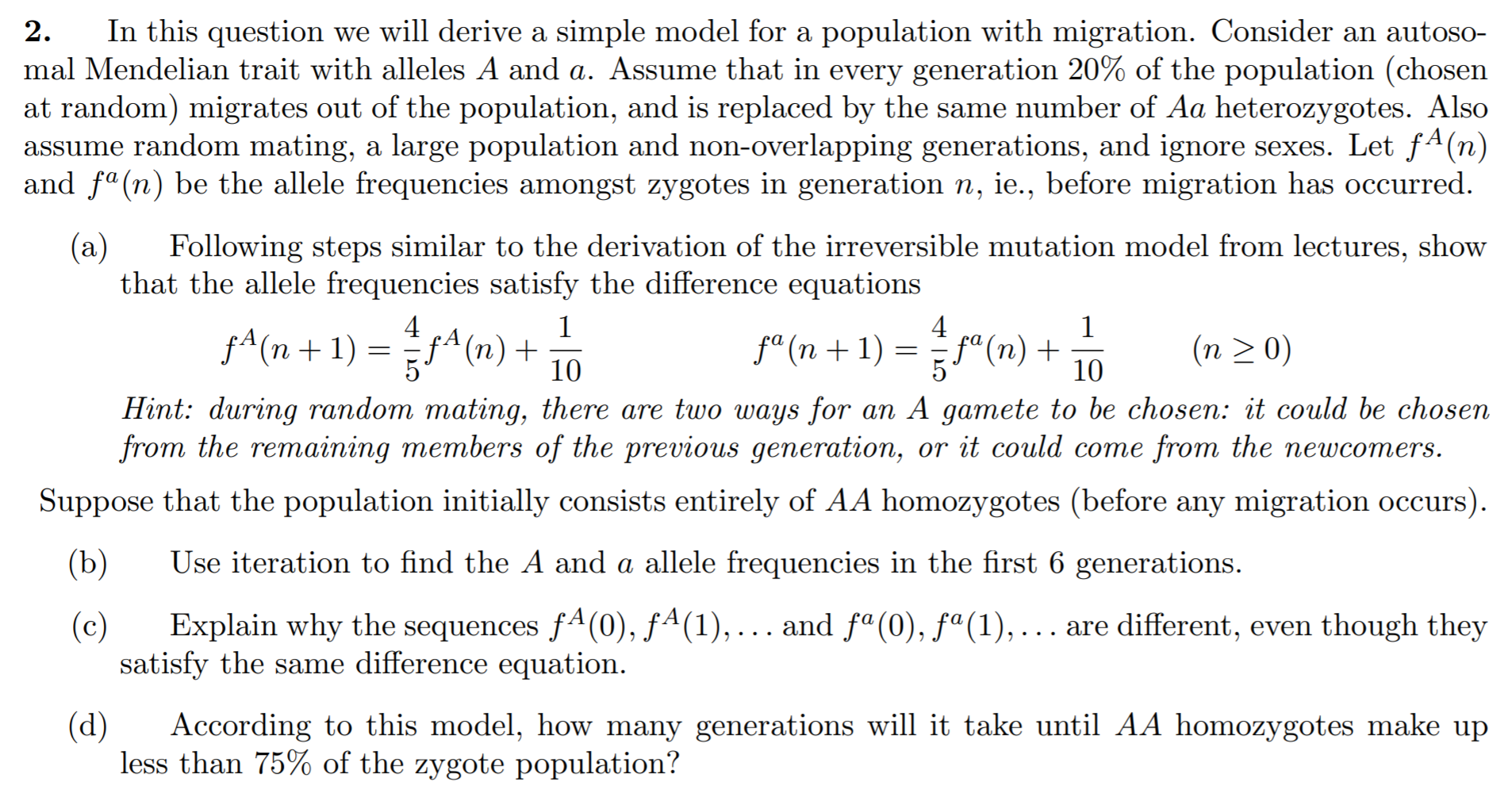
2. In this question we will derive a simple model for a population with migration. Consider an autoso- mal Mendelian trait with alleles A and a. Assume that in every generation 20% of the population (chosen at random) migrates out of the population, and is replaced by the same number of Aa heterozygotes. Also assume random mating, a large population and non-overlapping generations, and ignore sexes. Let fA(n) and f(n) be the allele frequencies amongst zygotes in generation n, ie., before migration has occurred. 1 (a) Following steps similar to the derivation of the irreversible mutation model from lectures, show that the allele frequencies satisfy the difference equations 4 4. 1 +1) (n) + fa n ) f+ (n > 0) 10 10 Hint: during random mating, there are two ways for an A gamete to be chosen: it could be chosen from the remaining members of the previous generation, or it could come from the newcomers. Suppose that the population initially consists entirely of AA homozygotes (before any migration occurs). (b) Use iteration to find the A and a allele frequencies in the first 6 generations. (c) Explain why the sequences fA(0), (1),... and fa (0), fa(1),... are different, even though they satisfy the same difference equation. (d) According to this model, how many generations will it take until AA homozygotes make up less than 75% of the zygote population? 2. In this question we will derive a simple model for a population with migration. Consider an autoso- mal Mendelian trait with alleles A and a. Assume that in every generation 20% of the population (chosen at random) migrates out of the population, and is replaced by the same number of Aa heterozygotes. Also assume random mating, a large population and non-overlapping generations, and ignore sexes. Let fA(n) and f(n) be the allele frequencies amongst zygotes in generation n, ie., before migration has occurred. 1 (a) Following steps similar to the derivation of the irreversible mutation model from lectures, show that the allele frequencies satisfy the difference equations 4 4. 1 +1) (n) + fa n ) f+ (n > 0) 10 10 Hint: during random mating, there are two ways for an A gamete to be chosen: it could be chosen from the remaining members of the previous generation, or it could come from the newcomers. Suppose that the population initially consists entirely of AA homozygotes (before any migration occurs). (b) Use iteration to find the A and a allele frequencies in the first 6 generations. (c) Explain why the sequences fA(0), (1),... and fa (0), fa(1),... are different, even though they satisfy the same difference equation. (d) According to this model, how many generations will it take until AA homozygotes make up less than 75% of the zygote population
Step by Step Solution
There are 3 Steps involved in it

Get step-by-step solutions from verified subject matter experts
 Study Help