



Question: 2. John Maynard Keynes wrote about the demand for reparations paid by Germany to the Allied Powers following WWI. He argued, in his monograph, The
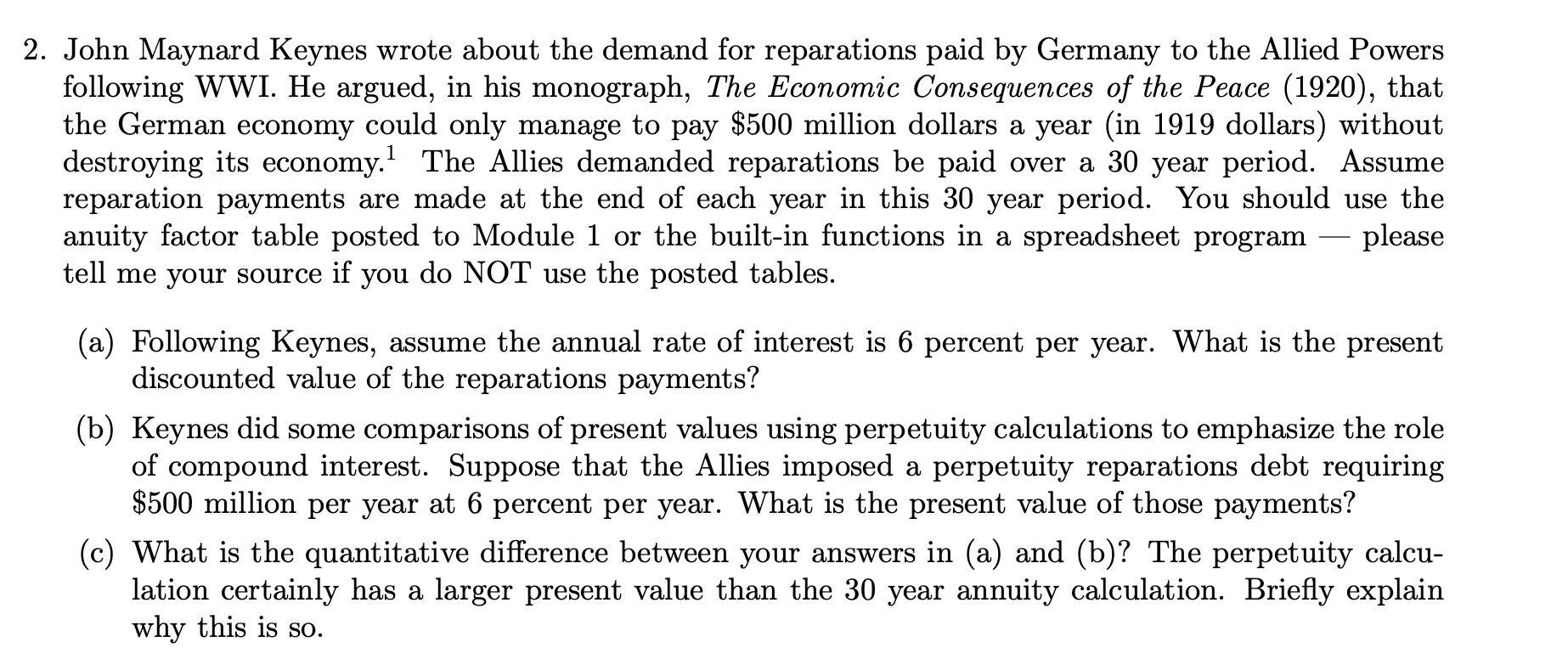
2. John Maynard Keynes wrote about the demand for reparations paid by Germany to the Allied Powers following WWI. He argued, in his monograph, The Economic Consequences of the Peace (1920), that the German economy could only manage to pay $500 million dollars a year (in 1919 dollars) without destroying its economy. The Allies demanded reparations be paid over a 30 year period. Assume reparation payments are made at the end of each year in this 30 year period. You should use the anuity factor table posted to Module 1 or the built-in functions in a spreadsheet program please tell me your source if you do NOT use the posted tables. (a) Following Keynes, assume the annual rate of interest is 6 percent per year. What is the present discounted value of the reparations payments? (b) Keynes did some comparisons of present values using perpetuity calculations to emphasize the role of compound interest. Suppose that the Allies imposed a perpetuity reparations debt requiring $500 million per year at 6 percent per year. What is the present value of those payments? (c) What is the quantitative difference between your answers in (a) and (b)? The perpetuity calcu- lation certainly has a larger present value than the 30 year annuity calculation. Briefly explain why this is so
Step by Step Solution
There are 3 Steps involved in it

Get step-by-step solutions from verified subject matter experts