







Question: 2. Let u(x, y, z) be a solution to the Laplace Problem: u = 0 (x,y,z) u(x, y,x,z) = f(x,y,z) (x, y, z) an.
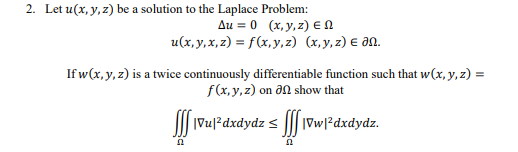
2. Let u(x, y, z) be a solution to the Laplace Problem: u = 0 (x,y,z) u(x, y,x,z) = f(x,y,z) (x, y, z) an. If w(x, y, z) is a twice continuously differentiable function such that w(x, y, z) = f(x, y, z) on an show that vw|dxdydz. 22 Vudxdydz 22
Step by Step Solution
There are 3 Steps involved in it
1 Expert Approved Answer
Step: 1 Unlock

Question Has Been Solved by an Expert!
Get step-by-step solutions from verified subject matter experts
Step: 2 Unlock
Step: 3 Unlock
 Study Help