







Question: H do (1) Let A = CON Find an orthogonal basis for U = im A. a + z = 2w (2) Let U =
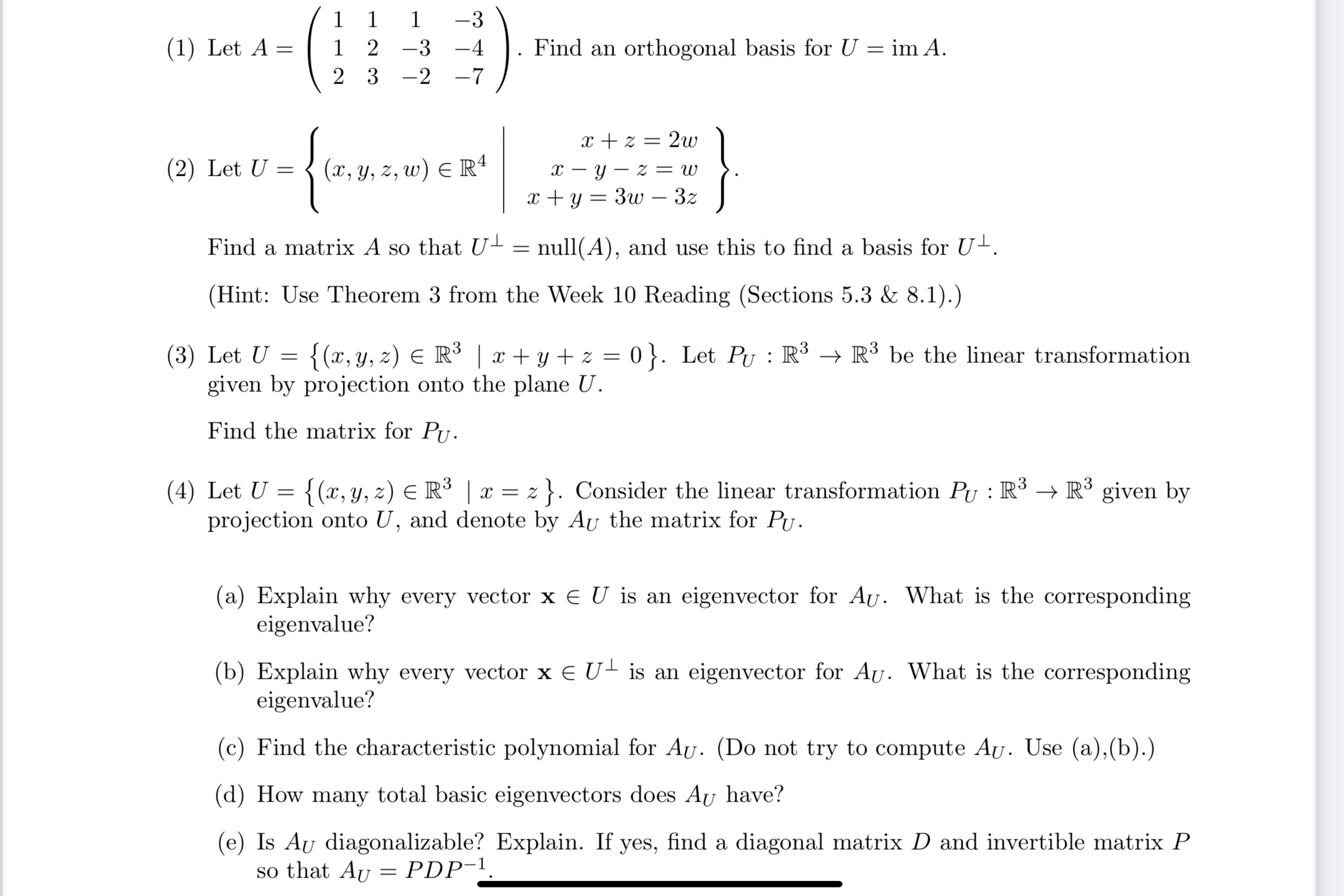
H do (1) Let A = CON Find an orthogonal basis for U = im A. a + z = 2w (2) Let U = (x, y, 2, w) ER4 x - y - z= w xty = 3w - 3z Find a matrix A so that U- = null(A), and use this to find a basis for UL. (Hint: Use Theorem 3 from the Week 10 Reading (Sections 5.3 & 8.1).) (3) Let U = {(x, y, z) ER3 [ xty+ z =0}. Let Py : R3 - R3 be the linear transformation given by projection onto the plane U. Find the matrix for Pu. (4) Let U = {(x, y, z) ER3 | x = z}. Consider the linear transformation Py : R3 - R' given by projection onto U, and denote by Au the matrix for Pu. (a) Explain why every vector x E U is an eigenvector for Au. What is the corresponding eigenvalue? (b) Explain why every vector x E UP is an eigenvector for Au. What is the corresponding eigenvalue? (c) Find the characteristic polynomial for Au. (Do not try to compute Au. Use (a), (b).) (d) How many total basic eigenvectors does Au have? (e) Is Au diagonalizable? Explain. If yes, find a diagonal matrix D and invertible matrix P so that Au = PDP-1
Step by Step Solution
There are 3 Steps involved in it

Get step-by-step solutions from verified subject matter experts
 Study Help