







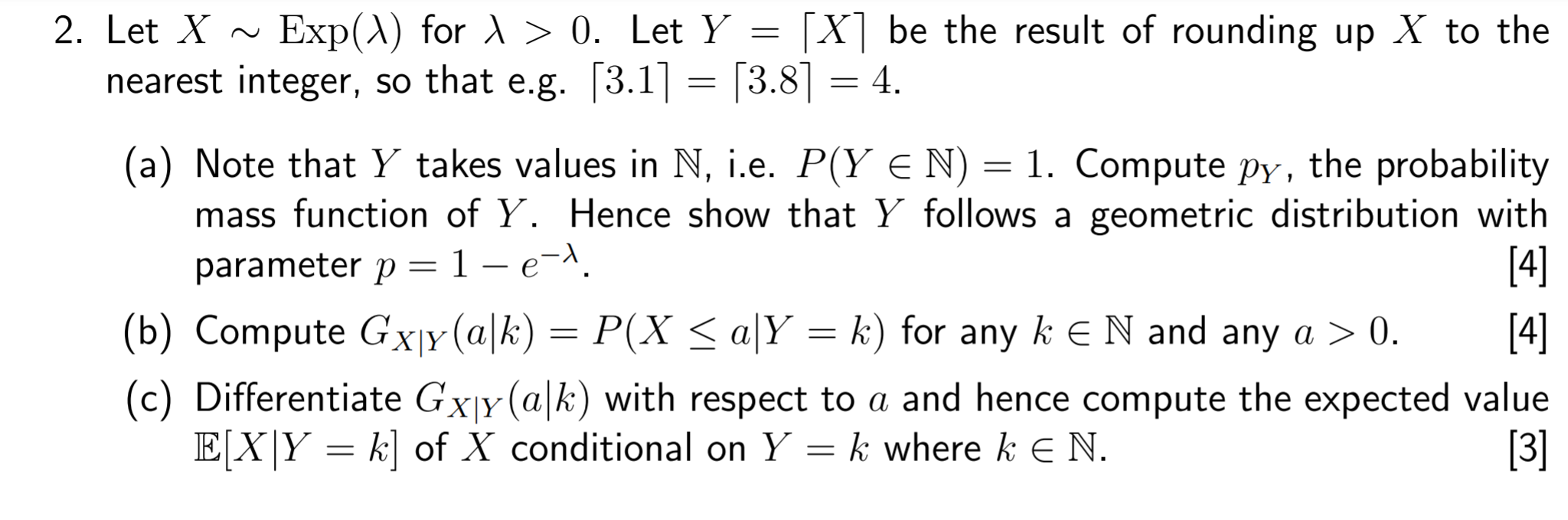
Question: 2. Let X Exp() for > 0. Let Y = [X] be the result of rounding up X to the nearest integer, so that e.g.
![2. Let X Exp() for > 0. Let Y = [X]](https://s3.amazonaws.com/si.experts.images/answers/2024/06/667e43c9165ed_920667e43c8ea4ea.jpg)
2. Let X Exp() for > 0. Let Y = [X] be the result of rounding up X to the nearest integer, so that e.g. [3.1] = [3.8] = 4
(a) Note that Y takes values in N, i.e. P(Y N) = 1. Compute pY , the probability mass function of Y . Hence show that Y follows a geometric distribution with parameter p = 1 exp( )
(It's OK to jump this question since I am confident about it)
(b) Compute GX|Y (a|k) = P(X a|Y = k) for any k N and any a > 0
(G is the generating function)
(c) Differentiate GX|Y (a|k) with respect to a and hence compute the expected value E[X|Y = k] of X conditional on Y = k where k N
(d) Show that EY [E[X|Y ]] = E[X] holds by considering the left and the right-hand side of this expression independently. Do not rely on the iterated conditional expectation formula for this calculation. Produce of word-processed (not handwritten!) explanation of why the area under the curve g(x) = xfX(x) can be written as EY [E[X|Y ]]. Your explanation should connect the notion of integral, area under the curve g, and how this area is split up by EY .
Please answer the above question as this is regarded as one whole question. Really appreciate your help and support.
![that e.g. [3.1] = [3.8] = 4(a) Note that Y takes values](https://s3.amazonaws.com/si.experts.images/answers/2024/06/667e43ca181e7_921667e43c9e7e86.jpg)
2. Let X N Exp()\\) for A > 0. Let Y : [X] be the result of rounding up X to the nearest integer, so that e.g. [3.1] = [3.8] = 4. (a) Note that Y takes values in N, i.e. P(Y E N) = 1. Compute py, the probability mass function of Y. Hence show that Y follows a geometric distribution with parameter p = 1 e')'. [4] (b) Compute GX|y(a|k) = P(X g alY = k) for any k E N and any a > 0. [4] (c) Differentiate GX|y(a,|k) with respect to a and hence compute the expected value IE[X|Y = k] of X conditional on Y : k where k E N. [3] CD Show that IEY [lE[X|Y]] = ]E[X] holds by considering the left and the right hand side of this expression independently. Do not rely on the iterated conditional expectation formula for this calculation. Produce of word-processed (not hand- written!) explanation of why the area under the curve g(a:) = :cfX(a:) can be written as Ey [IE[X|Y]]. Your explanation should connect the notion of integral, area under the curve 9 and how this area is split up by By. [4]
Step by Step Solution
There are 3 Steps involved in it

Get step-by-step solutions from verified subject matter experts
 Study Help