



Question: 2. Let X(t) and Y(t) be both zero-mean WSS random processes. Consider the random process Z(t)=x(t)+Y(t). Determine 3. (a) Auto correlation function and Power
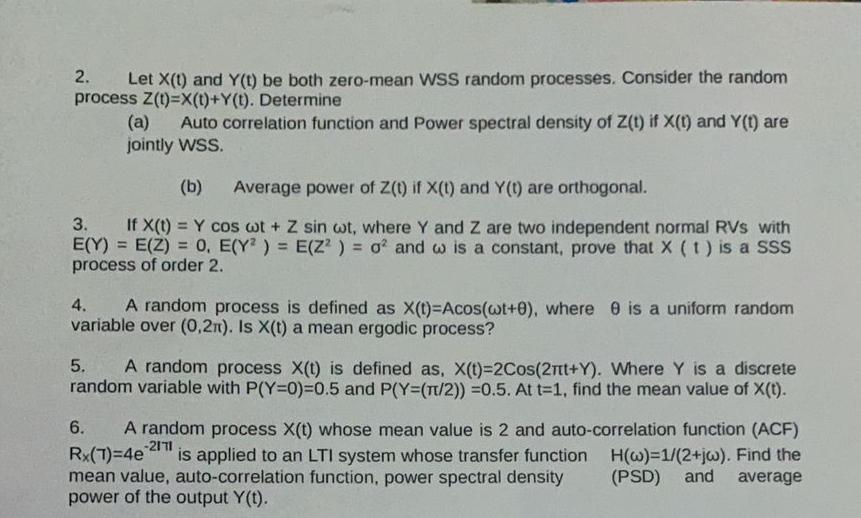
2. Let X(t) and Y(t) be both zero-mean WSS random processes. Consider the random process Z(t)=x(t)+Y(t). Determine 3. (a) Auto correlation function and Power spectral density of Z(t) if X(t) and Y(t) are jointly WSS. (b) Average power of Z(t) if X(t) and Y(t) are orthogonal. If X(t) = Y cos wt + Z sin wt, where Y and Z are two independent normal RVs with E(Y) =E(Z) = 0, E(Y2) = E(Z2) = 02 and w is a constant, prove that X (1) is a SSS process of order 2. 4. A random process is defined as X(t)=Acos(wt+0), where 0 is a uniform random variable over (0,2). Is X(t) a mean ergodic process? 5. A random process X(t) is defined as, x(t)=2Cos(2t+Y). Where Y is a discrete random variable with P(Y=0)=0.5 and P(Y=(/2)) =0.5. At t=1, find the mean value of x(t). 6. A random process X(t) whose mean value is 2 and auto-correlation function (ACF) Rx(1)=4e is applied to an LTI system whose transfer function -21T1 mean value, auto-correlation function, power spectral density power of the output Y(t). H(w)=1/(2+jw). Find the (PSD) and average
Step by Step Solution
There are 3 Steps involved in it

Get step-by-step solutions from verified subject matter experts