





Question: 4. Let X(t) be a stationary Gaussian random process with mean zero and autocorrelation function Rx(T) = 20sinc-(807). Let Y(t) = 4 cos(2 30t) +
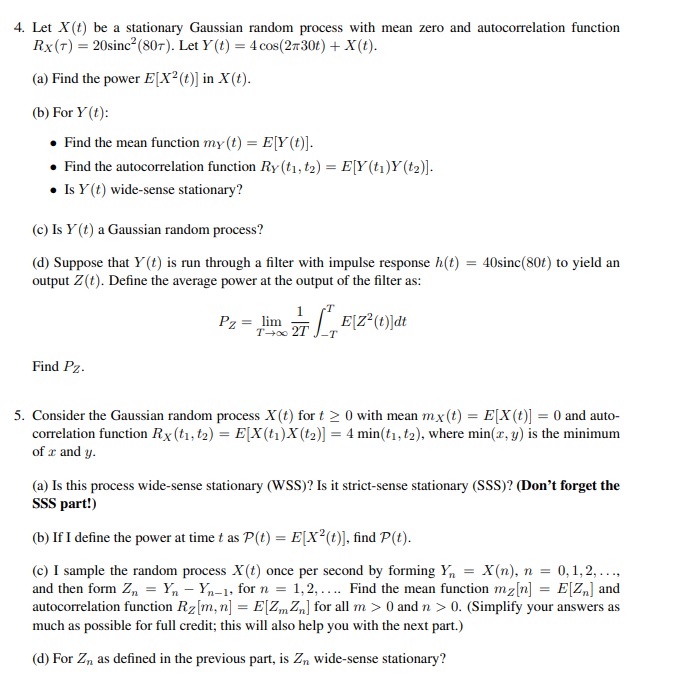
4. Let X(t) be a stationary Gaussian random
4. Let X(t) be a stationary Gaussian random process with mean zero and autocorrelation function Rx(T) = 20sinc-(807). Let Y(t) = 4 cos(2 30t) + X(t). (a) Find the power E[X2 (t)] in X(t). (b) For Y(t): . Find the mean function my (t) = E[Y ()]. . Find the autocorrelation function Ry (t1, t2) = E[Y (t)Y(t2)]. . Is Y (t) wide-sense stationary? (c) Is Y (t) a Gaussian random process? (d) Suppose that Y (t) is run through a filter with impulse response h(t) = 40sinc(80t) to yield an output Z(t). Define the average power at the output of the filter as: Pz = lim Find Pz- 5. Consider the Gaussian random process X(t) for t 2 0 with mean mx (t) = E[X(t)] = 0 and auto- correlation function Rx (1, t2) = E[X(1)X(t2)] = 4 min(t1, 12), where min(x, y) is the minimum of x and y. (a) Is this process wide-sense stationary (WSS)? Is it strict-sense stationary (SSS)? (Don't forget the SSS part!) (b) If I define the power at time t as P(t) = E[X2(t)], find P(t). (c) I sample the random process X(t) once per second by forming Y, = X(n), n = 0, 1, 2, ..., and then form Z, = Ym - Ym-1, for n = 1, 2, .... Find the mean function mz[n] = E[Z,] and autocorrelation function Rz[m, n] = E[ZmZ,] for all m > 0 and n > 0. (Simplify your answers as much as possible for full credit; this will also help you with the next part.) (d) For Zn as defined in the previous part, is Zn wide-sense stationary

Step by Step Solution

There are 3 Steps involved in it

1 Expert Approved Answer
Step: 1 Unlock blur-text-image

Question Has Been Solved by an Expert!

Get step-by-step solutions from verified subject matter experts

Step: 2 Unlock
Step: 3 Unlock

Students Have Also Explored These Related Mathematics Questions!