







Question: (2) Let Y be a dummy (indicator) variable that is equal to one if a California voter plans to vote YES on a ballot proposition.
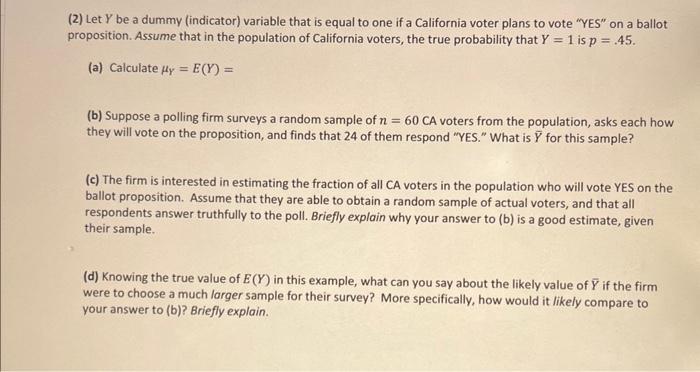
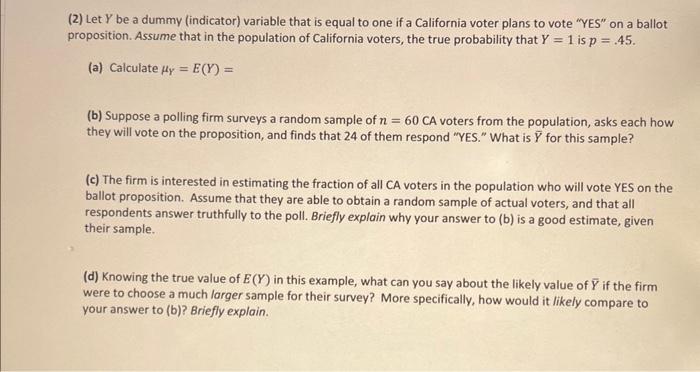
(2) Let Y be a dummy (indicator) variable that is equal to one if a California voter plans to vote "YES" on a ballot proposition. Assume that in the population of California voters, the true probability that Y = 1 is p = .45. (a) Calculate My = E(Y) = (b) Suppose a polling firm surveys a random sample of n = 60 CA voters from the population, asks each how they will vote on the proposition, and finds that 24 of them respond "YES." What is Y for this sample? (c) The firm is interested in estimating the fraction of all CA voters in the population who will vote YES on the ballot proposition. Assume that they are able to obtain a random sample of actual voters, and that all respondents answer truthfully to the poll. Briefly explain why your answer to (b) is a good estimate, given their sample. (d) Knowing the true value of E(Y) in this example, what can you say about the likely value of Y if the firm were to choose a much larger sample for their survey? More specifically, how would it likely compare to your answer to (b)? Briefly explain
Step by Step Solution
There are 3 Steps involved in it

Get step-by-step solutions from verified subject matter experts
 Study Help