







Question: 2. Margarita Robotics has a daily production function given by Q = K0'5L0'5, where K is the monthly num- ber of hours of use for
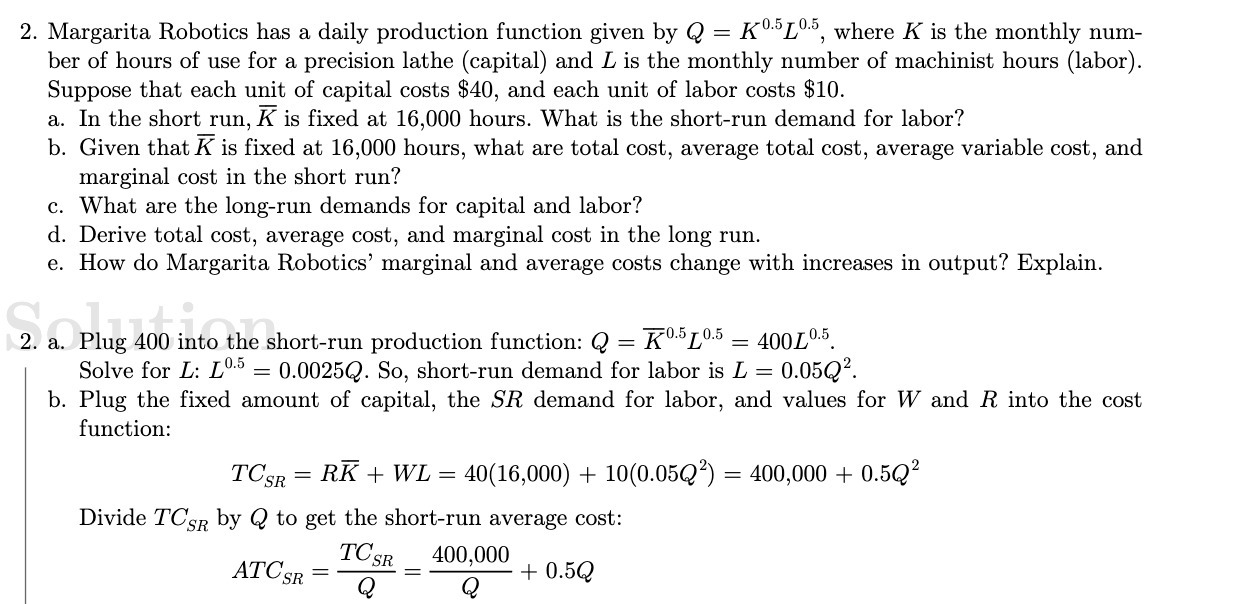
2. Margarita Robotics has a daily production function given by Q = K0'5L0'5, where K is the monthly num- ber of hours of use for a precision lathe (capital) and L is the monthly number of machinist hours (labor). Suppose that each unit of capital costs $40, and each unit of labor costs $10. a. In the short run, I? is fixed at 16,000 hours. What is the short-run demand for labor? b. Given that}? is fixed at 16,000 hours, what are total cost, average total cost, average variable cost, and marginal cost in the short run? c. What are the long-run demands for capital and labor? 6:. Derive total cost, average cost, and marginal cost in the long run. How do Margarita Robotics\" marginal and average costs change with increases in output? Explain. 5'\" 2. a. Plug 400 into the short-run production function: Q = KD'ELO'S = 400LD'5. Solve for L: 4150'5 = 0.002562. So, short-run demand for labor is L = 0.05Q2. b. Plug the fixed amount of capital, the SR demand for labor, and values for W and R into the cost function: TCSR = Br? + WL = 40(16,000) + 10(0.05Q2) = 400,000 + 0.5022 Divide TCSR by Q to get the short-run average cost: T03R 400,000 Q Q ATCSR = + 0.562
Step by Step Solution
There are 3 Steps involved in it

Get step-by-step solutions from verified subject matter experts
 Study Help