







Question: 2. Now your boss asks you to do sensitivity analysis (for the project in Question 1), focusing on how the change in the GP (variable)

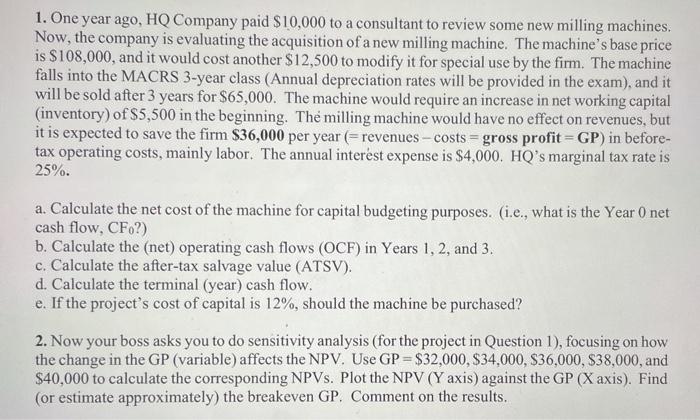
2. Now your boss asks you to do sensitivity analysis (for the project in Question 1), focusing on how the change in the GP (variable) affects the NPV, Use GP=$32,000, $34,000, $36,000, $38,000, and $40,000 to calculate the corresponding NPVs. Plot the NPV (Y axis) against the GP (X axis). Find (or estimate approximately) the breakeven GP. Comment on the results. 1. One year ago, HQ Company paid $10,000 to a consultant to review some new milling machines. Now, the company is evaluating the acquisition of a new milling machine. The machine's base price is $108,000, and it would cost another $12,500 to modify it for special use by the firm. The machine falls into the MACRS 3-year class (Annual depreciation rates will be provided in the exam), and it will be sold after 3 years for $65,000. The machine would require an increase in net working capital (inventory) of $5,500 in the beginning. The milling machine would have no effect on revenues, but it is expected to save the firm $36,000 per year (= revenues-costs = gross profit=GP) in before- tax operating costs, mainly labor. The annual interst expense is $4,000. HQ's marginal tax rate is 25%. a. Calculate the net cost of the machine for capital budgeting purposes. (i.e., what is the Year 0 net cash flow, CFo?) b. Calculate the (net) operating cash flows (OCF) in Years 1, 2, and 3. c. Calculate the after-tax salvage value (ATSV). d. Calculate the terminal (year) cash flow. e. If the project's cost of capital is 12%, should the machine be purchased? 2. Now your boss asks you to do sensitivity analysis (for the project in Question 1), focusing on how the change in the GP (variable) affects the NPV. Use GP = $32,000, 534,000, S36,000, 838,000, and $40,000 to calculate the corresponding NPVs. Plot the NPV (Y axis) against the GP (X axis). Find (or estimate approximately) the breakeven GP. Comment on the results. 2. Now your boss asks you to do sensitivity analysis (for the project in Question 1), focusing on how the change in the GP (variable) affects the NPV, Use GP=$32,000, $34,000, $36,000, $38,000, and $40,000 to calculate the corresponding NPVs. Plot the NPV (Y axis) against the GP (X axis). Find (or estimate approximately) the breakeven GP. Comment on the results. 1. One year ago, HQ Company paid $10,000 to a consultant to review some new milling machines. Now, the company is evaluating the acquisition of a new milling machine. The machine's base price is $108,000, and it would cost another $12,500 to modify it for special use by the firm. The machine falls into the MACRS 3-year class (Annual depreciation rates will be provided in the exam), and it will be sold after 3 years for $65,000. The machine would require an increase in net working capital (inventory) of $5,500 in the beginning. The milling machine would have no effect on revenues, but it is expected to save the firm $36,000 per year (= revenues-costs = gross profit=GP) in before- tax operating costs, mainly labor. The annual interst expense is $4,000. HQ's marginal tax rate is 25%. a. Calculate the net cost of the machine for capital budgeting purposes. (i.e., what is the Year 0 net cash flow, CFo?) b. Calculate the (net) operating cash flows (OCF) in Years 1, 2, and 3. c. Calculate the after-tax salvage value (ATSV). d. Calculate the terminal (year) cash flow. e. If the project's cost of capital is 12%, should the machine be purchased? 2. Now your boss asks you to do sensitivity analysis (for the project in Question 1), focusing on how the change in the GP (variable) affects the NPV. Use GP = $32,000, 534,000, S36,000, 838,000, and $40,000 to calculate the corresponding NPVs. Plot the NPV (Y axis) against the GP (X axis). Find (or estimate approximately) the breakeven GP. Comment on the results
Step by Step Solution
There are 3 Steps involved in it

Get step-by-step solutions from verified subject matter experts
 Study Help