





Question: 2. On most state highways, the fine for speeding depends on the speed of the car. In a certain state, suppose the fine as a
2. On most state highways, the fine for speeding
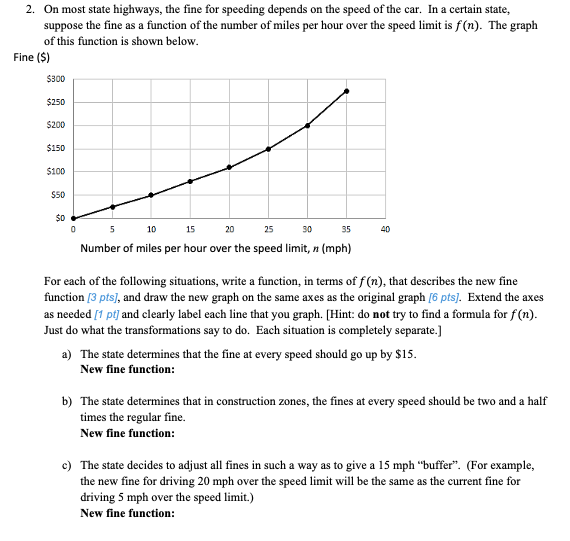
2. On most state highways, the fine for speeding depends on the speed of the car. In a certain state, suppose the fine as a function of the number of miles per hour over the speed limit is f (n). The graph of this function is shown below. Fine ($) $300 $250 $200 $150 $100 5SO $0 5 10 15 20 25 30 40 Number of miles per hour over the speed limit, a (mph) For each of the following situations, write a function, in terms of f (n), that describes the new fine function /3 pts], and draw the new graph on the same axes as the original graph /6 pts). Extend the axes as needed (1 pt] and clearly label each line that you graph. [ Hint: do not try to find a formula for f(n) Just do what the transformations say to do. Each situation is completely separate.] a) The state determines that the fine at every speed should go up by $15. New fine function: b) The state determines that in construction zones, the fines at every speed should be two and a half times the regular fine. New fine function: c) The state decides to adjust all fines in such a way as to give a 15 mph "buffer". (For example, the new fine for driving 20 mph over the speed limit will be the same as the current fine for driving 5 mph over the speed limit.) New fine function

Step by Step Solution

There are 3 Steps involved in it

1 Expert Approved Answer
Step: 1 Unlock blur-text-image
Question Has Been Solved by an Expert!

Get step-by-step solutions from verified subject matter experts

Step: 2 Unlock
Step: 3 Unlock

Students Have Also Explored These Related Mathematics Questions!