Question: 2 part question: Identify and describe the centralized procurement model. Identify and describe 3 challenges of this model. 2 part question: Identify and describe the
- 2 part question: Identify and describe the centralized procurement model. Identify and describe 3 challenges of this model.
- 2 part question: Identify and describe the decentralized procurement model. Identify and describe 3 advantages of this model.
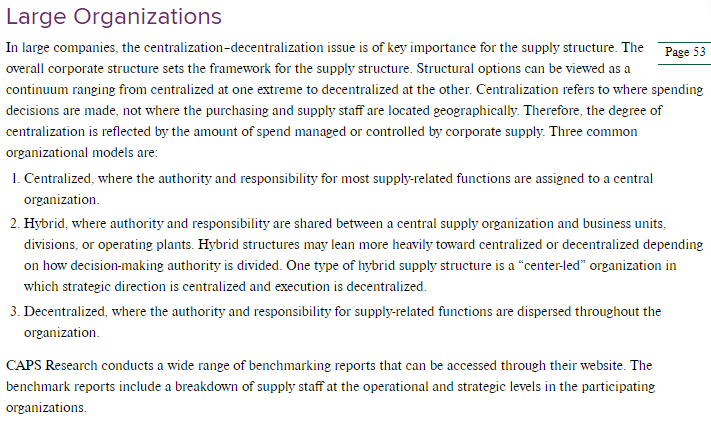
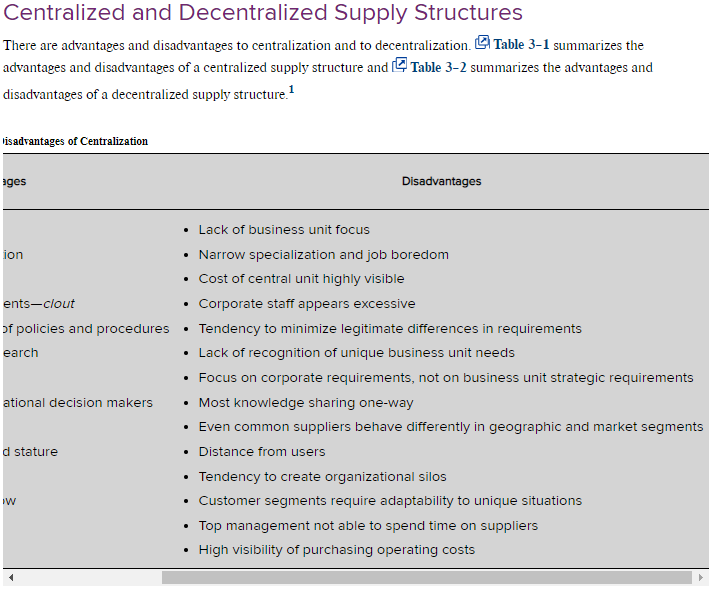
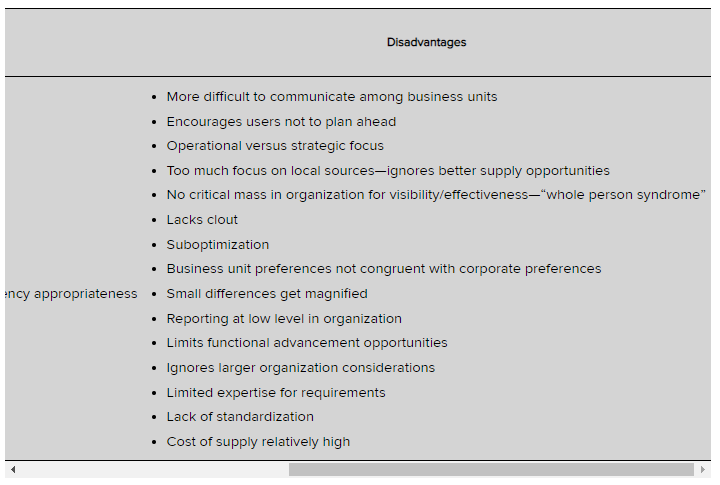
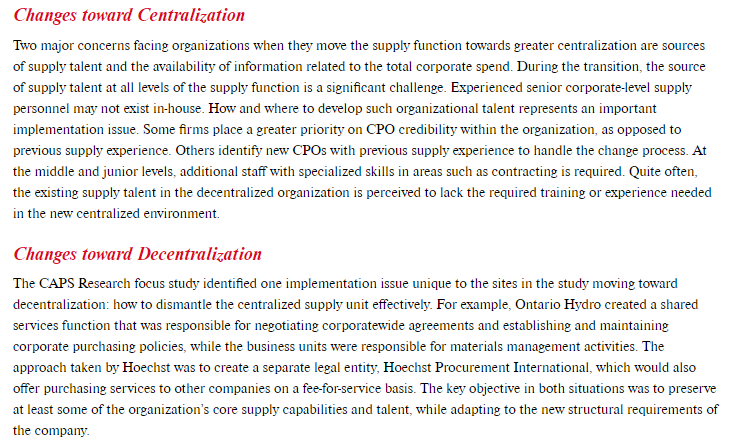
Large Organizations In large companies, the centralization-decentralization issue is of key importance for the supply structure. The Page 53 overall corporate structure sets the framework for the supply structure. Structural options can be viewed as a continuum ranging from centralized at one extreme to decentralized at the other. Centralization refers to where spending decisions are made, not where the purchasing and supply staff are located geographically. Therefore, the degree of centralization is reflected by the amount of spend managed or controlled by corporate supply. Three common organizational models are: 1. Centralized, where the authority and responsibility for most supply-related functions are assigned to a central organization 2. Hybrid, where authority and responsibility are shared between a central supply organization and business units, divisions, or operating plants. Hybrid structures may lean more heavily toward centralized or decentralized depending on how decision-making authority is divided. One type of hybrid supply structure is a "center-led" organization in which strategic direction is centralized and execution is decentralized. 3. Decentralized, where the authority and responsibility for supply-related functions are dispersed throughout the organization CAPS Research conducts a wide range of benchmarking reports that can be accessed through their website. The benchmark reports include a breakdown of supply staff at the operational and strategic levels in the participating organizations. Centralized and Decentralized Supply Structures There are advantages and disadvantages to centralization and to decentralization Table 3-1 summarizes the advantages and disadvantages of a centralized supply structure and Table 3-2 summarizes the advantages and disadvantages of a decentralized supply structure. 1 lisadvantages of Centralization ages Disadvantages Lack of business unit focus ion Narrow specialization and job boredom Cost of central unit highly visible ents-clout Corporate staff appears excessive of policies and procedures Tendency to minimize legitimate differences in requirements earch Lack of recognition of unique business unit needs Focus on corporate requirements, not on business unit strategic requirements ational decision makers Most knowledge sharing one-way Even common suppliers behave differently in geographic and market segments d stature Distance from users Tendency to create organizational silos Customer segments require adaptability to unique situations Top management not able to spend time on suppliers High visibility of purchasing operating costs w Disadvantages . More difficult to communicate among business units Encourages users not to plan ahead Operational versus strategic focus Too much focus on local sources,ignores better supply opportunities No critical mass in organization for visibility/effectiveness,"whole person syndrome" Lacks clout Suboptimization Business unit preferences not congruent with corporate preferences Ency appropriateness Small differences get magnified Reporting at low level in organization Limits functional advancement opportunities Ignores larger organization considerations Limited expertise for requirements Lack of standardization Cost of supply relatively high Changes toward Centralization Two major concerns facing organizations when they move the supply function towards greater centralization are sources of supply talent and the availability of information related to the total corporate spend. During the transition, the source of supply talent at all levels of the supply function is a significant challenge. Experienced senior corporate-level supply personnel may not exist in-house. How and where to develop such organizational talent represents an important implementation issue. Some firms place a greater priority on CPO credibility within the organization, as opposed to previous supply experience. Others identify new CPOs with previous supply experience to handle the change process. At the middle and junior levels, additional staff with specialized skills in areas such as contracting is required. Quite often, the existing supply talent in the decentralized organization is perceived to lack the required training or experience needed in the new centralized environment. Changes toward Decentralization The CAPS Research focus study identified one implementation issue unique to the sites in the study moving toward decentralization: how to dismantle the centralized supply unit effectively. For example, Ontario Hydro created a shared services function that was responsible for negotiating corporatewide agreements and establishing and maintaining corporate purchasing policies, while the business units were responsible for materials management activities. The approach taken by Hoechst was to create a separate legal entity, Hoechst Procurement International, which would also offer purchasing services to other companies on a fee-for-service basis. The key objective in both situations was to preserve at least some of the organization's core supply capabilities and talent, while adapting to the new structural requirements of the company









 Study Help