







Question: . 2. PERSONAL CHARACTERISTICS The correlation between personal characteristics and leadership marked theoretical approaches to leadership in the early twentieth century by the theory of
.
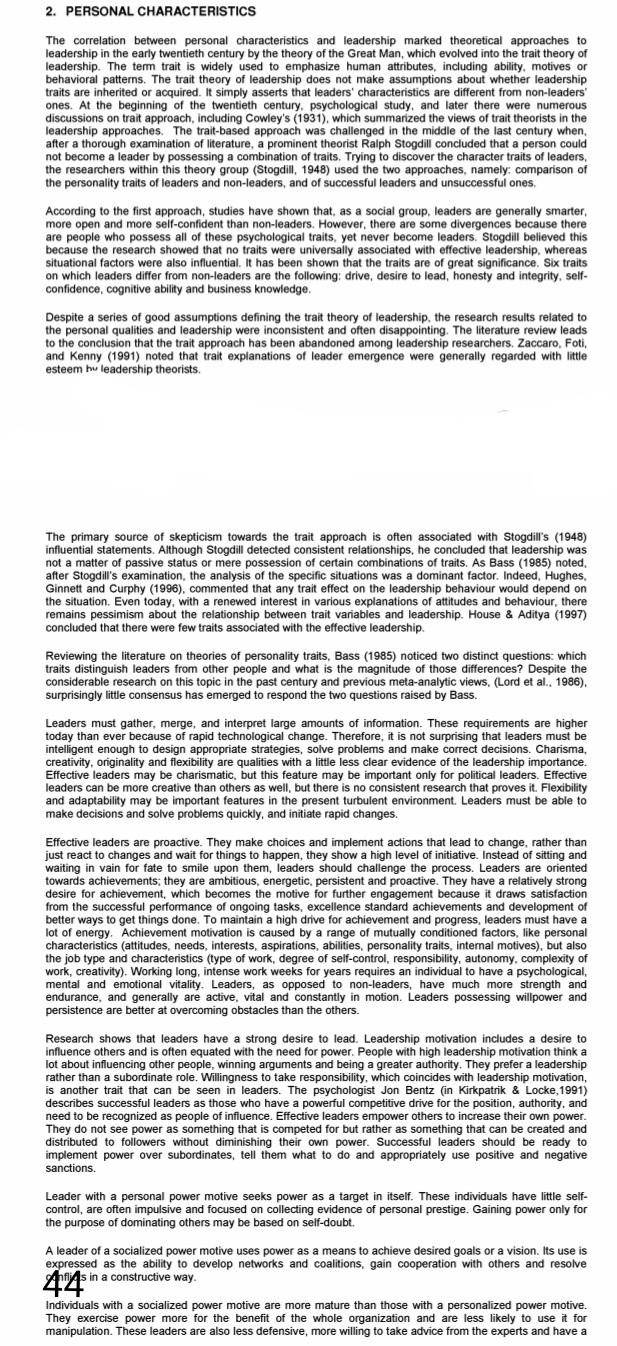
2. PERSONAL CHARACTERISTICS The correlation between personal characteristics and leadership marked theoretical approaches to leadership in the early twentieth century by the theory of the Great Man, which evolved into the trait theory of leadership. The term trait is widely used to emphasize human attributes, including ability, motives or behavioral patterns. The trait theory of leadership does not make assumptions about whether leadership traits are inherited or acquired. It simply asserts that leaders' characteristics are different from non-leaders' ones. At the beginning of the twentieth century, psychological study, and later there were numerous discussions on trait approach, including Cowley's (1931), which summarized the views of trait theorists in the leadership approaches. The trait-based approach was challenged in the middle of the last century when after a thorough examination of literature, a prominent theorist Ralph Stogdill concluded that a person could not become a leader by possessing a combination of traits. Trying to discover the character traits of leaders, the researchers within this theory group (Stogdill, 1948) used the two approaches, namely, comparison of the personality traits of leaders and non-leaders, and of successful leaders and unsuccessful ones, According to the first approach, studies have shown that, as a social group, leaders are generally smarter, more open and more self-confident than non-leaders. However, there are some divergences because there are people who possess all of these psychological traits, yet never become leaders. Stogdill believed this because the research showed that no traits were universally associated with effective leadership, whereas situational factors were also influential. It has been shown that the traits are of great significance. Six traits on which leaders differ from non-leaders are the following: drive, desire to lead, honesty and integrity, self- confidence, cognitive ability and business knowledge Despite a series of good assumptions defining the trait theory of leadership, the research results related to the personal qualities and leadership were inconsistent and often disappointing. The literature review leads to the conclusion that the trait approach has been abandoned among leadership researchers. Zaccaro, Foti, and Kenny (1991) noted that trait explanations of leader emergence were generally regarded with little esteem hu leadership theorists The primary source of skepticism towards the trait approach is often associated with Stogdill's (1948) influential statements. Although Stogdill detected consistent relationships, he concluded that leadership was not a matter of passive status or mere possession of certain combinations of traits. As Bass (1985) noted. after Stogdill's examination, the analysis of the specific situations was a dominant factor. Indeed, Hughes Ginnett and Curphy (1996), commented that any trait effect on the leadership behaviour would depend on the situation. Even today, with a renewed interest in various explanations of attitudes and behaviour, there remains pessimism about the relationship between trait variables and leadership. House & Aditya (1997) concluded that there were few traits associated with the effective leadership. Reviewing the literature on theories of personality traits, Bass (1985) noticed two distinct questions which traits distinguish leaders from other people and what is the magnitude of those differences? Despite the considerable research on this topic in the past century and previous meta-analytic views, (Lord et al., 1986). surprisingly little consensus has emerged to respond the two questions raised by Bass. Leaders must gather, merge, and interpret large amounts of information. These requirements are higher today than ever because of rapid technological change. Therefore, it is not surprising that leaders must be intelligent enough to design appropriate strategies, solve problems and make correct decisions. Charisma, creativity, orginality and flexibility are qualities with a little less clear evidence of the leadership importance. Effective leaders may be charismatic, but this feature may be important only for political leaders. Effective leaders can be more creative than others as well, but there is no consistent research that proves it. Flexibility and adaptability may be important features in the present turbulent environment. Leaders must be able to make decisions and solve problems quickly, and initiate rapid changes. Effective leaders are proactive. They make choices and implement actions that lead to change, rather than just react to changes and wait for things to happen, they show a high level of initiative. Instead of sitting and waiting in vain for fate to smile upon them, leaders should challenge the process. Leaders are oriented towards achievements, they are ambitious, energetic, persistent and proactive. They have a relatively strong desire for achievement, which becomes the motive for further engagement because it draws satisfaction from the successful performance of ongoing tasks, excellence standard achievements and development of better ways to get things done. To maintain a high drive for achievement and progress, leaders must have a lot of energy. Achievement motivation is caused by a range of mutually conditioned factors, like personal characteristics (attitudes, needs, interests, aspirations, abilities, personality traits, internal motives), but also the job type and characteristics (type of work, degree of self-control, responsibility, autonomy, complexity of work, creativity). Working long, intense work weeks for years requires an individual to have a psychological, mental and emotional vitality. Leaders, as opposed to non-leaders, have much more strength and endurance, and generally are active, vital and constantly in motion. Leaders possessing willpower and persistence are better at overcoming obstacles than the others. Research shows that leaders have a strong desire to lead. Leadership motivation includes a desire to influence others and is often equated with the need for power. People with high leadership motivation think a lot about influencing other people, winning arguments and being a greater authority. They prefer a leadership rather than a subordinate role. Willingness to take responsibility, which coincides with leadership motivation, is another trait that can be seen in leaders. The psychologist Jon Bentz (in Kirkpatrik & Locke, 1991) describes successful leaders as those who have a powerful competitive drive for the position, authority, and need to be recognized as people of influence. Effective leaders empower others to increase their own power. They do not see power as something that is competed for but rather as something that can be created and distributed to followers without diminishing their own power. Successful leaders should be ready to implement power over subordinates, tell them what to do and appropriately use positive and negative sanctions. Leader with a personal power motive seeks power as a target in itself. These individuals have little self- control, are often impulsive and focused on collecting evidence of personal prestige. Gaining power only for the purpose of dominating others may be based on self-doubt. A leader of a socialized power motive uses power as a means to achieve desired goals or a vision. Its use is expressed as the ability to develop networks and coalitions, gain cooperation with others and resolve in a constructive way. 44 Individuals with a socialized power motive are more mature than those with a personalized power motive. They exercise power more for the benefit of the whole organization and are less likely to use it for manipulation. These leaders are also less defensive, more willing to take advice from the experts and have a 2. PERSONAL CHARACTERISTICS The correlation between personal characteristics and leadership marked theoretical approaches to leadership in the early twentieth century by the theory of the Great Man, which evolved into the trait theory of leadership. The term trait is widely used to emphasize human attributes, including ability, motives or behavioral patterns. The trait theory of leadership does not make assumptions about whether leadership traits are inherited or acquired. It simply asserts that leaders' characteristics are different from non-leaders' ones. At the beginning of the twentieth century, psychological study, and later there were numerous discussions on trait approach, including Cowley's (1931), which summarized the views of trait theorists in the leadership approaches. The trait-based approach was challenged in the middle of the last century when after a thorough examination of literature, a prominent theorist Ralph Stogdill concluded that a person could not become a leader by possessing a combination of traits. Trying to discover the character traits of leaders, the researchers within this theory group (Stogdill, 1948) used the two approaches, namely, comparison of the personality traits of leaders and non-leaders, and of successful leaders and unsuccessful ones, According to the first approach, studies have shown that, as a social group, leaders are generally smarter, more open and more self-confident than non-leaders. However, there are some divergences because there are people who possess all of these psychological traits, yet never become leaders. Stogdill believed this because the research showed that no traits were universally associated with effective leadership, whereas situational factors were also influential. It has been shown that the traits are of great significance. Six traits on which leaders differ from non-leaders are the following: drive, desire to lead, honesty and integrity, self- confidence, cognitive ability and business knowledge Despite a series of good assumptions defining the trait theory of leadership, the research results related to the personal qualities and leadership were inconsistent and often disappointing. The literature review leads to the conclusion that the trait approach has been abandoned among leadership researchers. Zaccaro, Foti, and Kenny (1991) noted that trait explanations of leader emergence were generally regarded with little esteem hu leadership theorists The primary source of skepticism towards the trait approach is often associated with Stogdill's (1948) influential statements. Although Stogdill detected consistent relationships, he concluded that leadership was not a matter of passive status or mere possession of certain combinations of traits. As Bass (1985) noted. after Stogdill's examination, the analysis of the specific situations was a dominant factor. Indeed, Hughes Ginnett and Curphy (1996), commented that any trait effect on the leadership behaviour would depend on the situation. Even today, with a renewed interest in various explanations of attitudes and behaviour, there remains pessimism about the relationship between trait variables and leadership. House & Aditya (1997) concluded that there were few traits associated with the effective leadership. Reviewing the literature on theories of personality traits, Bass (1985) noticed two distinct questions which traits distinguish leaders from other people and what is the magnitude of those differences? Despite the considerable research on this topic in the past century and previous meta-analytic views, (Lord et al., 1986). surprisingly little consensus has emerged to respond the two questions raised by Bass. Leaders must gather, merge, and interpret large amounts of information. These requirements are higher today than ever because of rapid technological change. Therefore, it is not surprising that leaders must be intelligent enough to design appropriate strategies, solve problems and make correct decisions. Charisma, creativity, orginality and flexibility are qualities with a little less clear evidence of the leadership importance. Effective leaders may be charismatic, but this feature may be important only for political leaders. Effective leaders can be more creative than others as well, but there is no consistent research that proves it. Flexibility and adaptability may be important features in the present turbulent environment. Leaders must be able to make decisions and solve problems quickly, and initiate rapid changes. Effective leaders are proactive. They make choices and implement actions that lead to change, rather than just react to changes and wait for things to happen, they show a high level of initiative. Instead of sitting and waiting in vain for fate to smile upon them, leaders should challenge the process. Leaders are oriented towards achievements, they are ambitious, energetic, persistent and proactive. They have a relatively strong desire for achievement, which becomes the motive for further engagement because it draws satisfaction from the successful performance of ongoing tasks, excellence standard achievements and development of better ways to get things done. To maintain a high drive for achievement and progress, leaders must have a lot of energy. Achievement motivation is caused by a range of mutually conditioned factors, like personal characteristics (attitudes, needs, interests, aspirations, abilities, personality traits, internal motives), but also the job type and characteristics (type of work, degree of self-control, responsibility, autonomy, complexity of work, creativity). Working long, intense work weeks for years requires an individual to have a psychological, mental and emotional vitality. Leaders, as opposed to non-leaders, have much more strength and endurance, and generally are active, vital and constantly in motion. Leaders possessing willpower and persistence are better at overcoming obstacles than the others. Research shows that leaders have a strong desire to lead. Leadership motivation includes a desire to influence others and is often equated with the need for power. People with high leadership motivation think a lot about influencing other people, winning arguments and being a greater authority. They prefer a leadership rather than a subordinate role. Willingness to take responsibility, which coincides with leadership motivation, is another trait that can be seen in leaders. The psychologist Jon Bentz (in Kirkpatrik & Locke, 1991) describes successful leaders as those who have a powerful competitive drive for the position, authority, and need to be recognized as people of influence. Effective leaders empower others to increase their own power. They do not see power as something that is competed for but rather as something that can be created and distributed to followers without diminishing their own power. Successful leaders should be ready to implement power over subordinates, tell them what to do and appropriately use positive and negative sanctions. Leader with a personal power motive seeks power as a target in itself. These individuals have little self- control, are often impulsive and focused on collecting evidence of personal prestige. Gaining power only for the purpose of dominating others may be based on self-doubt. A leader of a socialized power motive uses power as a means to achieve desired goals or a vision. Its use is expressed as the ability to develop networks and coalitions, gain cooperation with others and resolve in a constructive way. 44 Individuals with a socialized power motive are more mature than those with a personalized power motive. They exercise power more for the benefit of the whole organization and are less likely to use it for manipulation. These leaders are also less defensive, more willing to take advice from the experts and have aStep by Step Solution
There are 3 Steps involved in it
1 Expert Approved Answer
Step: 1 Unlock

Question Has Been Solved by an Expert!
Get step-by-step solutions from verified subject matter experts
Step: 2 Unlock
Step: 3 Unlock
 Study Help