



Question: 2 Problem 7-23 Comiskey Fence Co is evaluating extending credit to a new group of customers. Although these customers will provide $180,000 in additional credit
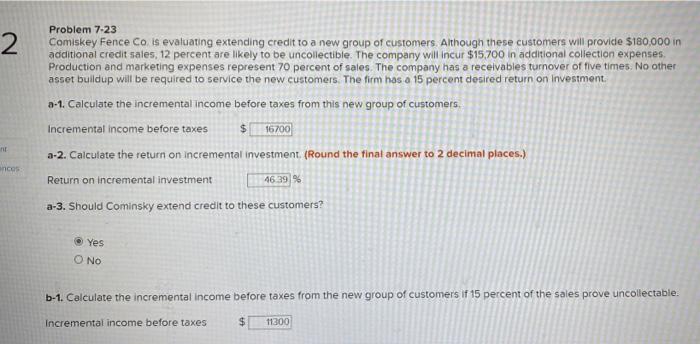
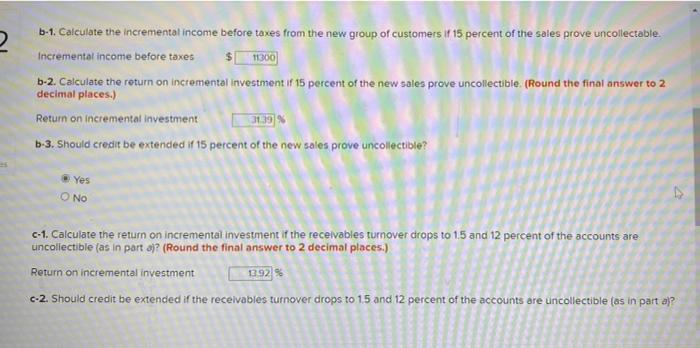
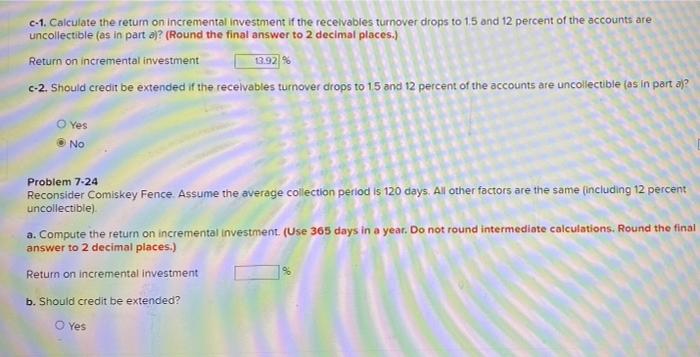
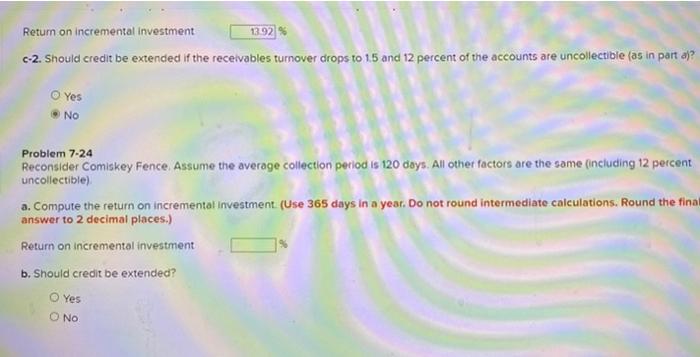
2 Problem 7-23 Comiskey Fence Co is evaluating extending credit to a new group of customers. Although these customers will provide $180,000 in additional credit sales, 12 percent are likely to be uncollectible. The company will incur $15.700 in additional collection expenses. Production and marketing expenses represent 70 percent of sales. The company has a receivables turnover of five times. No other asset buildup will be required to service the new customers. The firm has a 15 percent desired return on investment. 0-1. Calculate the incremental income before taxes from this new group of customers. Incremental income before taxes $ 16700 a-2. Calculate the return on incremental investment (Round the final answer to 2 decimal places.) Return on incremental investment 46.39% a-3. Should Cominsky extend credit to these customers? cos Yes O No b-1. Calculate the incremental income before taxes from the new group of customers if 15 percent of the sales prove uncollectable Incremental income before taxes $ 11300 $ 11300 b-1. Calculate the incremental income before taxes from the new group of customers if 15 percent of the sales prove uncollectable. Incremental income before taxes b-2. Calculate the return on incremental investment if 15 percent of the new sales prove uncollectible. (Round the final answer to 2 decimal places.) Return on incremental investment 31.39% b-3. Should credit be extended if 15 percent of the new sales prove uncollectible? Yes No c-1. Calculate the return on incremental investment if the receivables turnover drops to 1.5 and 12 percent of the accounts are uncollectible (as in part 6)? (Round the final answer to 2 decimal places.) Return on incremental investment 192% c-2. Should credit be extended if the receivables turnover drops to 15 and 12 percent of the accounts are uncollectible (os in part a? c-1. Calculate the return on incremental Investment if the receivables turnover drops to 15 and 12 percent of the accounts are uncollectible (as in part a)? (Round the final answer to 2 decimal places.) Return on incremental investment 13.92% c-2. Should credit be extended if the receivables turnover drops to 15 and 12 percent of the accounts are uncollectible (as in part al? Yes No Problem 7-24 Reconsider Comiskey Fence. Assume the average collection period is 120 days. All other factors are the same (including 12 percent uncollectible) a. Compute the return on incremental investment (Use 365 days in a year. Do not round intermediate calculations. Round the final answer to 2 decimal places.) Return on incremental investment % b. Should credit be extended? Yes Return on incremental investment 13 92 % c-2. Should credit be extended if the receivables turnover drops to 1.5 and 12 percent of the accounts are uncollectible (as in part a)? Yes No Problem 7-24 Reconsider Comiskey Fence Assume the average collection period is 120 days. All other factors are the same (including 12 percent uncollectible) a. Compute the return on incremental Investment (Use 365 days in a year. Do not round intermediate calculations. Round the final answer to 2 decimal places.) Return on incremental investment b. Should credit be extended? Yes NO
Step by Step Solution
There are 3 Steps involved in it

Get step-by-step solutions from verified subject matter experts