Question: 2 Product Placement Another setting in which this same type of ranking model is relevant is on Web sites that sell products to on-line shoppers.
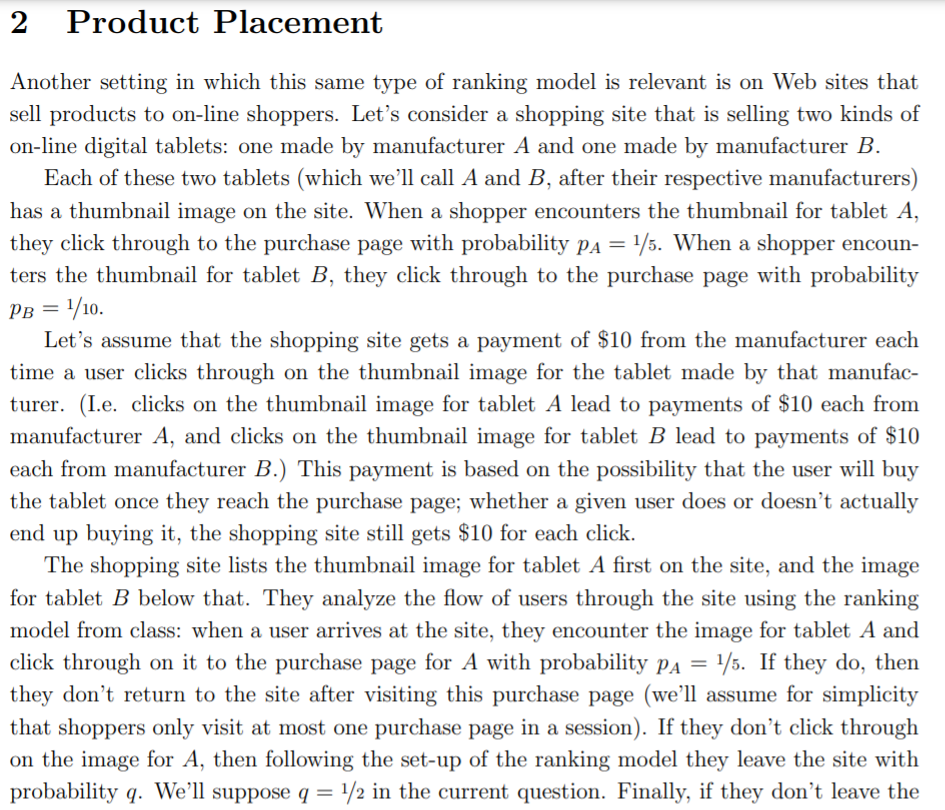
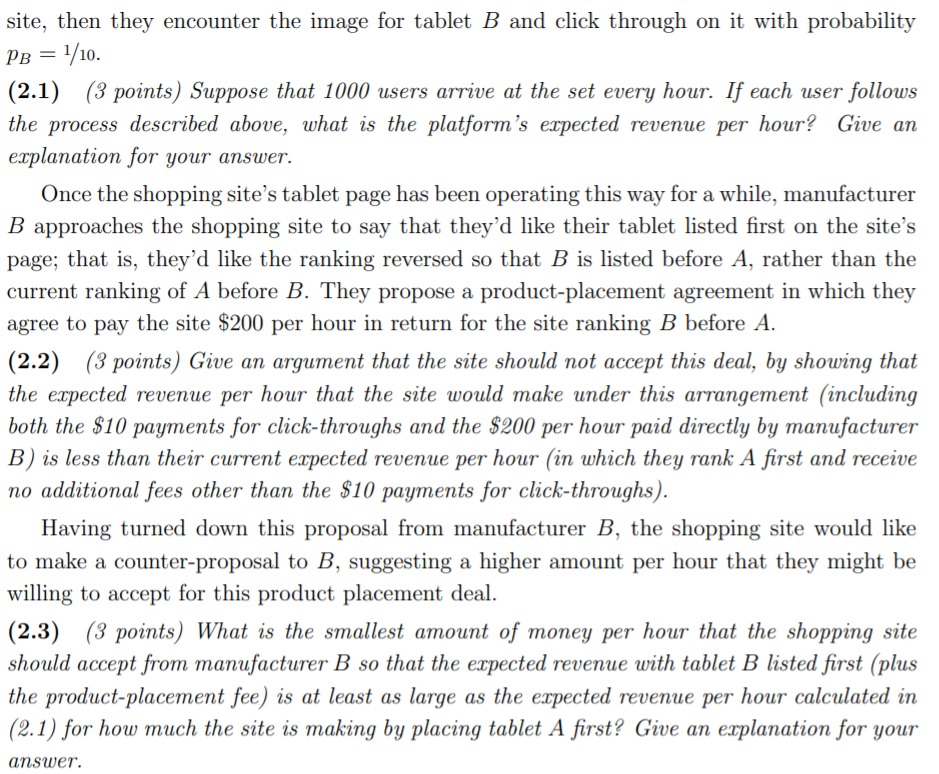
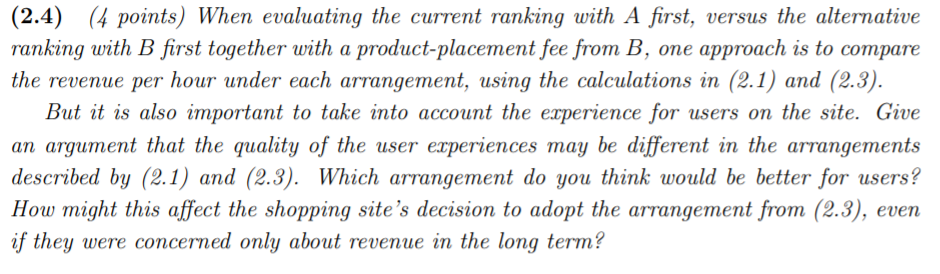
2 Product Placement Another setting in which this same type of ranking model is relevant is on Web sites that sell products to on-line shoppers. Let's consider a shopping site that is selling two kinds of on-line digital tablets: one made by manufacturer A and one made by manufacturer B. Each of these two tablets (which we'll call A and B, after their respective manufacturers) has a thumbnail image on the site. When a shopper encounters the thumbnail for tablet A, they click through to the purchase page with probability Pa = 1/5. When a shopper encoun- ters the thumbnail for tablet B, they click through to the purchase page with probability PB = 1/10. Let's assume that the shopping site gets a payment of $10 from the manufacturer each time a user clicks through on the thumbnail image for the tablet made by that manufac- turer. (I.e. clicks on the thumbnail image for tablet A lead to payments of $10 each from manufacturer A, and clicks on the thumbnail image for tablet B lead to payments of $10 each from manufacturer B.) This payment is based on the possibility that the user will buy the tablet once they reach the purchase page; whether a given user does or doesn't actually end up buying it, the shopping site still gets $10 for each click. The shopping site lists the thumbnail image for tablet A first on the site, and the image for tablet B below that. They analyze the flow of users through the site using the ranking model from class: when a user arrives at the site, they encounter the image for tablet A and click through on it to the purchase page for A with probability Pa = 1/5. If they do, then they don't return to the site after visiting this purchase page (we'll assume for simplicity that shoppers only visit at most one purchase page in a session). If they don't click through on the image for A, then following the set-up of the ranking model they leave the site with probability q. We'll suppose q = 1/2 in the current question. Finally, if they don't leave the = site, then they encounter the image for tablet B and click through on it with probability PB = 1/10. = (2.1) (3 points) Suppose that 1000 users arrive at the set every hour. If each user follows the process described above, what is the platform's expected revenue per hour? Give an explanation for your answer. Once the shopping site's tablet page has been operating this way for a while, manufacturer B approaches the shopping site to say that they'd like their tablet listed first on the site's page; that is, they'd like the ranking reversed so that B is listed before A, rather than the current ranking of A before B. They propose a product-placement agreement in which they agree to pay the site $200 per hour in return for the site ranking B before A. (2.2) (3 points) Give an argument that the site should not accept this deal, by showing that the expected revenue per hour that the site would make under this arrangement (including both the $10 payments for click-throughs and the $200 per hour paid directly by manufacturer B) is less than their current expected revenue per hour (in which they rank A first and receive no additional fees other than the $10 payments for click-throughs). Having turned down this proposal from manufacturer B, the shopping site would like to make a counter-proposal to B, suggesting a higher amount per hour that they might be willing to accept for this product placement deal. (2.3) (3 points) What is the smallest amount of money per hour that the shopping site should accept from manufacturer B so that the expected revenue with tablet B listed first (plus the product-placement fee) is at least as large as the expected revenue per hour calculated in (2.1) for how much the site is making by placing tablet A first? Give an explanation for your answer. (2.4) (4 points) When evaluating the current ranking with A first, versus the alternative ranking with B first together with a product-placement fee from B, one approach is to compare the revenue per hour under each arrangement, using the calculations in (2.1) and (2.3). But it is also important to take into account the experience for users on the site. Give an argument that the quality of the user experiences may be different in the arrangements described by (2.1) and (2.3). Which arrangement do you think would be better for users? How might this affect the shopping site's decision to adopt the arrangement from (2.3), even if they were concerned only about revenue in the long term? 2 Product Placement Another setting in which this same type of ranking model is relevant is on Web sites that sell products to on-line shoppers. Let's consider a shopping site that is selling two kinds of on-line digital tablets: one made by manufacturer A and one made by manufacturer B. Each of these two tablets (which we'll call A and B, after their respective manufacturers) has a thumbnail image on the site. When a shopper encounters the thumbnail for tablet A, they click through to the purchase page with probability Pa = 1/5. When a shopper encoun- ters the thumbnail for tablet B, they click through to the purchase page with probability PB = 1/10. Let's assume that the shopping site gets a payment of $10 from the manufacturer each time a user clicks through on the thumbnail image for the tablet made by that manufac- turer. (I.e. clicks on the thumbnail image for tablet A lead to payments of $10 each from manufacturer A, and clicks on the thumbnail image for tablet B lead to payments of $10 each from manufacturer B.) This payment is based on the possibility that the user will buy the tablet once they reach the purchase page; whether a given user does or doesn't actually end up buying it, the shopping site still gets $10 for each click. The shopping site lists the thumbnail image for tablet A first on the site, and the image for tablet B below that. They analyze the flow of users through the site using the ranking model from class: when a user arrives at the site, they encounter the image for tablet A and click through on it to the purchase page for A with probability Pa = 1/5. If they do, then they don't return to the site after visiting this purchase page (we'll assume for simplicity that shoppers only visit at most one purchase page in a session). If they don't click through on the image for A, then following the set-up of the ranking model they leave the site with probability q. We'll suppose q = 1/2 in the current question. Finally, if they don't leave the = site, then they encounter the image for tablet B and click through on it with probability PB = 1/10. = (2.1) (3 points) Suppose that 1000 users arrive at the set every hour. If each user follows the process described above, what is the platform's expected revenue per hour? Give an explanation for your answer. Once the shopping site's tablet page has been operating this way for a while, manufacturer B approaches the shopping site to say that they'd like their tablet listed first on the site's page; that is, they'd like the ranking reversed so that B is listed before A, rather than the current ranking of A before B. They propose a product-placement agreement in which they agree to pay the site $200 per hour in return for the site ranking B before A. (2.2) (3 points) Give an argument that the site should not accept this deal, by showing that the expected revenue per hour that the site would make under this arrangement (including both the $10 payments for click-throughs and the $200 per hour paid directly by manufacturer B) is less than their current expected revenue per hour (in which they rank A first and receive no additional fees other than the $10 payments for click-throughs). Having turned down this proposal from manufacturer B, the shopping site would like to make a counter-proposal to B, suggesting a higher amount per hour that they might be willing to accept for this product placement deal. (2.3) (3 points) What is the smallest amount of money per hour that the shopping site should accept from manufacturer B so that the expected revenue with tablet B listed first (plus the product-placement fee) is at least as large as the expected revenue per hour calculated in (2.1) for how much the site is making by placing tablet A first? Give an explanation for your answer. (2.4) (4 points) When evaluating the current ranking with A first, versus the alternative ranking with B first together with a product-placement fee from B, one approach is to compare the revenue per hour under each arrangement, using the calculations in (2.1) and (2.3). But it is also important to take into account the experience for users on the site. Give an argument that the quality of the user experiences may be different in the arrangements described by (2.1) and (2.3). Which arrangement do you think would be better for users? How might this affect the shopping site's decision to adopt the arrangement from (2.3), even if they were concerned only about revenue in the long term









 Study Help