







Question: 2. Question 2 (high-frequency trading arms-race). This question is based on the discussion about HFT in lecture 14. Suppose there are two market makers, 1
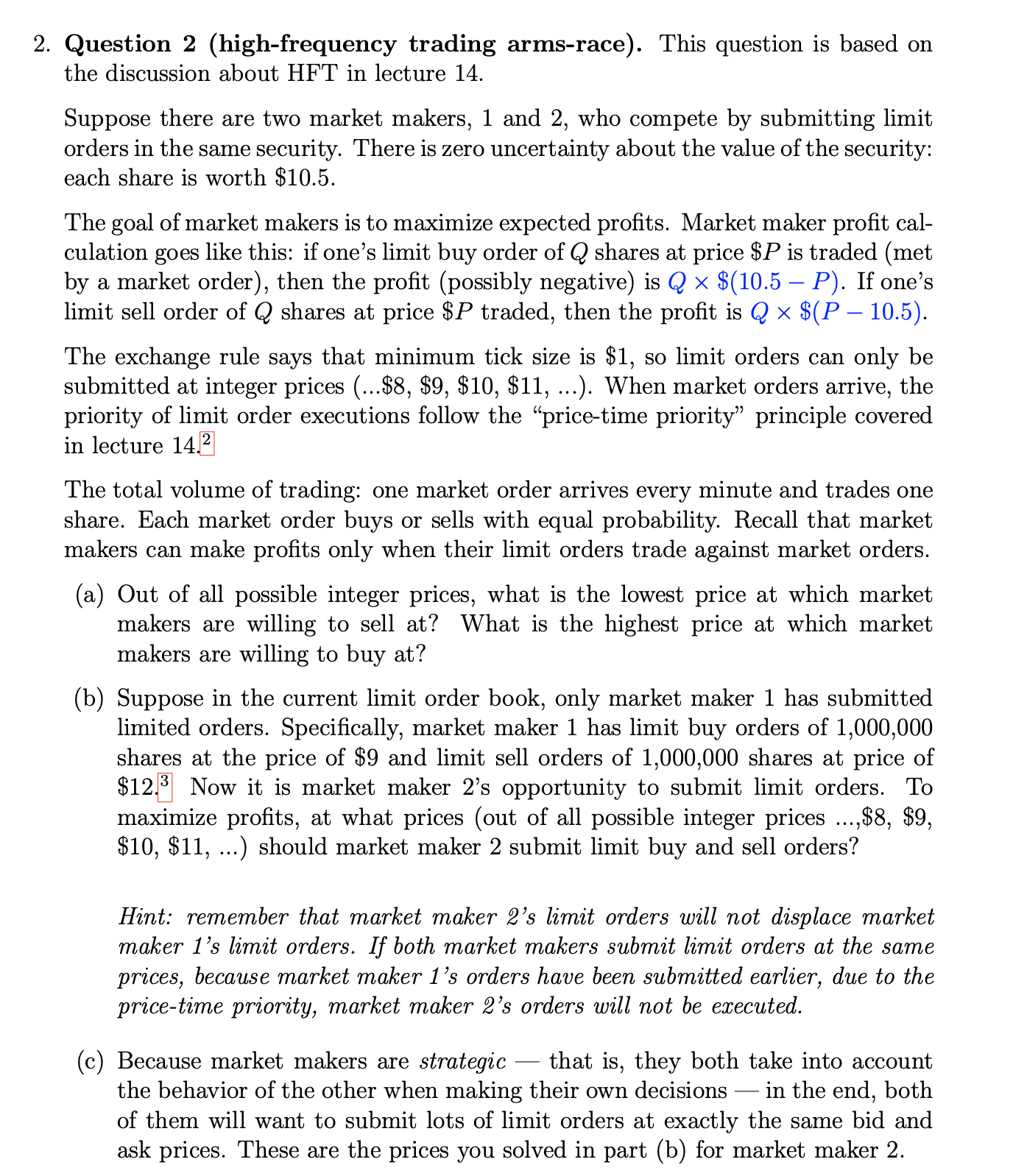
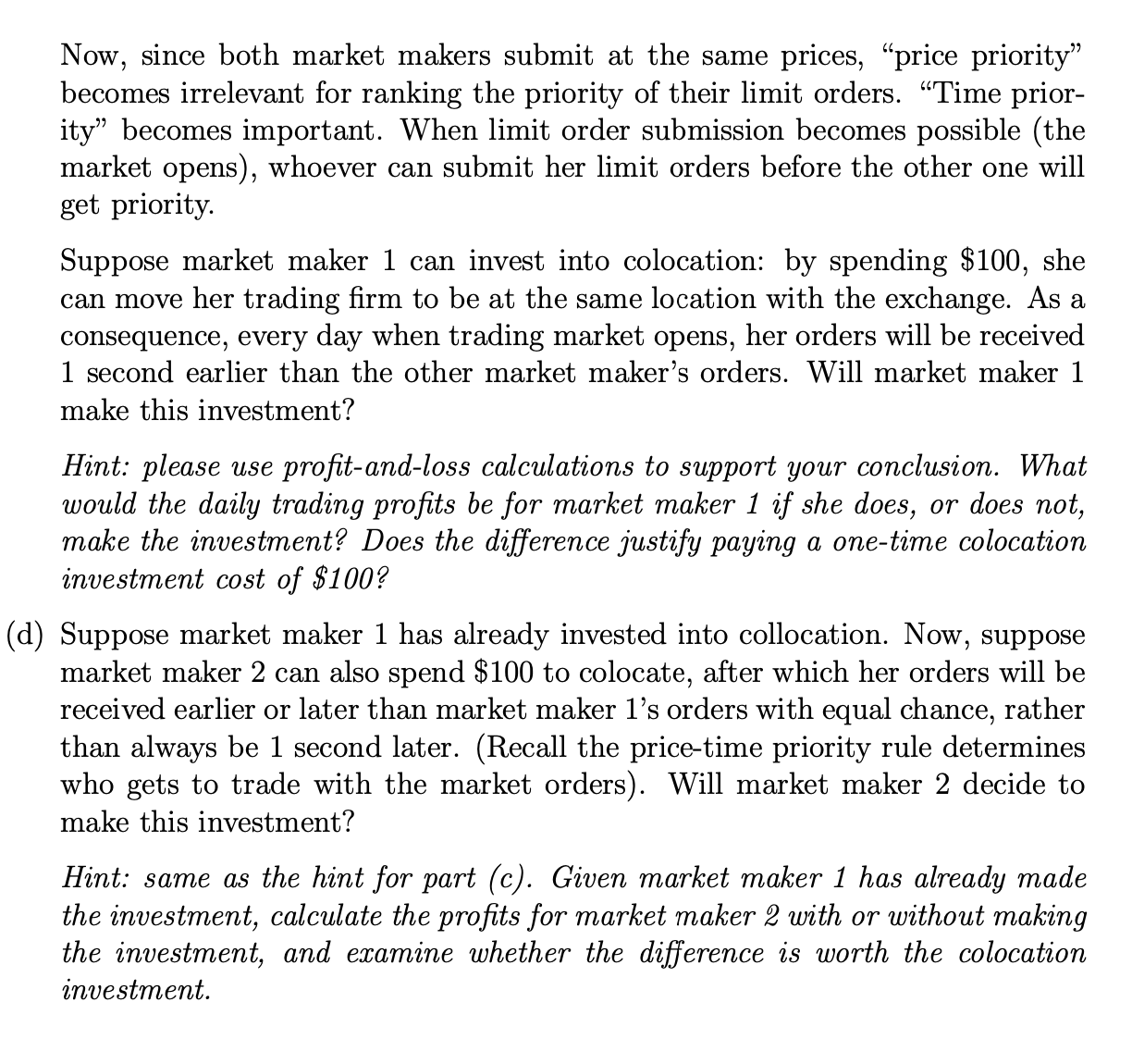
2. Question 2 (high-frequency trading arms-race). This question is based on the discussion about HFT in lecture 14. Suppose there are two market makers, 1 and 2, who compete by submitting limit orders in the same security. There is zero uncertainty about the value of the security: each share is worth $10.5. The goal of market makers is to maximize expected prots. Market maker prot cal- culation goes like this: if one's limit buy order of Q shares at price $P is traded (met by a market order), then the prot (possibly negative) is Q x $(10.5 P). If one's limit sell order of Q shares at price $P traded, then the prot is Q X $(P 10.5). The exchange rule says that minimum tick size is $1, so limit orders can only be submitted at integer prices (...$8, $9, $10, $11, ....) When market orders arrive, the priority of limit order executions follow the \"price-time priority\" principle covered in lecture 14! The total volume of trading: one market order arrives every minute and trades one share. Each market order buys or sells with equal probability. Recall that market makers can make prots only when their limit orders trade against market orders. (a) Out of all possible integer prices, what is the lowest price at which market makers are willing to sell at? What is the highest price at which market makers are willing to buy at? (b) Suppose in the current limit order book, only market maker 1 has submitted limited orders. Specically, market maker 1 has limit buy orders of 1,000,000 shares at the price of $9 and limit sell orders of 1,000,000 shares at price of $12.3 Now it is market maker 2's opportunity to submit limit orders. To maximize prots, at what prices (out of all possible integer prices ...,$8, $9, $10, $11, ...) should market maker 2 submit limit buy and sell orders? Hint: remember that market maker 2's limit orders will not displace market maker 1's limit orders. If both market makers submit limit orders at the same prices, because market maker 1 's orders have been submitted earlier, due to the price-time priority, market maker 2's orders will not be executed. (c) Because market makers are strategic that is, they both take into account the behavior of the other when making their own decisions in the end, both of them will want to submit lots of limit orders at exactly the same bid and ask prices. These are the prices you solved in part (b) for market maker 2. Now, since both market makers submit at the same prices, \"price priority\" becomes irrelevant for ranking the priority of their limit orders. \"Time prior- ity\" becomes important. When limit order submission becomes possible (the market Opens), whoever can submit her limit orders before the other one will get priority. Suppose market maker 1 can invest into colocation: by Spending $100, she can move her trading rm to be at the same location with the exchange. As a consequence, every day when trading market Opens, her orders will be received 1 second earlier than the other market maker's orders. Will market maker 1 make this investment? Hint: please use prot-and-loss calculations to support your conclusion. What would the daily trading prots be for market maker 1 if she does, or does not, make the investment? Does the dierence justify paying a one-time colocation investment cost of $100? Suppose market maker 1 has already invested into collocation. Now, suppose market maker 2 can also Spend $100 to colocate, after which her orders will be received earlier or later than market maker 1's orders with equal chance, rather than always be 1 second later. (Recall the price-time priority rule determines who gets to trade with the market orders). Will market maker 2 decide to make this investment? Hint: same as the hint for part (c) Given market maker 1 has already made the investment, calculate the prots for market maker 2 with or without making the investment, and eramine whether the dierence is worth the colocation investment
Step by Step Solution
There are 3 Steps involved in it

Get step-by-step solutions from verified subject matter experts
 Study Help