







Question: 2. Resolving conflicts by flipping a fair coin (10 points). Consider a game of potential conflict between two players for a prize valued at v
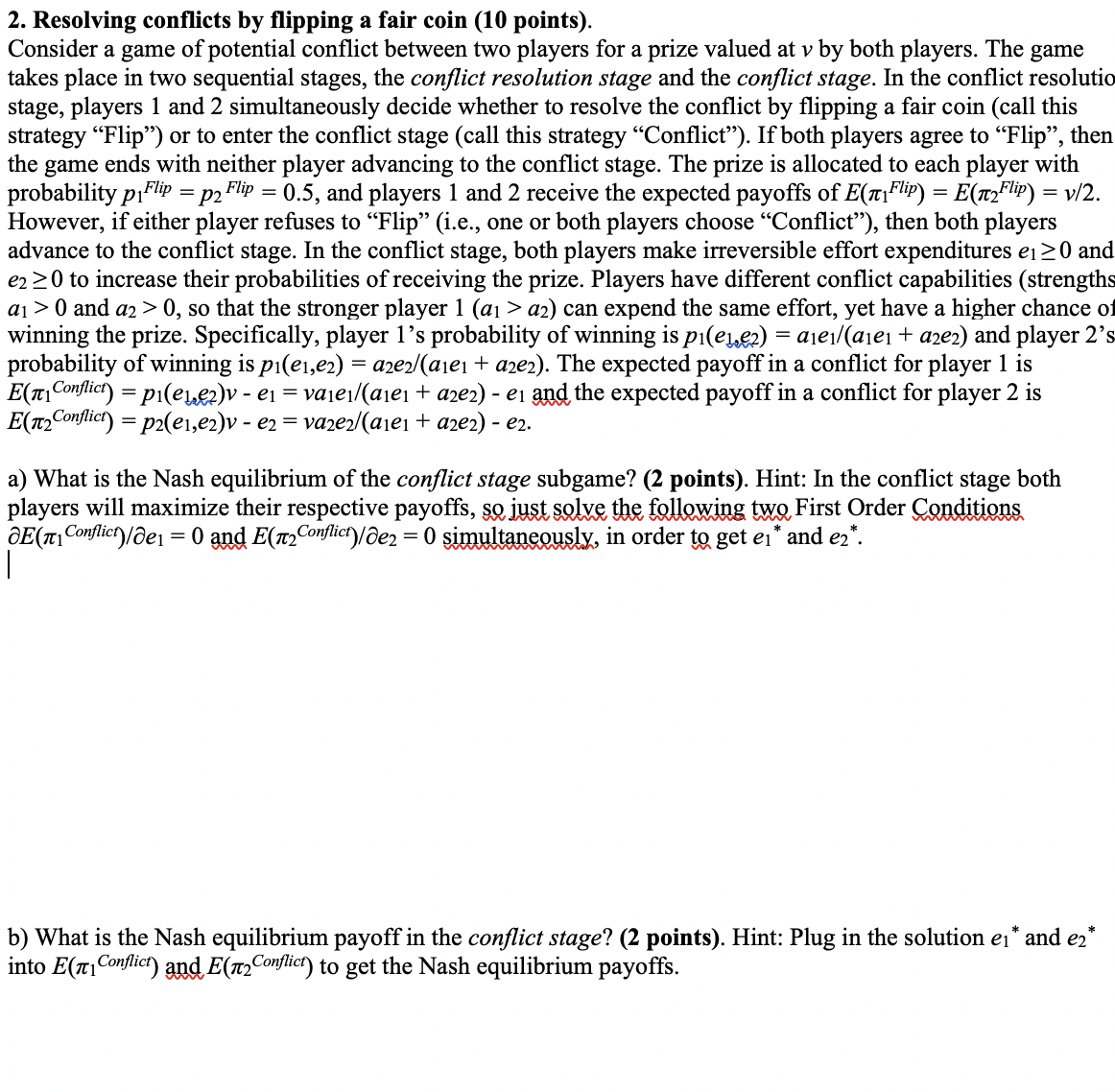
2. Resolving conflicts by flipping a fair coin (10 points). Consider a game of potential conflict between two players for a prize valued at v by both players. The game takes place in two sequential stages, the conflict resolution stage and the conflict stage. In the conflict resolution stage, players 1 and 2 simultaneously decide whether to resolve the conflict by flipping a fair coin (call this strategy "Flip") or to enter the conflict stage (call this strategy "Conflict"). If both players agree to "Flip", then the game ends with neither player advancing to the conflict stage. The prize is allocated to each player with probability piFlip = p2Flip = 0.5, and players 1 and 2 receive the expected payoffs of E(n1 Flip) = E(12Flip) = v/2. However, if either player refuses to "Flip" (i.e., one or both players choose "Conflict"), then both players advance to the conflict stage. In the conflict stage, both players make irreversible effort expenditures e1 2 0 and e2 2 0 to increase their probabilities of receiving the prize. Players have different conflict capabilities (strength a1 > 0 and a2 > 0, so that the stronger player 1 (a1 > a2) can expend the same effort, yet have a higher chance o winning the prize. Specifically, player I's probability of winning is pi(eze) = alei/(alei + aze2) and player 2' probability of winning is pi(e1,e2) = aze2/(alei + aze2). The expected payoff in a conflict for player 1 is E( 71 Conflict) = pi(eLez)v - e1 = vaiel/(alei + dze2) - el and the expected payoff in a conflict for player 2 is E(12 Conflict) = p2(e1,e2)v - e2 = vazez/(ale1 + adze2) - ez. a) What is the Nash equilibrium of the conflict stage subgame? (2 points). Hint: In the conflict stage both players will maximize their respective payoffs, so just solve the following two First Order Conditions OE(TT) Conflict)/de1 = 0 and E(72 Conflict)/de2 = 0 simultaneously, in order to get el* and ez". b) What is the Nash equilibrium payoff in the conflict stage? (2 points). Hint: Plug in the solution el* and ez* into E(71 Conflict) and E(72Conflict) to get the Nash equilibrium payoffs
Step by Step Solution
There are 3 Steps involved in it

Get step-by-step solutions from verified subject matter experts
 Study Help