







Question: 2. (SGS) In this problem, we introduce another version of Gauss-Seidel method. The symmetric Gauss-Seidel method combines the forward and backward versions of Gauss-
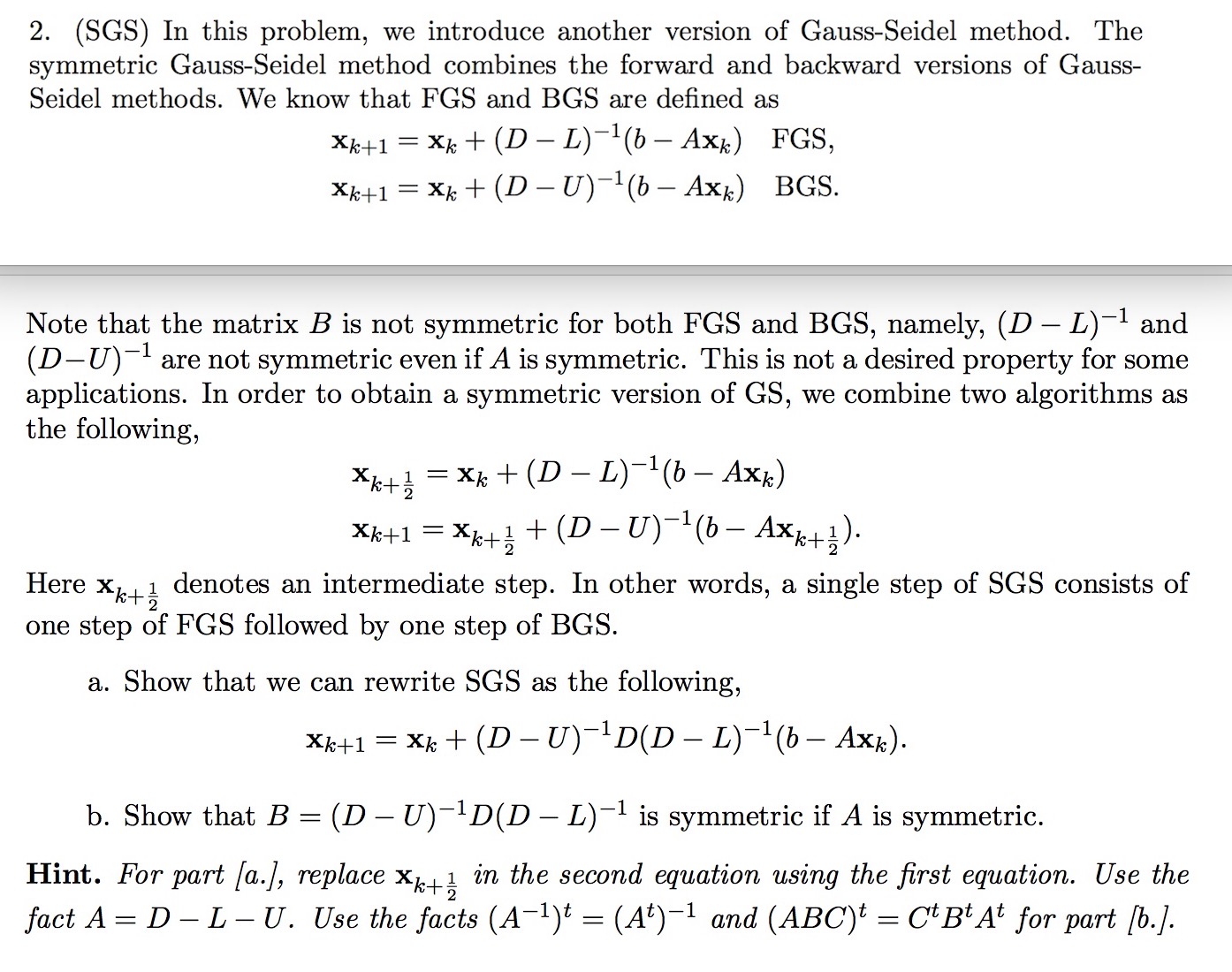
2. (SGS) In this problem, we introduce another version of Gauss-Seidel method. The symmetric Gauss-Seidel method combines the forward and backward versions of Gauss- Seidel methods. We know that FGS and BGS are defined as xk+1 = xk+(DL)(b - Axk) FGS, xk+1 = xk + (D -U)-(b- Axk) BGS. Note that the matrix B is not symmetric for both FGS and BGS, namely, (D L)- and (D-U) are not symmetric even if A is symmetric. This is not a desired property for some applications. In order to obtain a symmetric version of GS, we combine two algorithms as the following, Here X+ *k+ 1/1/2 = xk+ (D L) (b Axk) U) Xk+1=X+}+ (D-U)-(b Axk+}). denotes an intermediate step. In other words, a single step of SGS consists of one step of FGS followed by one step of BGS. a. Show that we can rewrite SGS as the following, b. Show that B - Xk+1 = Xk + (D U) D(D L) (b Axk). = (D U)D(D L)- is symmetric if A is symmetric. - Hint. For part [a.], replace + in the second equation using the first equation. Use the fact A = D L U. Use the facts (A)t = (A) and (ABC) t = Ct Bt A for part [b.].
Step by Step Solution
3.55 Rating (152 Votes )
There are 3 Steps involved in it

Get step-by-step solutions from verified subject matter experts
 Study Help