







Question: 2. Suppose that a model rocket blasts off, straight up, at time t = 0, with a vertical displacement given by a function f(t) for
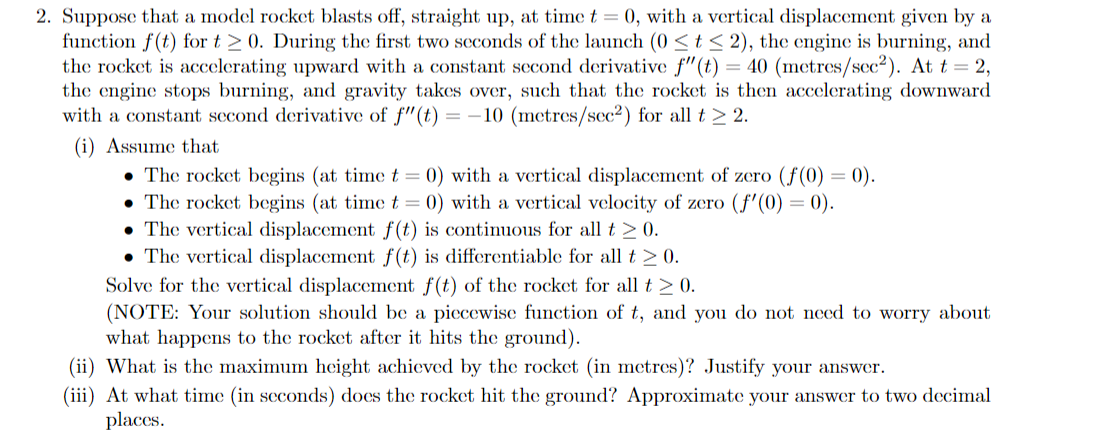
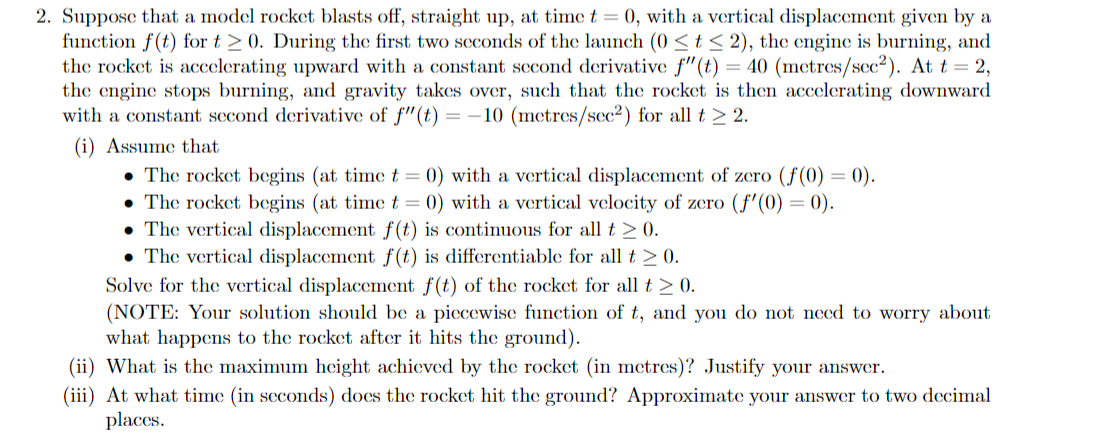
2. Suppose that a model rocket blasts off, straight up, at time t = 0, with a vertical displacement given by a function f(t) for t 2 0. During the first two seconds of the launch (0 2. (i) Assume that . The rocket begins (at time t = 0) with a vertical displacement of zero (f(0) = 0). . The rocket begins (at time t = 0) with a vertical velocity of zero (f' (0) = 0). . The vertical displacement f(t) is continuous for all t 2 0. . The vertical displacement f(t) is differentiable for all t 2 0. Solve for the vertical displacement f(t) of the rocket for all t 2 0. (NOTE: Your solution should be a piecewise function of t, and you do not need to worry about what happens to the rocket after it hits the ground). (ii) What is the maximum height achieved by the rocket (in metres)? Justify your answer. (iii) At what time (in seconds) does the rocket hit the ground? Approximate your answer to two decimal places
Step by Step Solution
There are 3 Steps involved in it

Get step-by-step solutions from verified subject matter experts
 Study Help