







Question: 2. Suppose that a model rocket blasts off, straight up, at time t = 0, with a vertical displacement given by a function f(t) for
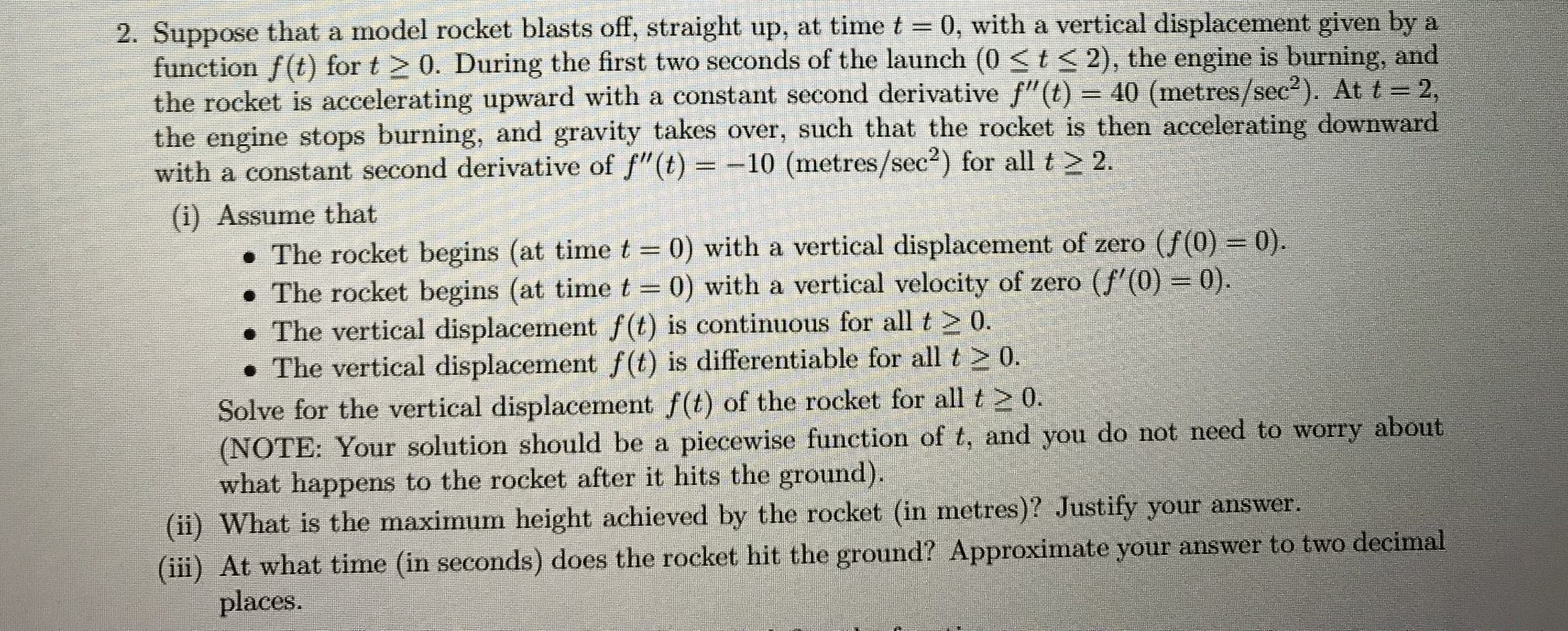
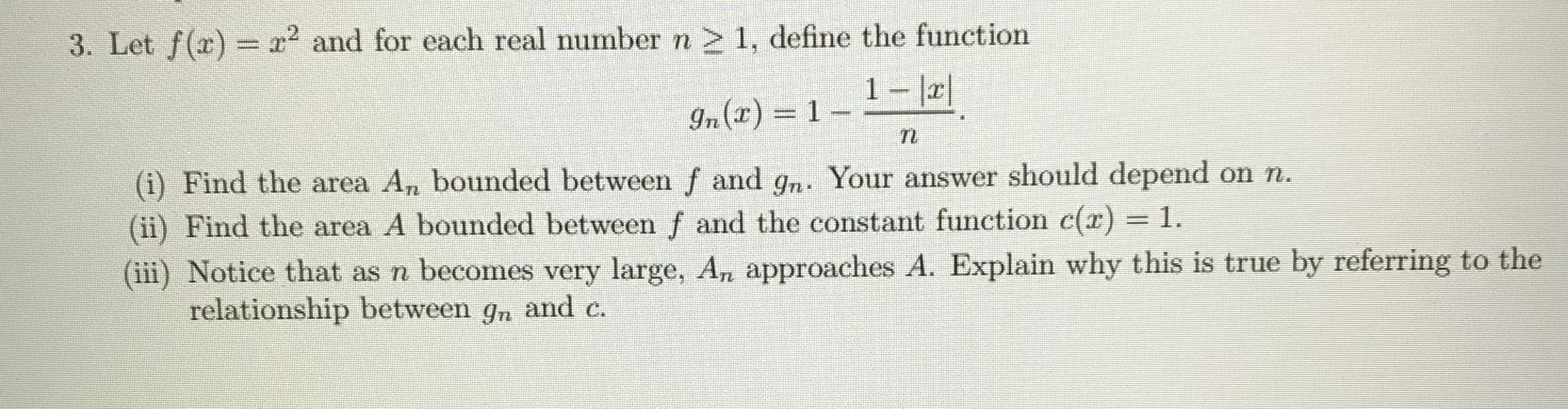
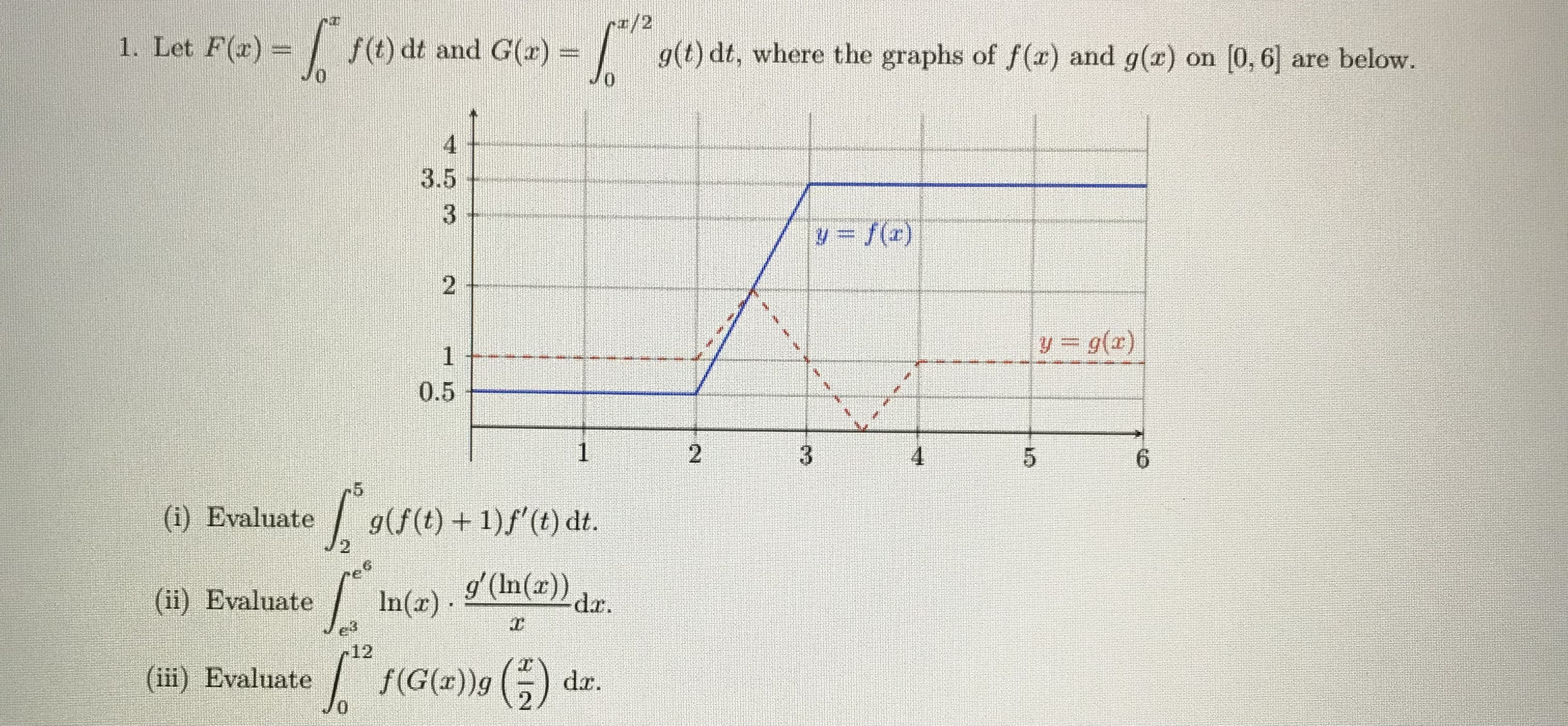
2. Suppose that a model rocket blasts off, straight up, at time t = 0, with a vertical displacement given by a function f(t) for t 2 0. During the first two seconds of the launch (0 0. . The vertical displacement f(t) is differentiable for all t > 0. Solve for the vertical displacement f(t) of the rocket for all t > 0. (NOTE: Your solution should be a piecewise function of t, and you do not need to worry about what happens to the rocket after it hits the ground). (ii) What is the maximum height achieved by the rocket (in metres)? Justify your answer. (iii) At what time (in seconds) does the rocket hit the ground? Approximate your answer to two decimal places.3. Let f(x) = r2 and for each real number n 2 1, define the function n (i) Find the area An bounded between f and gn. Your answer should depend on n. (ii) Find the area A bounded between f and the constant function c(r) = 1. (iii) Notice that as n becomes very large, An approaches A. Explain why this is true by referring to the relationship between gn and c./2 1. Let F(x) = / f(t) at and G(x) = g(t) dt, where the graphs of f(r) and g(z) on [0, 6] are below. 3.5 3 y = f(x) 2 y = g(2) 0.5 (i) Evaluate / 9(f(t) + 1)f'(t) at. e6 (ii) Evaluate In(x) . 9 (In(+)ar. (iii) Evaluate f(G(I))g de
Step by Step Solution
There are 3 Steps involved in it

Get step-by-step solutions from verified subject matter experts
 Study Help