







Question: 2) Suppose we wish to solve the second-order ODE initial value problem (IVP) + p(t) dt + q(t) y = r(t) y'(0) = , where
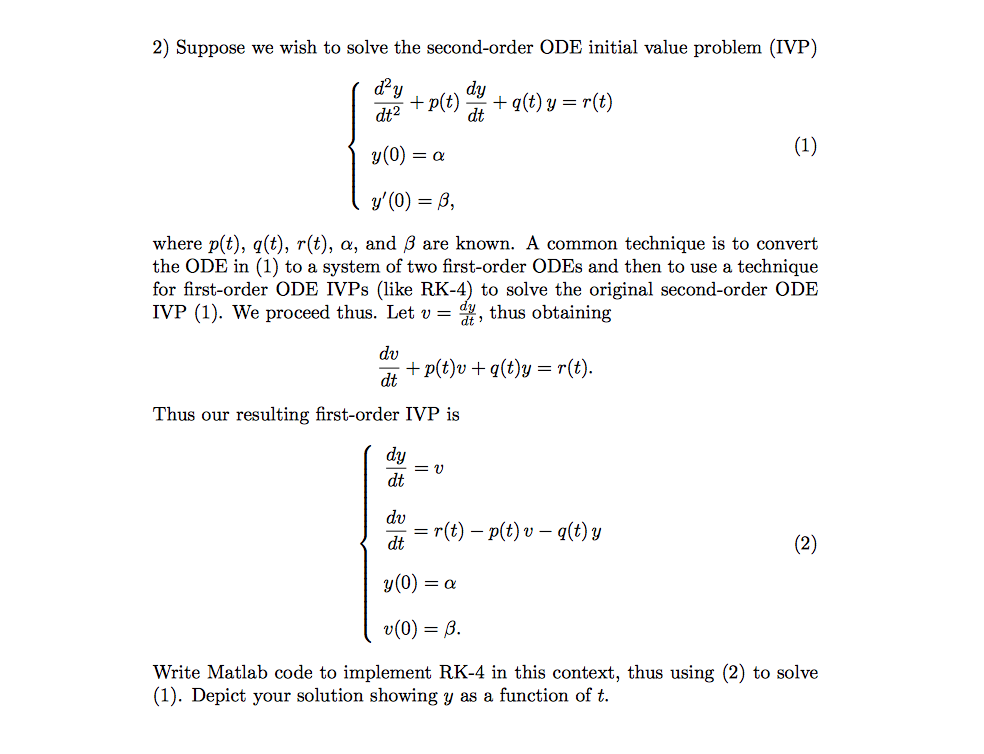
2) Suppose we wish to solve the second-order ODE initial value problem (IVP) + p(t) dt + q(t) y = r(t) y'(0) = , where p(t), q(t), r(t), , and are known. A common technique is to convert the ODE in (1) to a system of two first-order ODEs and then to use a technique for first-order ODE IVPs (like RK-4) to solve the original second-order ODE IVP (1). We proceed thus. Let v- d, thus obtaining + p(t)u + q(t)y = (t). Thus our resulting first-order IVP is dt dt = r(t)-p(t) u-g(t) u u(0) = Write Matlab code to implement RK-4 in this context, thus using (2) to solve (1). Depict your solution showing y as a function of t 2) Suppose we wish to solve the second-order ODE initial value problem (IVP) + p(t) dt + q(t) y = r(t) y'(0) = , where p(t), q(t), r(t), , and are known. A common technique is to convert the ODE in (1) to a system of two first-order ODEs and then to use a technique for first-order ODE IVPs (like RK-4) to solve the original second-order ODE IVP (1). We proceed thus. Let v- d, thus obtaining + p(t)u + q(t)y = (t). Thus our resulting first-order IVP is dt dt = r(t)-p(t) u-g(t) u u(0) = Write Matlab code to implement RK-4 in this context, thus using (2) to solve (1). Depict your solution showing y as a function of t
Step by Step Solution
There are 3 Steps involved in it

Get step-by-step solutions from verified subject matter experts
 Study Help