



Question: 2. The demand function for toys is given by QT=20(PT)243PB+0.02I Where QT and PT denote the quantity and price of toys, respectively. The price of
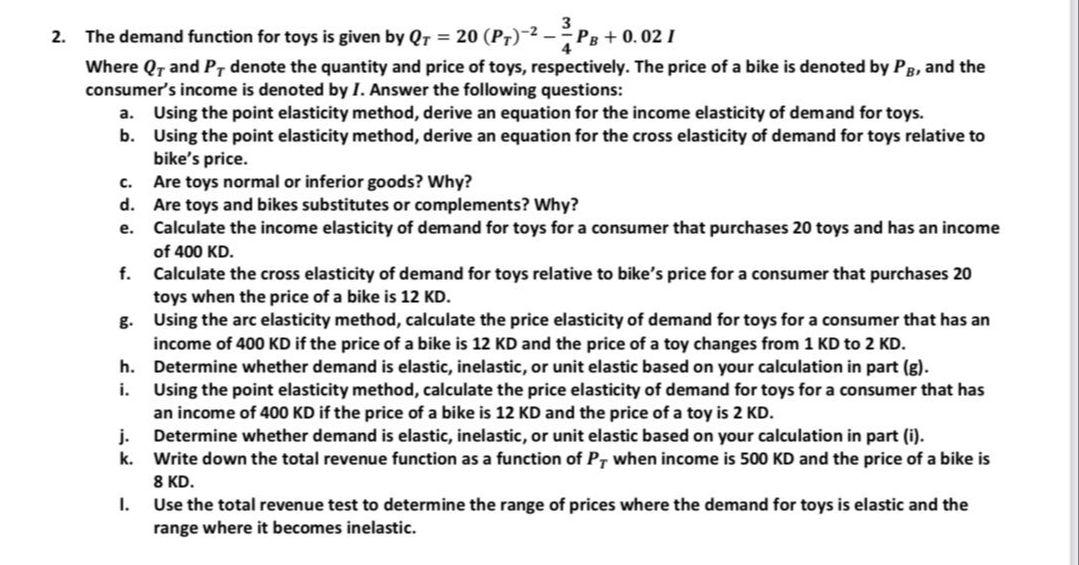
2. The demand function for toys is given by QT=20(PT)243PB+0.02I Where QT and PT denote the quantity and price of toys, respectively. The price of a bike is denoted by PB, and the consumer's income is denoted by I. Answer the following questions: a. Using the point elasticity method, derive an equation for the income elasticity of demand for toys. b. Using the point elasticity method, derive an equation for the cross elasticity of demand for toys relative to bike's price. c. Are toys normal or inferior goods? Why? d. Are toys and bikes substitutes or complements? Why? e. Calculate the income elasticity of demand for toys for a consumer that purchases 20 toys and has an income of 400 KD. f. Calculate the cross elasticity of demand for toys relative to bike's price for a consumer that purchases 20 toys when the price of a bike is 12 KD. g. Using the arc elasticity method, calculate the price elasticity of demand for toys for a consumer that has an income of 400KD if the price of a bike is 12KD and the price of a toy changes from 1KD to 2KD. h. Determine whether demand is elastic, inelastic, or unit elastic based on your calculation in part (g). i. Using the point elasticity method, calculate the price elasticity of demand for toys for a consumer that has an income of 400KD if the price of a bike is 12KD and the price of a toy is 2KD. j. Determine whether demand is elastic, inelastic, or unit elastic based on your calculation in part (i). k. Write down the total revenue function as a function of PT when income is 500KD and the price of a bike is 8 KD. I. Use the total revenue test to determine the range of prices where the demand for toys is elastic and the range where it becomes inelastic. 2. The demand function for toys is given by QT=20(PT)243PB+0.02I Where QT and PT denote the quantity and price of toys, respectively. The price of a bike is denoted by PB, and the consumer's income is denoted by I. Answer the following questions: a. Using the point elasticity method, derive an equation for the income elasticity of demand for toys. b. Using the point elasticity method, derive an equation for the cross elasticity of demand for toys relative to bike's price. c. Are toys normal or inferior goods? Why? d. Are toys and bikes substitutes or complements? Why? e. Calculate the income elasticity of demand for toys for a consumer that purchases 20 toys and has an income of 400 KD. f. Calculate the cross elasticity of demand for toys relative to bike's price for a consumer that purchases 20 toys when the price of a bike is 12 KD. g. Using the arc elasticity method, calculate the price elasticity of demand for toys for a consumer that has an income of 400KD if the price of a bike is 12KD and the price of a toy changes from 1KD to 2KD. h. Determine whether demand is elastic, inelastic, or unit elastic based on your calculation in part (g). i. Using the point elasticity method, calculate the price elasticity of demand for toys for a consumer that has an income of 400KD if the price of a bike is 12KD and the price of a toy is 2KD. j. Determine whether demand is elastic, inelastic, or unit elastic based on your calculation in part (i). k. Write down the total revenue function as a function of PT when income is 500KD and the price of a bike is 8 KD. I. Use the total revenue test to determine the range of prices where the demand for toys is elastic and the range where it becomes inelastic
Step by Step Solution
There are 3 Steps involved in it

Get step-by-step solutions from verified subject matter experts