







Question: 2. (The Hamiltonian) We're now going to learn a method which makes a lot of calculus of varia- tions problems (including the next problem
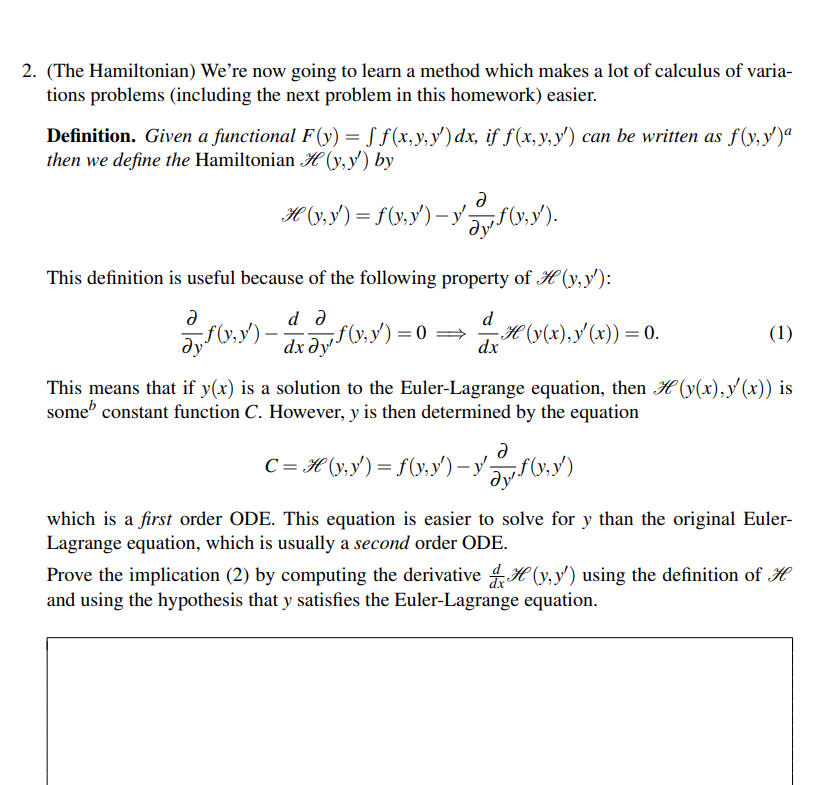
2. (The Hamiltonian) We're now going to learn a method which makes a lot of calculus of varia- tions problems (including the next problem in this homework) easier. Definition. Given a functional F(y) = f f(x,y,y') dx, if f(x, y, y') can be written as f(x,y)a then we define the Hamiltonian H(y,y) by H (y,Y') = f(x,y) (x,y). This definition is useful because of the following property of H (y,y'): d d Z(;) 2(x, y) = 0 ; (x,y) d -H (y(x), y'(x)) = 0. dx This means that if y(x) is a solution to the Euler-Lagrange equation, then H(y(x), y(x)) is some constant function C. However, y is then determined by the equation a C = H (y,y') = f(x,y) yf(x, y) (1) which is a first order ODE. This equation is easier to solve for y than the original Euler- Lagrange equation, which is usually a second order ODE. Prove the implication (2) by computing the derivative and using the hypothesis that y satisfies the Euler-Lagrange (y, y') using the definition of H equation. "That is, x does not appear in the integrand for F(y). bThere may be many solutions y(x) to the Euler-Lagrange equation, since it is a differential equation and we haven't specified any initial conditions or boundary conditions. The value of C depends on which solution we pick.
Step by Step Solution
There are 3 Steps involved in it

Get step-by-step solutions from verified subject matter experts
 Study Help