







Question: 2. The One-Sample T-Test Procedure (Large N). Test the difference between a sample mean and a known or hypothesized value. (3 points) Problem: People
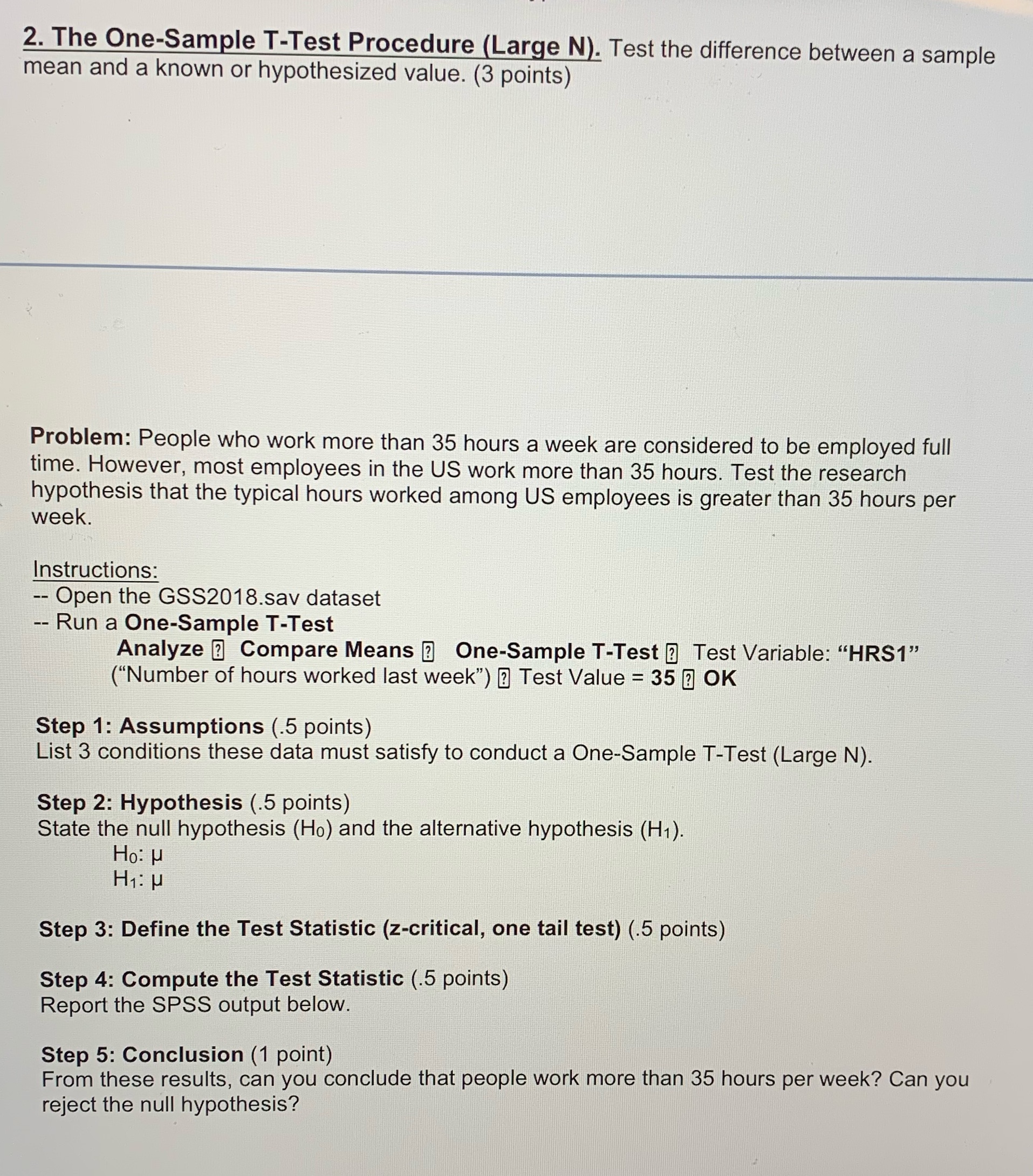
2. The One-Sample T-Test Procedure (Large N). Test the difference between a sample mean and a known or hypothesized value. (3 points) Problem: People who work more than 35 hours a week are considered to be employed full time. However, most employees in the US work more than 35 hours. Test the research hypothesis that the typical hours worked among US employees is greater than 35 hours per week. Instructions: -- Open the GSS2018.sav dataset -- Run a One-Sample T-Test Analyze Compare Means One-Sample T-Test ("Number of hours worked last week") ? Test Value = 35 Step 1: Assumptions (.5 points) Test Variable: "HRS1" OK List 3 conditions these data must satisfy to conduct a One-Sample T-Test (Large N). Step 2: Hypothesis (.5 points) State the null hypothesis (Ho) and the alternative hypothesis (H1). Ho: H: H Step 3: Define the Test Statistic (z-critical, one tail test) (.5 points) Step 4: Compute the Test Statistic (.5 points) Report the SPSS output below. Step 5: Conclusion (1 point) From these results, can you conclude that people work more than 35 hours per week? Can you reject the null hypothesis?
Step by Step Solution
There are 3 Steps involved in it

Get step-by-step solutions from verified subject matter experts
 Study Help