







Question: 2) Tiling a surface (completely and exactly covering it) with dominos is a common CSP problem in AI as shown in the figure below: UPM:
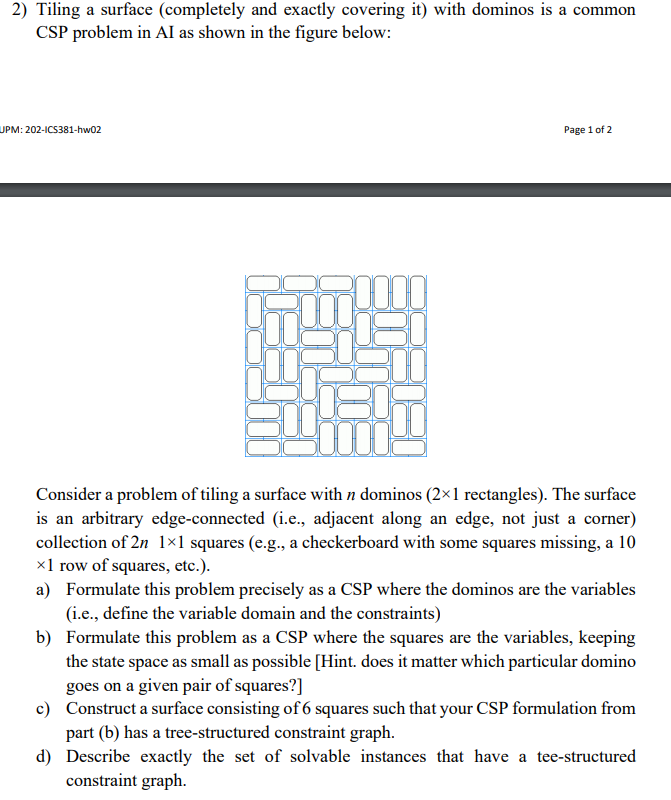
2) Tiling a surface (completely and exactly covering it) with dominos is a common CSP problem in AI as shown in the figure below: UPM: 202-ICS381-hw02 Page 1 of 2 181 ELHO Consider a problem of tiling a surface with n dominos (2x1 rectangles). The surface is an arbitrary edge-connected (i.e., adjacent along an edge, not just a corner) collection of 2n 1x1 squares (e.g., a checkerboard with some squares missing, a 10 *1 row of squares, etc.). a) Formulate this problem precisely as a CSP where the dominos are the variables (i.e., define the variable domain and the constraints) b) Formulate this problem as a CSP where the squares are the variables, keeping the state space as small as possible [Hint. does it matter which particular domino goes on a given pair of squares?] c) Construct a surface consisting of 6 squares such that your CSP formulation from part (b) has a tree-structured constraint graph. d) Describe exactly the set of solvable instances that have a tee-structured constraint graph. 2) Tiling a surface (completely and exactly covering it) with dominos is a common CSP problem in AI as shown in the figure below: UPM: 202-ICS381-hw02 Page 1 of 2 181 ELHO Consider a problem of tiling a surface with n dominos (2x1 rectangles). The surface is an arbitrary edge-connected (i.e., adjacent along an edge, not just a corner) collection of 2n 1x1 squares (e.g., a checkerboard with some squares missing, a 10 *1 row of squares, etc.). a) Formulate this problem precisely as a CSP where the dominos are the variables (i.e., define the variable domain and the constraints) b) Formulate this problem as a CSP where the squares are the variables, keeping the state space as small as possible [Hint. does it matter which particular domino goes on a given pair of squares?] c) Construct a surface consisting of 6 squares such that your CSP formulation from part (b) has a tree-structured constraint graph. d) Describe exactly the set of solvable instances that have a tee-structured constraint graph
Step by Step Solution
There are 3 Steps involved in it

Get step-by-step solutions from verified subject matter experts
 Study Help