







Question: 2. Two firms produce a homogenous good and compete simultaneously in quantity. Market demand is given by P(Y) = a - Yl. The average and
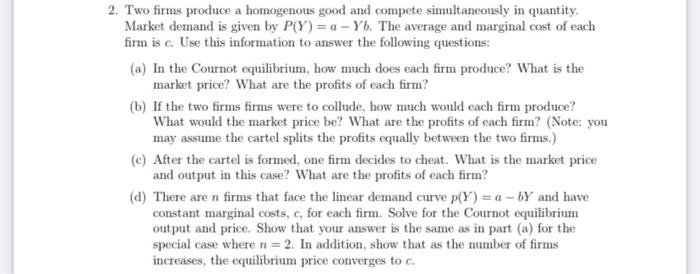
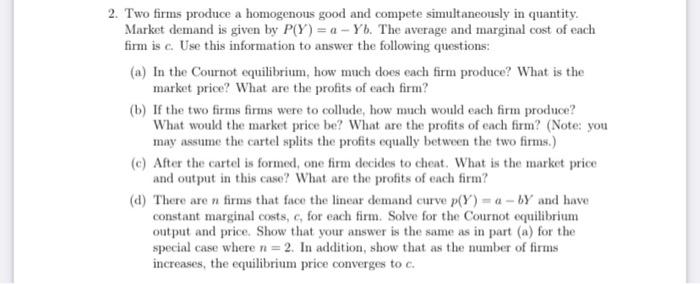
2. Two firms produce a homogenous good and compete simultaneously in quantity. Market demand is given by P(Y) = a - Yl. The average and marginal cost of each firm is c. Use this information to answer the following questions: (a) In the Cournot equilibrium, how much does each firm produce? What is the market price? What are the profits of each firm? (b) If the two firms firms were to collude, how much would each firm produce? What would the market price be? What are the profits of each firm? (Note: you may assume the cartel splits the profits equally between the two firms.) (c) After the cartel is formed, one firm decides to cheat. What is the market price and output in this case? What are the profits of each firm? (d) There are n firms that face the linear demand curve p(Y) = a - b and have constant marginal costs, c, for each firm. Solve for the Cournot equilibrium output and price. Show that your answer is the same as in part (a) for the special case where n = 2. In addition, show that as the number of firms increases, the equilibrium price converges to c. 2. Two firms produce a homogenous good and compete simultaneously in quantity. Market demand is given by P(Y) = a - Yh. The average and marginal cost of each firm is c. Use this information to answer the following questions: (a) In the Cournot equilibrium, how much does each firm produce? What is the market price? What are the profits of each firm? (b) If the two firms firms were to collude, how much would each firm produce? What would the market price be? What are the profits of each firm? (Note: you may assume the cartel splits the profits equally between the two firms.) (c) After the cartel is formed, one firm decides to cheat. What is the market price and output in this case? What are the profits of each firm? (d) There are n firms that face the linear demand curve p(Y) = a - b and have constant marginal costs, c, for each firm. Solve for the Cournot equilibrium output and price. Show that your answer is the same as in part (a) for the special case where n = 2. In addition, show that as the number of firms increases, the equilibrium price converges to c. 2. Two firms produce a homogenous good and compete simultaneously in quantity. Market demand is given by P(Y) = a - Yl. The average and marginal cost of each firm is c. Use this information to answer the following questions: (a) In the Cournot equilibrium, how much does each firm produce? What is the market price? What are the profits of each firm? (b) If the two firms firms were to collude, how much would each firm produce? What would the market price be? What are the profits of each firm? (Note: you may assume the cartel splits the profits equally between the two firms.) (c) After the cartel is formed, one firm decides to cheat. What is the market price and output in this case? What are the profits of each firm? (d) There are n firms that face the linear demand curve p(Y) = a - b and have constant marginal costs, c, for each firm. Solve for the Cournot equilibrium output and price. Show that your answer is the same as in part (a) for the special case where n = 2. In addition, show that as the number of firms increases, the equilibrium price converges to c. 2. Two firms produce a homogenous good and compete simultaneously in quantity. Market demand is given by P(Y) = a - Yh. The average and marginal cost of each firm is c. Use this information to answer the following questions: (a) In the Cournot equilibrium, how much does each firm produce? What is the market price? What are the profits of each firm? (b) If the two firms firms were to collude, how much would each firm produce? What would the market price be? What are the profits of each firm? (Note: you may assume the cartel splits the profits equally between the two firms.) (c) After the cartel is formed, one firm decides to cheat. What is the market price and output in this case? What are the profits of each firm? (d) There are n firms that face the linear demand curve p(Y) = a - b and have constant marginal costs, c, for each firm. Solve for the Cournot equilibrium output and price. Show that your answer is the same as in part (a) for the special case where n = 2. In addition, show that as the number of firms increases, the equilibrium price converges to c
Step by Step Solution
There are 3 Steps involved in it

Get step-by-step solutions from verified subject matter experts
 Study Help