





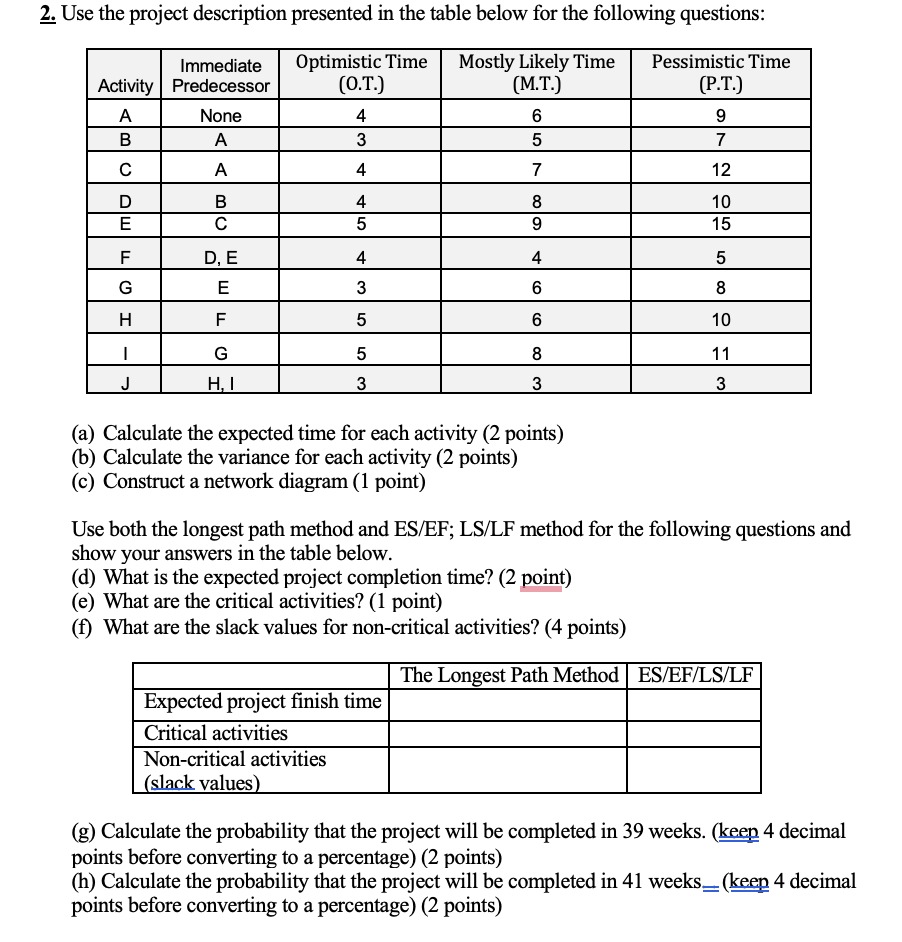
Question: 2. Use the project description presented in the table below for the following questions: Optimistic Time (O.T.) Pessimistic Time (P.T.) Immediate Activity Predecessor A None
2. Use the project description presented in the

2. Use the project description presented in the table below for the following questions: Optimistic Time (O.T.) Pessimistic Time (P.T.) Immediate Activity Predecessor A None B A Mostly Likely Time (M.T.) 6 5 4 3 voro 9 7 4 7 12 D E B 4 5 8 9 10 15 LO F 4 4 4 5 | I D, E E G 3 6 8 F 5 6 10 I G 5 00 8 11 J HI 3 3 3 (a) Calculate the expected time for each activity (2 points) (b) Calculate the variance for each activity (2 points) (c) Construct a network diagram (1 point) Use both the longest path method and ES/EF; LS/LF method for the following questions and show your answers in the table below. (d) What is the expected project completion time? (2 point) (e) What are the critical activities? (1 point) (f) What are the slack values for non-critical activities? (4 points) The Longest Path Method ES/EF/LS/LF Expected project finish time Critical activities Non-critical activities (slack values) (g) Calculate the probability that the project will be completed in 39 weeks. (keep 4 decimal points before converting to a percentage) (2 points) (h) Calculate the probability that the project will be completed in 41 weeks (keep 4 decimal points before converting to a percentage) (2 points)

Step by Step Solution

There are 3 Steps involved in it

1 Expert Approved Answer
Step: 1 Unlock blur-text-image

Question Has Been Solved by an Expert!

Get step-by-step solutions from verified subject matter experts

Step: 2 Unlock
Step: 3 Unlock

Students Have Also Explored These Related General Management Questions!