Question: 2. Various concepts discussed in this chapter have been implemented at Brueggers. Name two of the concepts. Discuss how they have been utilized effectively by
2. Various concepts discussed in this chapter have been implemented at Brueggers. Name two of the concepts. Discuss how they have been utilized effectively by Brueggers.
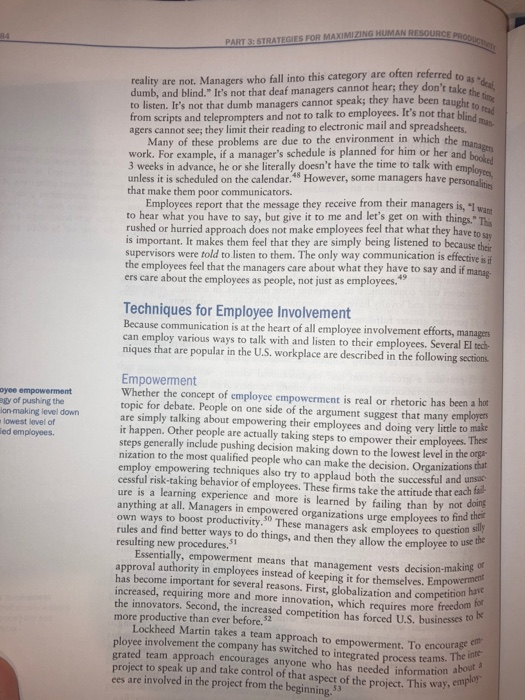
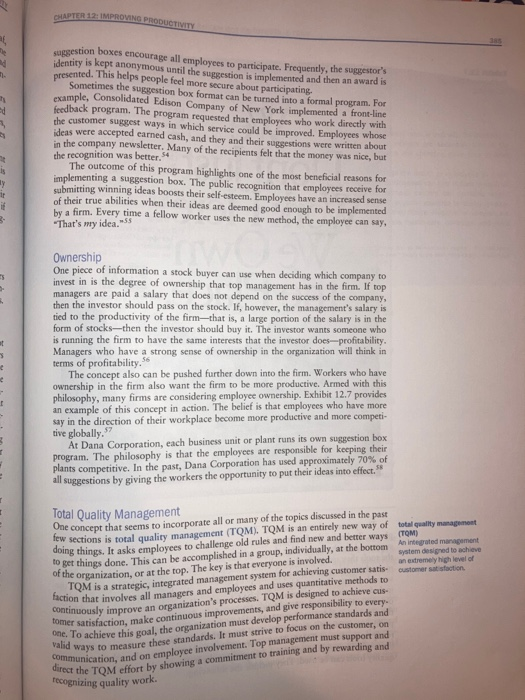
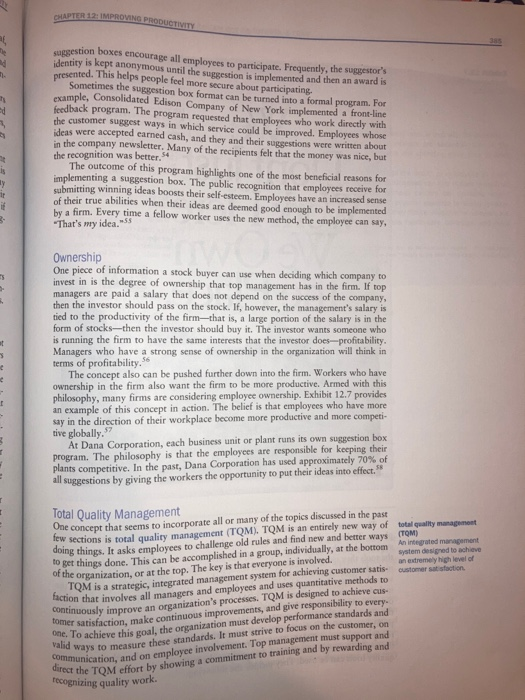
Case: Bruegger's Bagel Bakery1 It's the fourth quarter, your team is down by seven points, and the ball is at midfield with less than 1 minute left to play in the game. What strategy do you put into action to move your team down the field? Do you tighten up and get conservative, or do you loosen up and call the unexpected play? Further, do you, as the coach, call the play, or do you let the quarterback call it? Mike Dressell, Nordahl Brue, and Jim Briggs, founders of Bruegger's Bagel Bakery, would probably have opted for the latter. When the trio first considered the idea of opening a bagel bakery, they knew they had to develop a decentralized approach, that is, they knew they wanted to let the individual managers call the plays. Because each of them was busy in another occupation (Dressell had a construction company, Brue was an attorney, and Briggs was an accountant), they didn't have the time or knowledge to get involved in opera- tional decisions. PASSING THE BALL, NOT THE BUCK Basically, Dressell , Brue, and Briggs adopted the attitude that if you wanted some- thing done right, you didn't necessarily have to do it yourself. Rather than getting involved directly in operating decisions, the founders made a strategic decision to hire local managers to run their bagel shops. Local managers were offered a partner ship that gave them 20% ownership of the individual shops they supervised. The managers were empowered with the responsibility and authority to make decisions that affected their "cluster" of units. Offering the managers financial incentives beyond their salaries, the owners wanted the managers to have a higher stake in the survival of their shops and therefore more incentive to make things work. Initially, the playing field was left wide open for local managers in terms of developing their own techniques for managing their shops, watching costs, and cre- ating their own menu items. The principal partners took a sideline approach to over- seeing each manager's game plan but would occasionally visit some of the units. Bruegger's created an environment that encouraged ingenuity and innovativeness. Each cluster manager was in the driver's seat, and all of the managers knew who but tered their bagels, so to speak-it was no one other than themselves! Various clusters of stores offered different styles of bagels (some lighter, some darker) and different lines of beverages. Some had paper goods with the company logo; others didn't. Some offered creative bagel delights, such as pizza bagels, others offered more tradi- tional bagels. Again, the decisions were made by the individual managers of cach cluster of stores, thereby adding an element of uniqueness to cach. SMELL OF VICTORY Since the principal partners first considered the idea of Bruegger's Bagel Bakery in 1983, the company has grown rapidly. The first market was in Albany, New York, and in less than 3 years, they added other markets, including Cedar Rapids, lowa; Minneapolis, Minnesota; Boston, Massachusetts, and Raleigh-Durham, North Carolina. A SLIGHT SHIFT IN THE GAME PLAN As the company continued to grow, Bruegger reached a point at which the decision to set some company-wide standards became evident. Although the partners wanted to continue giving managers the freedom to make decisions affecting their individual clusters, they believed that there was a need to coordinate the activities of the various stores, Top management at Bruegger's Corp. believed the best way to manage growth effectively was to develop a strong corporate culture. Bruegger's strategic philosophy had always been in line with the idea of empow. erment. The partners wanted their managers to have "bragging rights for the suc cess of their individual stores. After all, Bruegger's success reflected individual management techniques and decision making. Although the principal partners did not want to interfere with the managers' decisions to offer particular products, they did persuade the managers to rely on market research to ascertain the viability of keeping certain items on the menu. CONCLUSION Brueger's Bagel Bakery has demonstrated that setting standards can be done with out robbing" managers of the motivation to run their shops the way they choose. HR CHALLENGES Too Cold to Work? degrees employees keyed only 54% of the time and had a 25% error rate. In this study, the decline in temperatures resulted in 10% Increase in labor costs. Can temperature affect productivity? The likely answer would be yes, according to a recent study by Dr. Alan Hedge, an ergonom les professor at Comell University. From the results of his research, when office temperature was decreased from 77 to 68 degrees, typing performance decreased. Temperature is a key variable within the work environment and can affect performance Dr. Hedge's study found that while at 77 degrees employees were keying 100% of the time with a 10% error rate, at 68 SOURCE: Links Office Temperature to Metode Performance." BUSES 14 October 2004 by Ban Lut 2004 by Bones W... with permission of Business Wire, en format Textbook wa Corte Center way so they can get the job done. Sun Hydraulics employees do not have titles or even job descriptions. Workers cooperate with each other and have the autonomy to switch roles in the production process at will. Everyone knows what everyone else is doing, so if some do not pull their weight, it's noticed. When an organization's culture is not in sync with management or with the rap idly changing times, that organization may decide to change its image and develop a new corporate culture. To be successful at changing a corporate culture, companies that make this strategic decision should be aware of several things. First, corporate culture can never be imposed. A company cannot force employees to change their values simply because it is in the best interests of the organization. However, it can change someone's behavior. By changing an employee's behavior, the company can hope that his or her attitudes will change in the process Management must be aware of this subtlety and attempt to help guide the change. Another concern that a corporation must keep in mind when developing or changing its culture is that certain cultures work best in specific environments. To determine what culture is right for a company, the goals, mission, and direction of the organization must be taken into consideration. The culture should be developed to support the organization's goal. By focusing on what the organization wants to accomplish, how to do this and what environment is needed become apparent. A cul ture that supports the organization's goals and environment can then be developed Employee involvement is critical to the success of a changing corporate culture and overall productivity. The following sections examine employee involvement in detail. employee Involvement Strategy that allows workers more responsibility and accountability EMPLOYEE INVOLVEMENT Employee involvement (EI) can be induced by a series of strategies that firms can adopt to allow workers more responsibility and accountability for preparing a prod. uct or offering a service. The term itself can refer to a wide range of practices, from simply soliciting employees' work-improvement ideas in small group meetings with front-line workers to forming self-managed work teams of workers who are given total control over their jobs and working environment. Also included in the concept of El is the idea that unions or other worker-represented groups should have the power to participate in the plant and company-level decision-making process. El is based on two principles that managers have been familiar with for many years. The first is that people tend to support what they helped to create. For exam ple, someone who is actively involved in developing new policies for handling prove uct return procedures is more likely to help ensure that it is carried out correctly, make sure that it really does work, and to sell it to their friends and co-workers. The sond principle underlying El is the idea that people who know most about the for information and participation of the people actually performing the job can pro- er functioning of an operation are those who actually perform the work. Asking ile insights not available from managers or consultants Benefits of Employee Involvement As an increasing number of firms have begun to implement El techniques, the bene Dve repercussions of using El in an organization, fes of doing so have begun to surface. The following is a list of selected possible posi- formal, it has been found to be one way to generate a great deal of information in a limited amount of time, 47 When managers are asked by their supervisors to communicate with lower-level employees, the response is generally, "But I already do that." The problem is that more likely to be involved in making those decisions. managers who think they may be talking with and listening to their employees in trained in interviewing techniques to collect the information. Although this is more Communication and Involvement One of the key components of successful implementation of El is open and truthful communication among and between employees at all levels in the organization. Vari- ous techniques can be used to open the lines of communication in an organization; some are more appropriate for service firms, and others are more useful in manufac- turing situations. Further, the usefulness of some techniques depends on the level in the organization from which the employees are drawn. Advancements in technology have presented managers with a variety of commu- nication tools from which to choose. Techniques such as voice mail and videoconfer- encing revolutionized the business of communicating in the workplace in the 1990s." In the workplace today, technological handheld devices such as BlackBerrys are com- monplace and can keep the employee connected with the company at all times. Less technical ways to communicate with employees exist as well. One fre- quently used method for getting a pulse on the workplace is simply by asking. Employces can be polled in several ways. Many firms use attitude surveys, which request employee opinions on topics such as benefits and compensation and the cafe- ria menu. Another way to gather employee input is to interview them. Firms can ei- ther hire consultants to perform the interviews or use employees who have been 2. Similarly, employees who have a say in the decision are more committed to implementing it. 3. Involving employees in the decision-making and planning practices of the organization provides a greater understanding of the organization's objectives and improves their commitment to achieving these objectives. In addition, employee commitment and loyalty have been associated with higher productivity. ** 4. El provides greater fulfillment of psychological needs, and therefore it provides greater employee satisfaction. 5. El can capitalize on the increased social pressure that other members will place on fellow workers to comply with the decisions the group made as a whole. 6. El provides a greater team and organizational identity, which is shown in greater cooperation and coordination among members at all levels. 7. When conflict does arise under El situations, the people involved are better able to constructively deal with it. 8. El produces better decisions. 45 PART 3: STRATEGIES FOR MAXIMIZING HUMAN RESOURCE PRODO reality are not. Managers who fall into this category are often referred to as "dal dumb, and blind." It's not that deaf managers cannot hear; they don't take the time from scripts and teleprompters and not to talk to employees. It's not that blind man to listen. It's not that dumb managers cannot speak; they have been taught totul Many of these problems are due to the environment in which the managers work. For example, if a manager's schedule is planned for him or her and booked 3 weeks in advance, he or she literally doesn't have the time to talk with employees unless it is scheduled on the calendar. However, some managers have personalities Lockheed Martin takes a team approach to empowerment. To encourage en ployee involvement the company has switched to integrated process teams. The inte grated team approach encourages anyone who has needed information about # project to speak up and take control of that aspect of the project. This way, emplo 84 agers cannot see; they limit their reading to electronic mail and spreadsheets. oyee empowerment egy of pushing the lon making level down lowest level of led employees that make them poor communicators. Employees report that the message they receive from their managers is, "I want to hear what you have to say, but give it to me and let's get on with things." T rushed or hurried approach does not make employees feel that what they have to say is important. It makes them feel that they are simply being listened to because their supervisors were told to listen to them. The only way communication is effective is it the employees feel that the managers care about what they have to say and if manag- ers care about the employees as people, not just as employees.*' Techniques for Employee Involvement Because communication is at the heart of all employee involvement efforts, managers can employ various ways to talk with and listen to their employees. Several El tech niques that are popular in the U.S. workplace are described in the following sections Empowerment Whether the concept of employee empowerment is real or rhetoric has been a hot topic for debate. People on one side of the argument suggest that many employens are simply talking about empowering their employees and doing very little to make it happen. Other people are actually taking steps to empower their employees. These steps generally include pushing decision making down to the lowest level in the orga nization to the most qualified people who can make the decision. Organizations that employ empowering techniques also try to applaud both the successful and unsa cessful risk-taking behavior of employees. These firms take the attitude that each fail anything at all. Managers in empowered organizations urge employees to find their own ways to boost productivity. These managers ask employees to question si rules and find better ways to do things, and then they allow the employee resulting new procedures." Essentially, empowerment means that management vests decision-making of approval authority in employees instead of keeping it for themselves. Empowerment has become important for several reasons. First, globalization and competition have the innovators. Second, the increased competition has forced U.S. businesses to be more productive than ever before. S2 to use the ees are involved in the project from the beginning. CHAPTER 12-IMPROVING PRODUCTIVITY communication, and on employee involvement. Top management must support and direct the TQM effort by showing a commitment to training and by rewarding and suggestion boxes encourage all employees to participate. Frequently, the suggestor's identity is kept anonymous until the suggestion is implemented and then an award is presented. This helps people feel more secure about participating Sometimes the suggestion box format can be turned into a formal program. For example, Consolidated Edison Company of New York implemented a front-line feedback program. The program requested that employees who work directly with the customer suggest ways in which service could be improved. Employees whose ideas were accepted earned cash, and they and their suggestions were written about in the company newsletter. Many of the recipients felt that the money was nice, but the recognition was better.54 The outcome of this program highlights one of the most beneficial reasons for implementing a suggestion box. The public recognition that employees receive for submitting winning ideas boost their self-esteem. Employees have an increased sense of their true abilities when their ideas are deemed good enough to be implemented by a firm. Every time a fellow worker uses the new method, the employee can say, Is ly ir it 3 "That's my idea. 55 at 3 Ownership One piece of information a stock buyer can use when deciding which company to invest in is the degree of ownership that top management has in the firm. If top managers are paid a salary that does not depend on the success of the company, then the investor should pass on the stock. If, however, the management's salary is tied to the productivity of the firmthat is, a large portion of the salary is in the form of stocks--then the investor should buy it. The investor wants someone who is running the firm to have the same interests that the investor does-profitability. Managers who have a strong sense of ownership in the organization will think in terms of profitability. The concept also can be pushed further down into the firm. Workers who have ownership in the firm also want the firm to be more productive. Armed with this philosophy, many firms are considering employee ownership. Exhibit 12.7 provides an example of this concept in action. The belief is that employees who have more say in the direction of their workplace become more productive and more competi- tive globally. At Dana Corporation, each business unit or plant runs its own suggestion box program. The philosophy is that the employees are responsible for keeping their plants competitive. In the past, Dana Corporation has used approximately 70% of all suggestions by giving the workers the opportunity to put their ideas into effect. ** 1 An integrated management Total Quality Management One concept that seems to incorporate all or many of the topics discussed in the past few sections is total quality management (TQM). TQM is an entirely new way of total quality management doing things. It asks employees to challenge old rules and find new and better ways TOM to get things done. This can be accomplished in a group, individually, at the bottom of the organization, or at the top. The key is that everyone is involved. system designed to achieve an extremely high level of TQM is a strategic, integrated management system for achieving customer satis- customer satisfaction faction that involves all managers and employees and uses quantitative methods to continuously improve an organization's processes. TQM is designed to achieve cus- fomer satisfaction, make continuous improvements, and give responsibility to every One. To achieve this goal, the organization must develop performance standards and valid ways to measure these standards. It must strive to focus on the customer, od recognizing quality work CHAPTER 12-IMPROVING PRODUCTIVITY communication, and on employee involvement. Top management must support and direct the TQM effort by showing a commitment to training and by rewarding and 38 suggestion boxes encourage all employees to participate. Frequently, the suggestor's identity is kept anonymous until the suggestion is implemented and then an award is presented. This helps people feel more secure about participating Sometimes the suggestion box format can be turned into a formal program. For example, Consolidated Edison Company of New York implemented a front-line feedback program. The program requested that employees who work directly with the customer suggest ways in which service could be improved. Employees whose ideas were accepted earned cash, and they and their suggestions were written about in the company newsletter. Many of the recipients felt that the money was nice, but the recognition was better.54 The outcome of this program highlights one of the most beneficial reasons for implementing a suggestion box. The public recognition that employees receive for submitting winning ideas boost their self-esteem. Employees have an increased sense of their true abilities when their ideas are deemed good enough to be implemented by a firm. Every time a fellow worker uses the new method, the employee can say, Is ly ir it "That's my idea. 55 at 3 Ownership One piece of information a stock buyer can use when deciding which company to invest in is the degree of ownership that top management has in the firm. If top managers are paid a salary that does not depend on the success of the company, then the investor should pass on the stock. If, however, the management's salary is tied to the productivity of the firmthat is, a large portion of the salary is in the form of stocks-then the investor should buy it. The investor wants someone who is running the firm to have the same interests that the investor does--profitability. Managers who have a strong sense of ownership in the organization will think in terms of profitability. The concept also can be pushed further down into the firm. Workers who have ownership in the firm also want the firm to be more productive. Armed with this philosophy, many firms are considering employee ownership. Exhibit 12.7 provides an example of this concept in action. The belief is that employees who have more say in the direction of their workplace become more productive and more competi- tive globally. At Dana Corporation, each business unit or plant runs its own suggestion box program. The philosophy is that the employees are responsible for keeping their plants competitive. In the past, Dana Corporation has used approximately 70% of all suggestions by giving the workers the opportunity to put their ideas into effect. ** 1 An integrated management Total Quality Management One concept that seems to incorporate all or many of the topics discussed in the past few sections is total quality management (TQM). TQM is an entirely new way of total quality management doing things. It asks employees to challenge old rules and find new and better ways TOM to get things done. This can be accomplished in a group, individually, at the bottom of the organization, or at the top. The key is that everyone is involved. system designed to achieve an extremely high level of TQM is a strategic, integrated management system for achieving customer satis- customer satisfaction faction that involves all managers and employees and uses quantitative methods to continuously improve an organization's processes. TQM is designed to achieve cus- fomer satisfaction, make continuous improvements, and give responsibility to every One. To achieve this goal, the organization must develop performance standards and valid ways to measure these standards. It must strive to focus on the customer, od recognizing quality work









 Study Help