


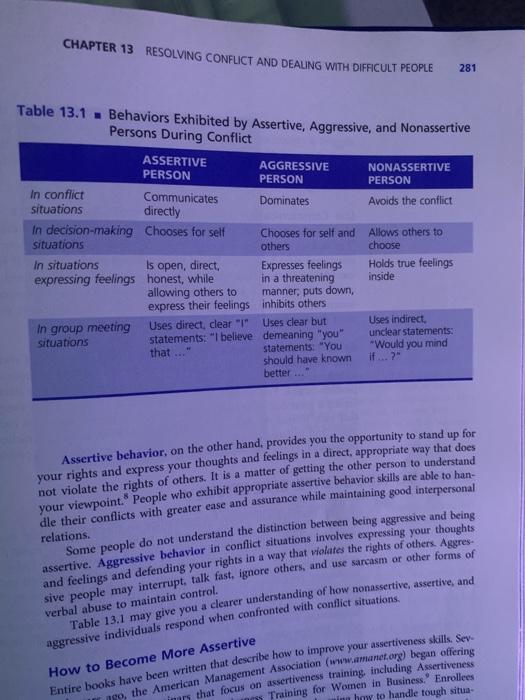
Question: 2. What behaviors do you exhibit based on the descriptions on table 13.1 in this chapter? How has this style worked for and against you?

2. What behaviors do you exhibit based on the
2. What behaviors do you exhibit based on the descriptions on table 13.1 in this chapter? How has this style worked for and against you? Cite an example. CHAPTER 13 RESOLVING CONFLICT AND DEALING WITH DIFFICULT PEOPLE 281 Table 13.1 - Behaviors Exhibited by Assertive, Aggressive, and Nonassertive Persons During Conflict ASSERTIVE AGGRESSIVE PERSON NONASSERTIVE PERSON PERSON In conflict Communicates Dominates situations Avoids the conflict directly In decision-making Chooses for self Chooses for self and Allows others to situations others choose In situations Is open, direct, Expresses feelings Holds true feelings expressing feelings honest, while in a threatening inside allowing others to manner, puts down, express their feelings inhibits others Uses direct clear in Uses clear but In group meeting Uses indirect, unclear statements: situations statements: "I believe demeaning "you" that statements "You "Would you mind should have known if...?" better... Assertive behavior, on the other hand, provides you the opportunity to stand up for your rights and express your thoughts and feelings in a direct, appropriate way that does not violate the rights of others. It is a matter of getting the other person to understand your viewpoint. People who exhibit appropriate assertive behavior skills are able to han dle their conflicts with greater ease and assurance while maintaining good interpersonal relations. Some people do not understand the distinction between being aggressive and being assertive. Aggressive behavior in conflict situations involves expressing your thoughts and feelings and defending your rights in a way that violates the rights of others Aggres. sive people may interrupt, talk fast, ignore others, and use sarcasm or other forms of verbal abuse to maintain control Table 13.1 may give you a clearer understanding of how nonassertive, assertive, and aggressive individuals respond when confronted with conflict situations How to Become More Assertive Entire books have been written that describe how to improve your assertiveness skills. Sev o the American Management Association (www.amanet.org) began offering mars that focus on assertiveness training, including Assertiveness In Training for Women in Business. Enrollees in my to handle tough situs

Step by Step Solution

There are 3 Steps involved in it

1 Expert Approved Answer
Step: 1 Unlock blur-text-image

Question Has Been Solved by an Expert!

Get step-by-step solutions from verified subject matter experts

Step: 2 Unlock
Step: 3 Unlock

Students Have Also Explored These Related General Management Questions!