







Question: 2) When an experimental manipulation produces very weak effects, there are two possibilities: 1) the independent variable does not substantially influence the dependent variable, or
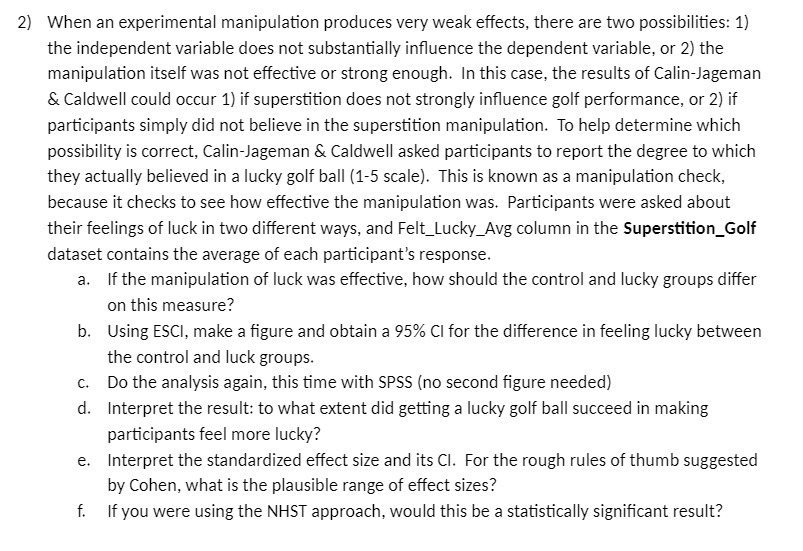
2) When an experimental manipulation produces very weak effects, there are two possibilities: 1) the independent variable does not substantially influence the dependent variable, or 2) the manipulation itself was not effective or strong enough. In this case, the results of Calin-Jageman & Caldwell could occur 1) if superstition does not strongly influence golf performance, or 2) if participants simply did not believe in the superstition manipulation. To help determine which possibility is correct, Calin-Jageman & Caldwell asked participants to report the degree to which they actually believed in a lucky golf ball (1-5 scale). This is known as a manipulation check, because it checks to see how effective the manipulation was. Participants were asked about their feelings of luck in two different ways, and Felt_Lucky_Avg column in the Superstition_Golf dataset contains the average of each participant's response. a. If the manipulation of luck was effective, how should the control and lucky groups differ on this measure? b. Using ESCI, make a figure and obtain a 95% Cl for the difference in feeling lucky between the control and luck groups. C. Do the analysis again, this time with SPSS (no second figure needed) d. Interpret the result: to what extent did getting a lucky golf ball succeed in making participants feel more lucky? e. Interpret the standardized effect size and its Cl. For the rough rules of thumb suggested by Cohen, what is the plausible range of effect sizes? f. If you were using the NHST approach, would this be a statistically significant result
Step by Step Solution
There are 3 Steps involved in it

Get step-by-step solutions from verified subject matter experts
 Study Help