







Question: 2. When estimating wage equations, we expect that young, inexperienced workers will have relatively low wages; with additional experience their wages will rise, but then
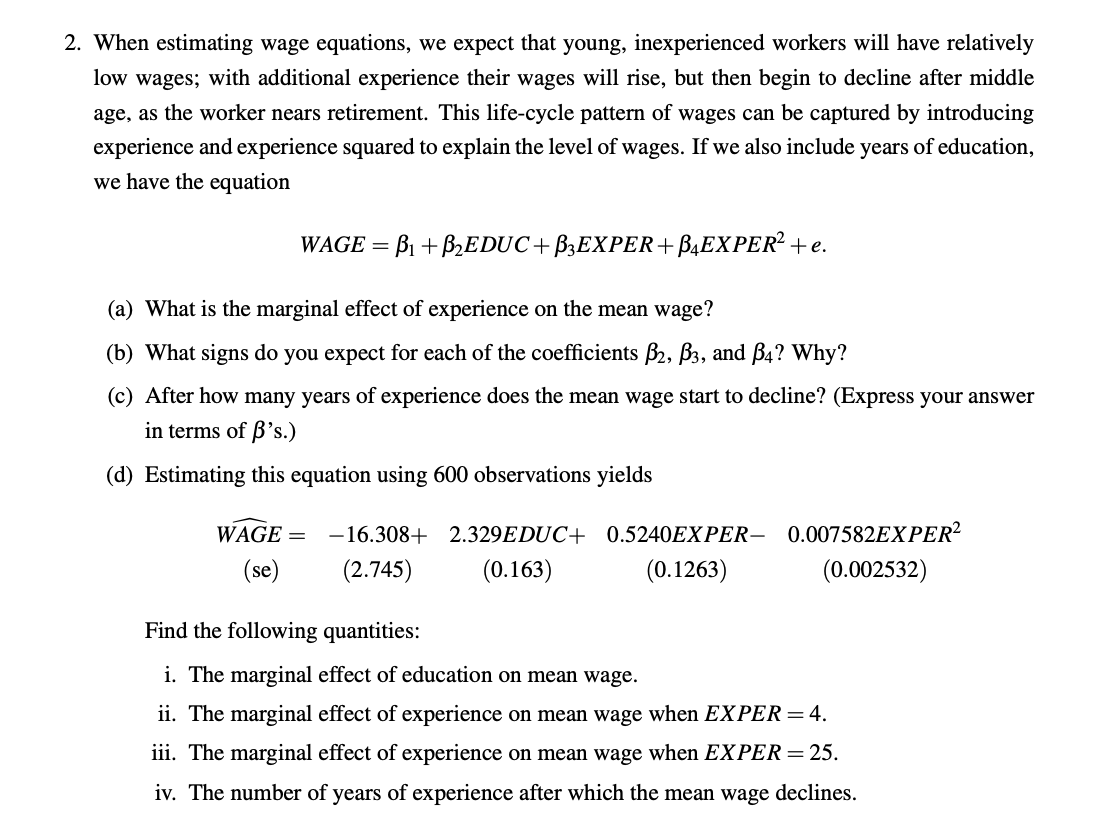
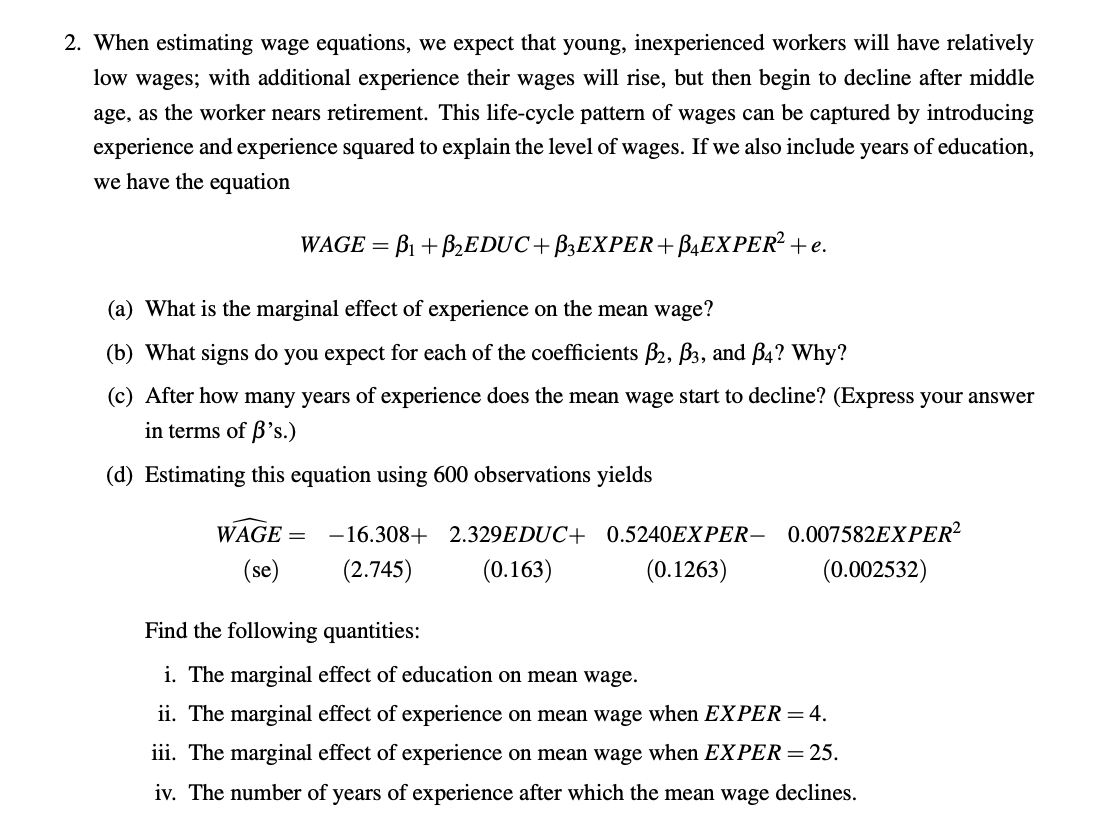
2. When estimating wage equations, we expect that young, inexperienced workers will have relatively low wages; with additional experience their wages will rise, but then begin to decline after middle age, as the worker nears retirement. This life-cycle pattern of wages can be captured by introducing experience and experience squared to explain the level of wages. If we also include years of education, we have the equation WAGE = B, + B,EDUC + B;EXPER + B4EXPER? + e. (a) What is the marginal effect of experience on the mean wage? (b) What signs do you expect for each of the coefficients B, B3, and B4? Why? (c) After how many years of experience does the mean wage start to decline? (Express your answer in terms of 's.) (d) Estimating this equation using 600 observations yields WAGE = 16.308+ 2.329EDUC+ 0.5240EXPER 0.007582EXPER> (se) (2.745) (0.163) (0.1263) (0.002532) Find the following quantities: i. The marginal effect of education on mean wage. ii. The marginal effect of experience on mean wage when EXPER = 4. iii. The marginal effect of experience on mean wage when EXPER = 25. iv. The number of years of experience after which the mean wage declines
Step by Step Solution
There are 3 Steps involved in it

Get step-by-step solutions from verified subject matter experts
 Study Help