Question: please help case study for Human Resources class Reliable kide Inc. a Monday morning as Arjun Singh watched the sun rise from his 20 floor
please help case study for Human Resources class
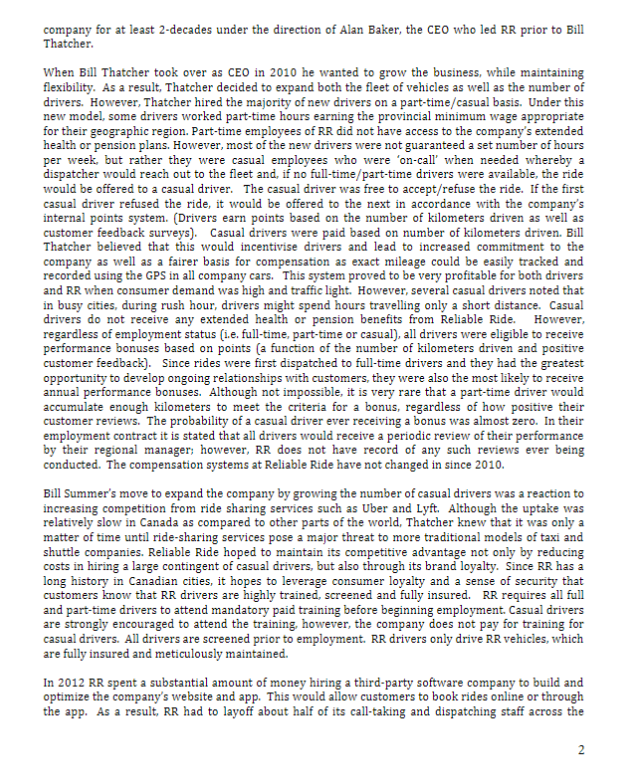
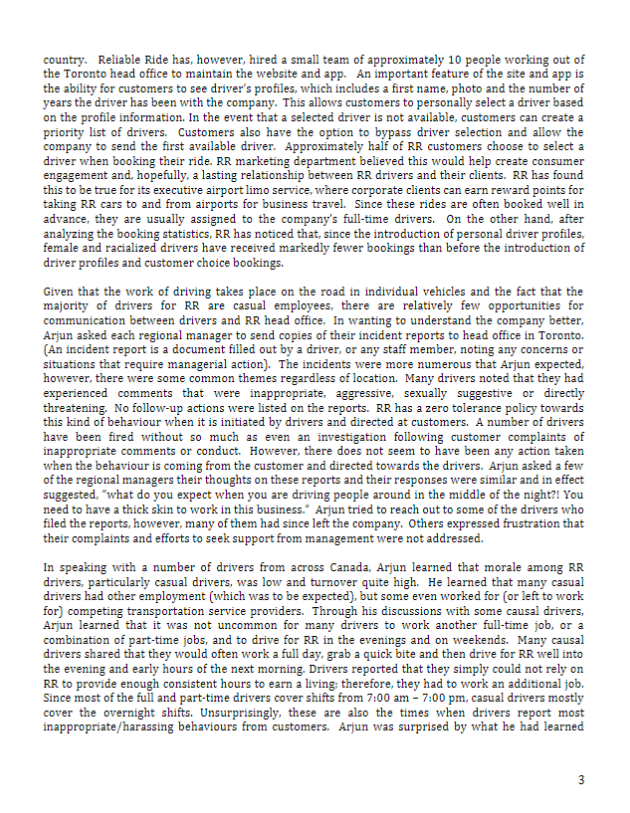
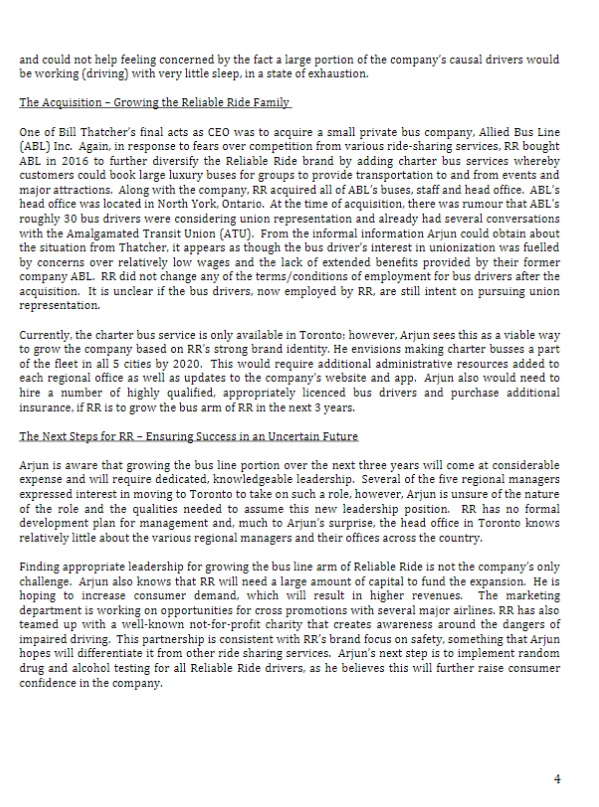
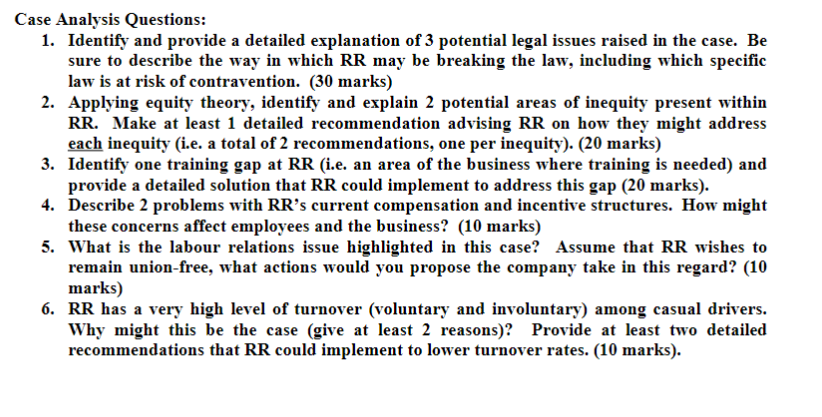
Reliable kide Inc. a Monday morning as Arjun Singh watched the sun rise from his 20 floor corner office in Toronto's financial district. Arjun was recently hired as the new CEO of Reliable Ride Inc., replacing long time CEO Bill Thatcher who retired a few months earlier. Arjun had served a number of C-suite roles throughout his career as former coo for a logistics company and as a CFO of a public transportation commission in his hometown of Vancouver, British Columbia. His educational background included an undergraduate degree in engineering and graduate degrees in finance and business. With roughly 20 years experience in industry, Arjun was well positioned to finally take the helm at Reliable Ride. He was both excited and nervous to begin this new chapter in his career. He had learned from the many mistakes made by both himself and others at previous companies and was determined, this time, to run Reliable Ride right! Bill Thatcher stayed on for the first six months of Arjun's employment to help him transition into the new role and learn about the company. This was especially important given Reliable Ride's recent acquisition of Allied Bus Lines. Arjun spent the first three months of his new appointment gathering as much information as possible about every aspect of Reliable Ride. Arjun, a firm believer in getting additional perspectives before making major decisions, has enlisted the help of a consulting firm to help him identify some of the major problems at Reliable Ride and to inform possible recommendations to address these problems. The results of Arjun's information gathering have been summarized below and given to the consulting firm. Arjun and his executive team are eagerly awaiting the report from the consulting firm. Reliable Ride (RR) - Company History. Structure and Key Business Practices Reliable Ride (RR) was started over 40 years ago as an airport limousine car service based in Toronto. In those days the business consisted of a fleet of 5 luxury sedans and 5 drivers, an office manager who coordinated bookings and administrative work and the owner, who oversaw the operations of the business. Over the past four decades. RR has grown to be a large, nation-wide full shuttle service providing airport limousines to airports in major Canadian cities, including: Toronto, Vancouver, Montreal, Calgary and Halifax. RR also provides taxi services as well as event transportation in all of the aforementioned cities. In addition to transportation to-and-from the airport, RR customers can book a RR Taxi, van or shuttle bus, which can accommodate groups of up to 12 passengers. Additionally, each location of RR has 2 limo-buses, which can accommodate up to 20 passengers for transportation to- and-from special events. In total, RR has a fleet of over 250 vehicles and generates gross annual revenues in excess of $50 million. The head office of Reliable Ride, located in Toronto, is home to the company's marketing, accounting/finance and operations departments. RR does not have an HR department or an HR specialist on senior staff. Major decisions that affect employees are made by the executive team and communicated to the regional offices, where regional managers will inform employees of any changes. Most interactions between employees and RR take place at the regional office level. Across the 5-major cities, RR employs a total of 200 drivers, 75 who are full-time and 125 who work on a part-time or casual basis. The full-time drivers are paid an hourly wage of $17/hour (in all cities). When appropriate, full-time drivers are paid overtime (i.e. if their weekly hours extend beyond legislated provincial standards). Full-time drivers enjoy access to RR's extended benefits and defined contribution pension plan. The majority of the full-time drivers are males who have been with the company for at least 2-decades under the direction of Alan Baker, the CEO who led RR prior to Bill Thatcher. When Bill Thatcher took over as CEO in 2010 he wanted to grow the business, while maintaining flexibility. As a result, Thatcher decided to expand both the fleet of vehicles as well as the number of drivers. However, Thatcher hired the majority of new drivers on a part-time/casual basis. Under this new model, some drivers worked part-time hours earning the provincial minimum wage appropriate for their geographic region. Part-time employees of RR did not have access to the company's extended health or pension plans. However, most of the new drivers were not guaranteed a set number of hours per week, but rather they were casual employees who were 'on-call' when needed whereby a dispatcher would reach out to the fleet and, if no full-time/part-time drivers were available, the ride would be offered to a casual driver. The casual driver was free to accept/refuse the ride. If the first casual driver refused the ride, it would be offered to the next in accordance with the company's internal points system. (Drivers earn points based on the number of kilometers driven as well as customer feedback surveys). Casual drivers were paid based on number of kilometers driven. Bill ould incentivise drivers and lead to increased commitment to the company as well as a fairer basis for compensation as exact mileage could be easily tracked and recorded using the GPS in all company cars. This system proved to be very profitable for both drivers and RR when consumer demand was high and traffic light. However, several casual drivers noted that in busy cities, during rush hour, drivers might spend hours travelling only a short distance. Casual not receive any extended health or pension benefits from Reliable Ride. However, regardless of employment status (i.e. full-time, part-time or casual), all drivers were eligible to receive performance bonuses based on points (a function of the number of kilometers driven and positive customer feedback). Since rides were first dispatched to full-time drivers and they had the greatest opportunity to develop ongoing relationships with customers, they were also the most likely to receive annual performance bonuses. Although not impossible, it is very rare that a part-time driver would kilometers to meet the criteria for a bonus, regardless of how positive their customer reviews. The probability of a casual driver ever receiving a bonus was almost zero. In their employment contract it is stated that all drivers would receive a periodic review of their performance by their regional manager; however, RR does not have record of any such reviews ever being conducted. The compensation systems at Reliable Ride have not changed in since 2010. Bill Summer's move to expand the company by growing the number of casual drivers was a reaction to increasing competition from ride sharing services such as Uber and Lyft. Although the uptake was relatively slow in Canada as compared to other parts of the world, Thatcher knew that it was only a matter of time until ride-sharing services pose a major threat to more traditional models of taxi and shuttle companies. Reliable Ride hoped to maintain its competitive advantage not only by reducing costs in hiring a large contingent of casual drivers, but also through its brand loyalty. Since RR has a long history in Canadian cities, it hopes to leverage consumer loyalty and a sense of security that customers know that RR drivers are highly trained, screened and fully insured. RR requires all full and part-time drivers to attend mandatory paid training before beginning employment. Casual drivers are strongly encouraged to attend the training, however, the company does not pay for training for casual drivers. All drivers are screened prior to employment. RR drivers only drive RR vehicles, which are fully insured and meticulously maintained. In 2012 RR spent a substantial amount of money hiring a third-party software company to build and optimize the company's website and app. This would allow customers to book rides online or through the app. As a result, RR had to layoff about half of its call-taking and dispatching staff across the country. Reliable Ride has, however, hired a small team of approximately 10 people working out of the Toronto head office to maintain the website and app. An important feature of the site and app is the ability for customers to see driver's profiles, which includes a first name, photo and the number of years the driver has been with the company. This allows customers to personally select a driver based on the profile information. In the event that a selected driver is not available, customers can create a priority list of drivers. Customers also have the option to bypass driver selection and allow the company to send the first available driver. Approximately half of RR customers choose to select a driver when booking their ride. RR marketing department believed this would help create consumer engagement and hopefully, a lasting relationship between RR drivers and their clients. RR has found this to be true for its executive airport limo service, where corporate clients can earn reward points for taking RR cars to and from airports for business travel. Since these rides are often booked well in advance, they are usually assigned to the company's full-time drivers. On the other hand, after analyzing the booking statistics, RR has noticed that, since the introduction of personal driver profiles, female and racialized drivers have received markedly fewer bookings than before the introduction of driver profiles and customer choice bookings. Given that the work of driving takes place on the road in individual vehicles and the fact that the majority of drivers for RR are casual employees, there are relatively few opportunities for communication between drivers and RR head office. In wanting to understand the company better, Arjun asked each regional manager to send copies of their incident reports to head office in Toronto. (An incident report is a document filled out by a driver, or any staff member, noting any concerns or situations that require managerial action. The incidents were more numerous that Arjun expected, however, there were some common themes regardless of location. Many drivers noted that they had experienced comments that were inappropriate, aggressive, sexually suggestive or directly threatening. No follow-up actions were listed on the reports. RR has a zero tolerance policy towards this kind of behaviour when it is initiated by drivers and directed at customers. A number of drivers have been fired without so much as even an investigation following customer complaints of inappropriate comments or conduct. However, there does not seem to have been any action taken when the behaviour is coming from the customer and directed towards the drivers. Arjun asked a few of the regional managers their thoughts on these reports and their responses were similar and in effect o you expect when you are driving people around in the middle of the night?! You need to have a thick skin to work in this business." Arjun tried to reach out to some of the drivers who filed the reports, however, many of them had since left the company. Others expressed frustration that their complaints and efforts to seek support from management were not addressed. In speaking with a number of drivers from across Canada, Arjun learned that morale among RR drivers, particularly casual drivers, was low and turnover quite high. He learned that many casual drivers had other employment (which was to be expected), but some even worked for (or left to work for) competing transportation service providers. Through his discussions with some causal drivers, Arjun learned that it was not uncommon for many drivers to work another full-time job, or a combination of part-time jobs, and to drive for RR in the evenings and on weekends. Many causal drivers shared that they would often work a full day, grab a quick bite and then drive for RR well into the evening and early hours of the next morning. Drivers reported that they simply could not rely on RR to provide enough consistent hours to earn a living therefore, they had to work an additional job. Since most of the full and part-time drivers cover shifts from 7:00 am - 7:00 pm, casual drivers mostly cover the overnight shifts. Unsurprisingly, these are also the times when drivers report most inappropriate/harassing behaviours from customers. Arjun was surprised by what he had learned and could not help feeling concerned by the fact a large portion of the company's causal drivers would be working (driving) with very little sleep, in a state of exhaustion. The Acquisition - Growing the Reliable Ride Family One of Bill Thatcher's final acts as CEO was to acquire a small private bus company, Allied Bus Line (ABL) Inc. Again, in response to fears over competition from various ride-sharing services, RR bought ABL in 2016 to further diversify the Reliable Ride brand by adding charter bus services whereby customers could book large luxury buses for groups to provide transportation to and from events and major attractions. Along with the company, RR acquired all of ABL's buses, staff and head office. ABL'S head office was located in North York, Ontario. At the time of acquisition, there was rumour that ABL'S roughly 30 bus drivers were considering union representation and already had several conversations with the Amalgamated Transit Union (ATU). From the informal information Arjun could obtain about the situation from Thatcher, it appears as though the bus driver's interest in unionization was fuelled by concerns over relatively low wages and the lack of extended benefits provided by their former company ABL. RR did not change any of the terms /conditions of employment for bus drivers after the acquisition. It is unclear if the bus drivers, now employed by RR, are still intent on pursuing union representation. Currently, the charter bus service is only available in Toronto; however, Arjun sees this as a viable way to grow the company based on RR's strong brand identity. He envisions making charter busses a part of the fleet in all 5 cities by 2020. This would require additional administrative resources added to each regional office as well as updates to the company's website and app. Arjun also would need to hire a number of highly qualified, appropriately licenced bus drivers and purchase additional insurance, if RR is to grow the bus arm of RR in the next 3 years. The Next Steps for RR- Ensuring Success in an Uncertain Future Arjun is aware that growing the bus line portion over the next three years will come at considerable expense and will require dedicated, knowledgeable leadership. Several of the five regional managers expressed interest in moving to Toronto to take on such a role, however, Arjun is unsure of the nature of the role and the qualities needed to assume this new leadership position. RR has no formal development plan for management and, much to Arjun's surprise, the head office in Toronto knows relatively little about the various regional managers and their offices across the country. Finding appropriate leadership for growing the bus line arm of Reliable Ride is not the company's only challenge. Arjun also knows that RR will need a large amount of capital to fund the expansion. He is hoping to increase consumer demand, which will result in hi department is working on opportunities for cross promotions with several major airlines. RR has also teamed up with a well-known not-for-profit charity that creates awareness around the dangers of impaired driving. This partnership is consistent with RR's brand focus on safety, something that Arjun hopes will differentiate it from other ride sharing services. Arjun's next step is to implement random drug and alcohol testing for all Reliable Ride drivers, as he believes this will further raise consumer confidence in the company Case Analysis Questions: 1. Identify and provide a detailed explanation of 3 potential legal issues raised in the case. Be sure to describe the way in which RR may be breaking the law, including which specific law is at risk of contravention. (30 marks) 2. Applying equity theory, identify and explain 2 potential areas of inequity present within RR. Make at least 1 detailed recommendation advising RR on how they might address each inequity (i.e. a total of 2 recommendations, one per inequity). (20 marks) 3. Identify one training gap at RR (i.e. an area of the business where training is needed) and provide a detailed solution that RR could implement to address this gap (20 marks). 4. Describe 2 problems with RR's current compensation and incentive structures. How might these concerns affect employees and the business? (10 marks) 5. What is the labour relations issue highlighted in this case? Assume that RR wishes to remain union-free, what actions would you propose the company take in this regard? (10 marks) 6. RR has a very high level of turnover (voluntary and involuntary) among casual drivers. Why might this be the case (give at least 2 reasons)? Provide at least two detailed recommendations that RR could implement to lower turnover rates. (10 marks)









 Study Help