



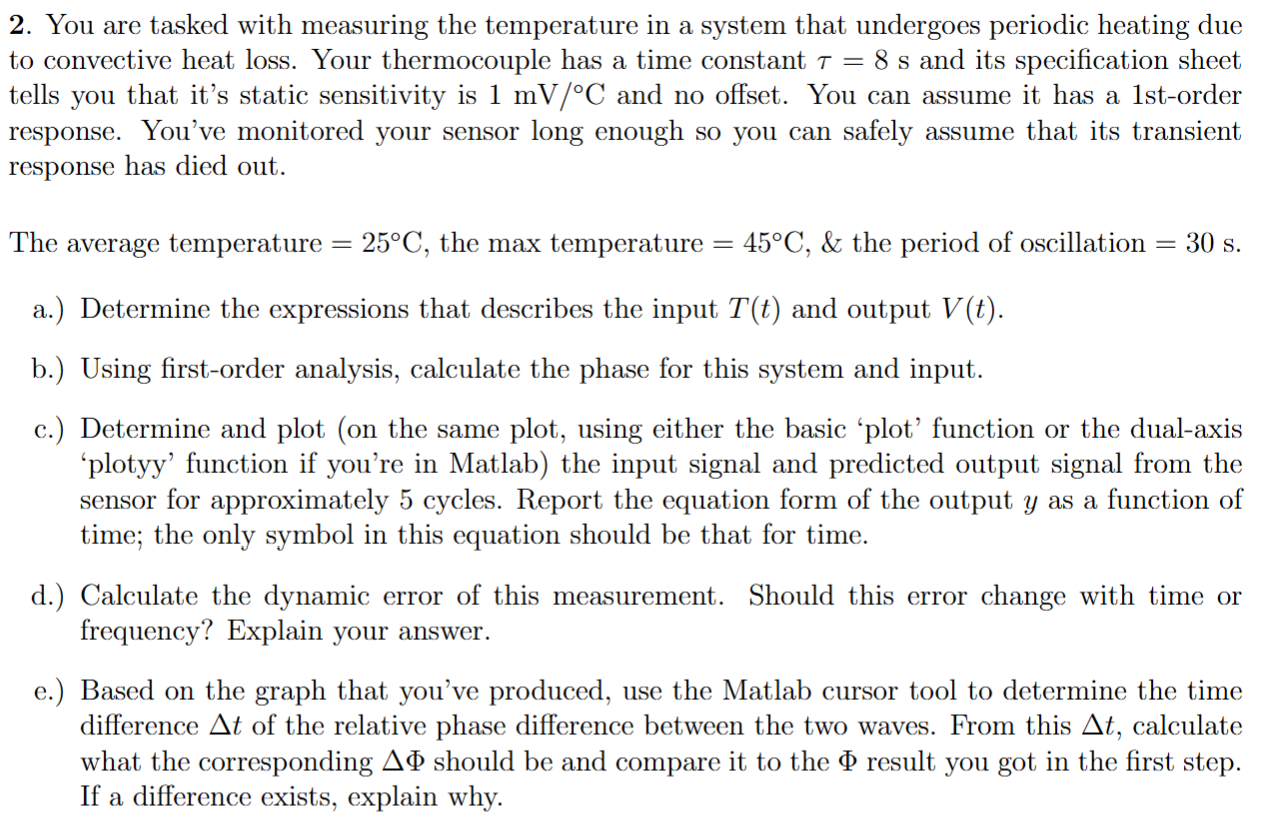
Question: 2 . You are tasked with measuring the temperature in a system that undergoes periodic heating due to convective heat loss. Your thermocouple has a
You are tasked with measuring the temperature in a system that undergoes periodic heating due to convective heat loss. Your thermocouple has a time constant taumathrm~s and its specification sheet tells you that it's static sensitivity is mathrmmVcircmathrmC and no offset. You can assume it has a storder response. You've monitored your sensor long enough so you can safely assume that its transient response has died out.
The average temperature circmathrmC the max temperature circmathrmC& the period of oscillation mathrm~s
a Determine the expressions that describes the input Tt and output Vt
b Using firstorder analysis, calculate the phase for this system and input.
c Determine and plot on the same plot, using either the basic 'plot' function or the dualaxis 'plotyy' function if you're in Matlab the input signal and predicted output signal from the sensor for approximately cycles. Report the equation form of the output y as a function of time; the only symbol in this equation should be that for time.
d Calculate the dynamic error of this measurement. Should this error change with time or frequency? Explain your answer.
e Based on the graph that you've produced, use the Matlab cursor tool to determine the time difference Delta t of the relative phase difference between the two waves. From this Delta t calculate what the corresponding Delta Phi should be and compare it to the Phi result you got in the first step. If a difference exists, explain why.
Step by Step Solution
There are 3 Steps involved in it
1 Expert Approved Answer
Step: 1 Unlock

Question Has Been Solved by an Expert!
Get step-by-step solutions from verified subject matter experts
Step: 2 Unlock
Step: 3 Unlock