Question: 20 1. Construct a general, or abstract model for the following problem. By general, we mean that the model would work for all problems with
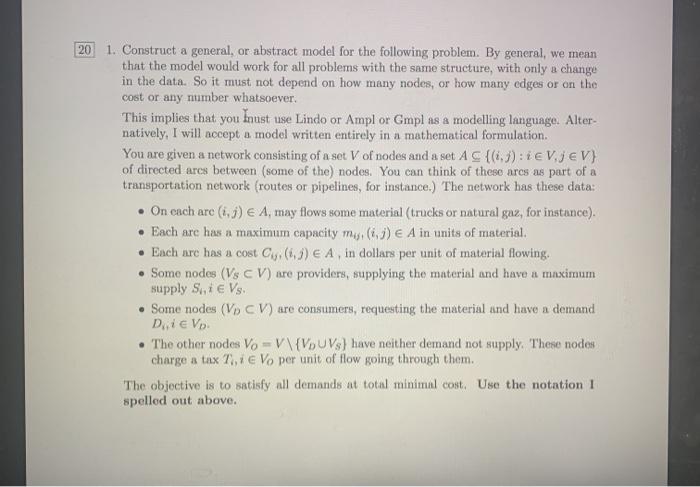
20 1. Construct a general, or abstract model for the following problem. By general, we mean that the model would work for all problems with the same structure, with only a change in the data. So it must not depend on how many nodes, or how many edges or on the cost or any number whatsoever, This implies that you knust use Lindo or Ampl or Gmpl as a modelling language. Alter- natively, I will accept a model written entirely in a mathematical formulation. You are given a network consisting of a set V of nodes and a set AC {(1,3):1 VjEV} of directed ares between (some of the) nodes. You can think of these ares as part of a transportation network (routes or pipelines, for instance.) The network has these data: . On each arc (1.2) A, may flows some material trucks or natural gaz, for instance). Each are has a maximum capacity muj) e A in units of material. Each are has a cost C) E A in dollars per unit of material flowing . Some nodes (Vs CV) are providers, supplying the material and have a maximum supply S. e V Some nodes (Vo CV) are consumers, requesting the material and have a demand Die Vp The other nodes Vo =V\{VU Vs) have neither demand not supply. These nodes charge a tax T), E Vo per unit of flow going through them. The objective is to satisfy all demands at total minimal cost. Use the notation 1 spelled out above. 20 1. Construct a general, or abstract model for the following problem. By general, we mean that the model would work for all problems with the same structure, with only a change in the data. So it must not depend on how many nodes, or how many edges or on the cost or any number whatsoever, This implies that you knust use Lindo or Ampl or Gmpl as a modelling language. Alter- natively, I will accept a model written entirely in a mathematical formulation. You are given a network consisting of a set V of nodes and a set AC {(1,3):1 VjEV} of directed ares between (some of the) nodes. You can think of these ares as part of a transportation network (routes or pipelines, for instance.) The network has these data: . On each arc (1.2) A, may flows some material trucks or natural gaz, for instance). Each are has a maximum capacity muj) e A in units of material. Each are has a cost C) E A in dollars per unit of material flowing . Some nodes (Vs CV) are providers, supplying the material and have a maximum supply S. e V Some nodes (Vo CV) are consumers, requesting the material and have a demand Die Vp The other nodes Vo =V\{VU Vs) have neither demand not supply. These nodes charge a tax T), E Vo per unit of flow going through them. The objective is to satisfy all demands at total minimal cost. Use the notation 1 spelled out above









 Study Help